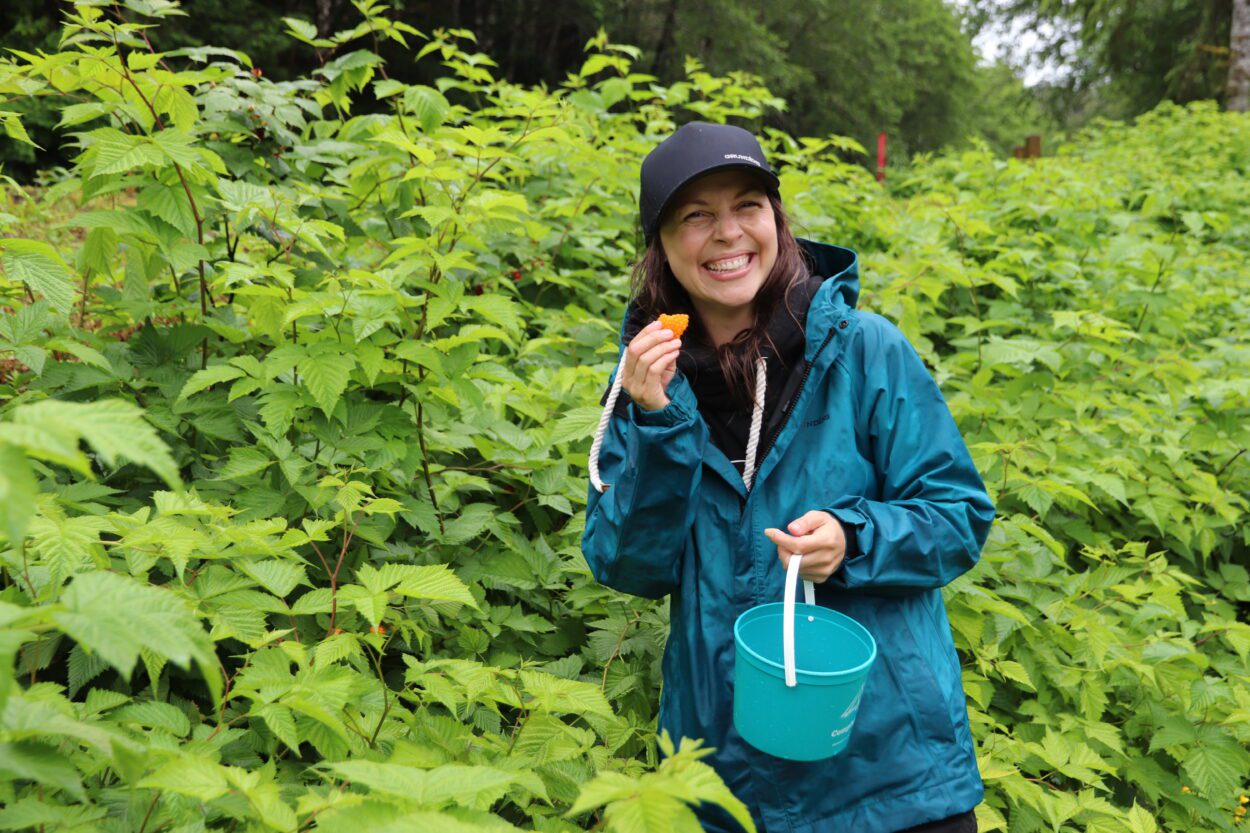
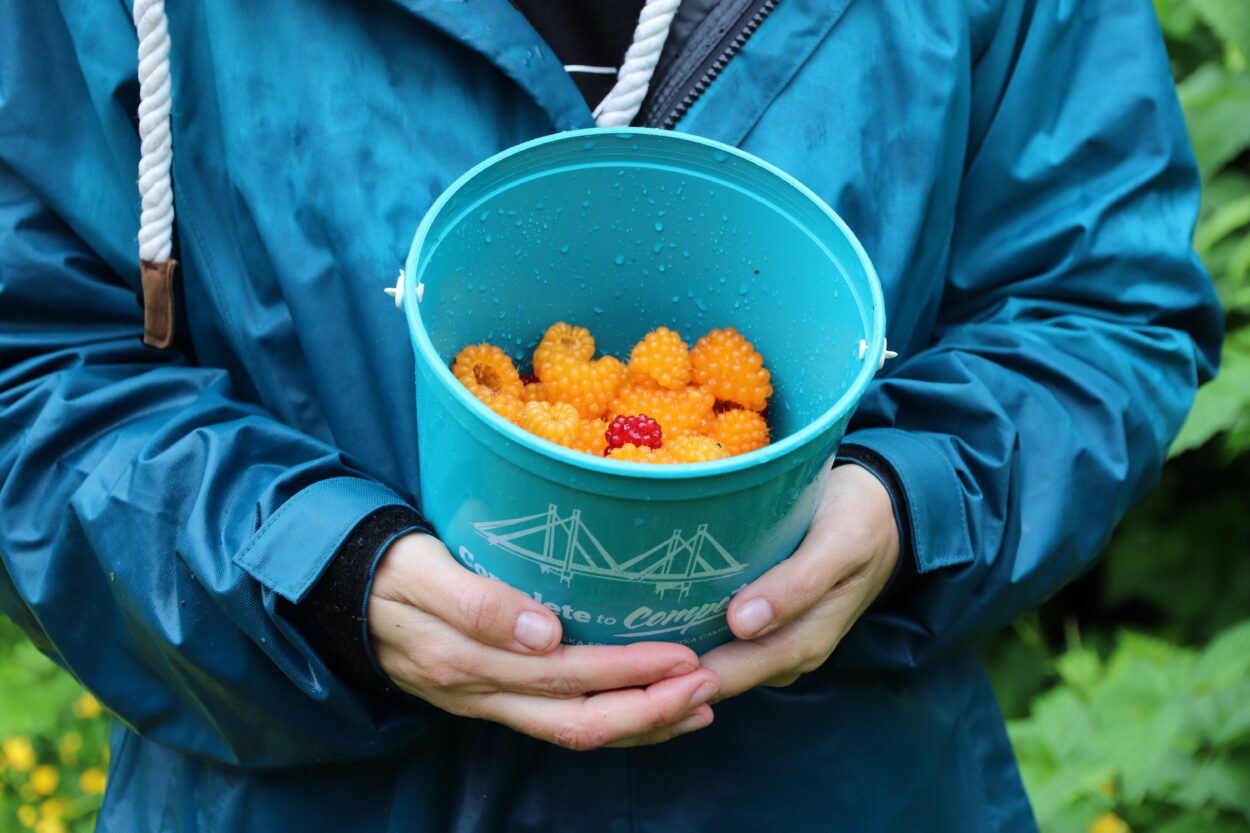
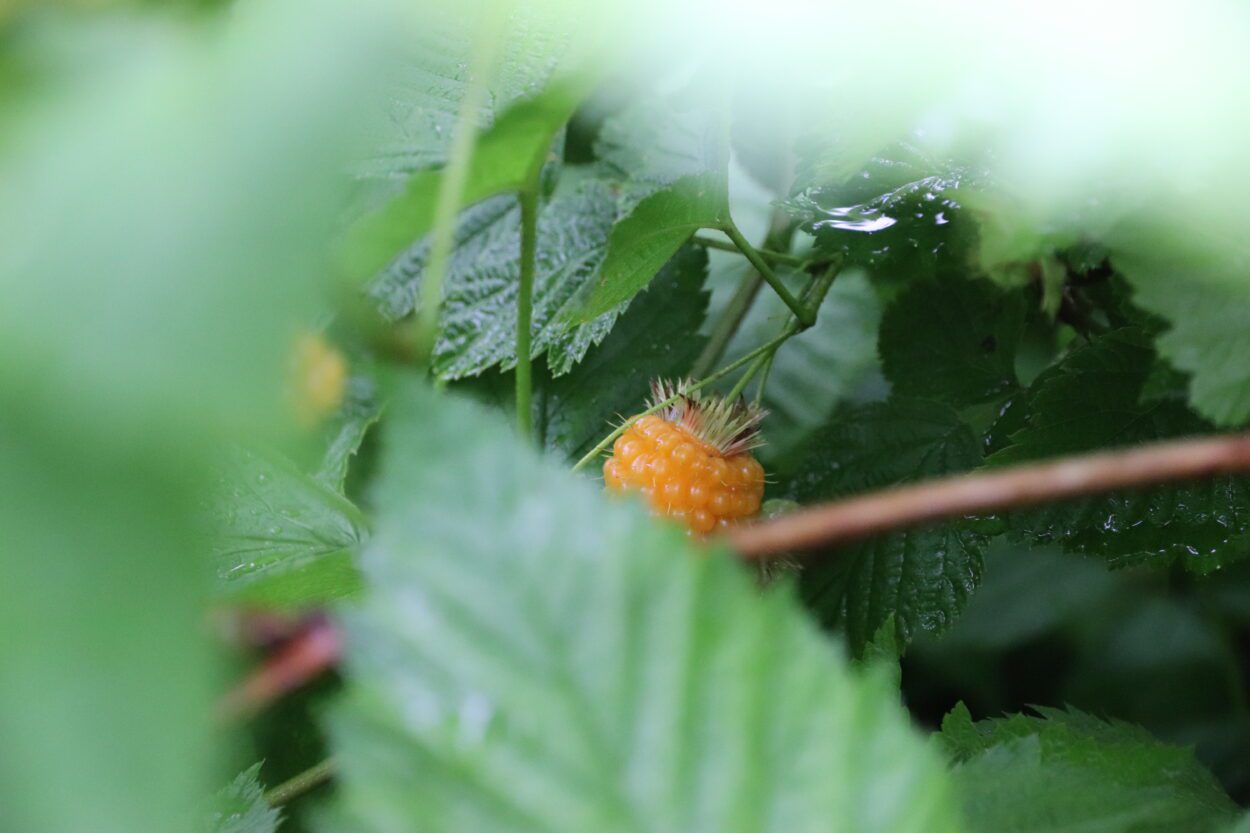
Kaa,laa Mary Goddard plucks golden and red salmonberries from bright green bushes near Starrigavan Estuary on the northern part of Sitka’s road system. The skies are grey and rain drizzles down on her head as she fills her blue plastic bucket.
Goddard, a Lingít artist in Sitka, is just over a month into a three-month challenge of eating only Alaska Native foods.
“So anything that I can fish, forage or hunt for here,” she says. “That just means nothing from the grocery stores, like refined sugars, flours, processed foods, anything that’s not natural to Alaska.”
Traditional foods were a cornerstone of Goddard’s diet growing up in the small Southeast Alaska village of Yakutat.
“We lived off of fish, moose meat and berries,” she says. “But one thing that didn’t seem to be a lot of knowledge around was a lot of the Indigenous plants…I spent a good portion of my time learning about the plants just from books and anyone that was willing to teach.”
Now, she’s trying to put that knowledge into practice and incorporate all the ingredients: the fish, the meat, the plants.
“The Lingít culture is over 10,000 years old,” Goddard says. “Lingít people had exactly what they needed here, and so I just wanted to lean into that a little bit more.”
Goddard says her journey to take on the 90-day challenge began with the spring herring egg harvest, which kicks off the foraging season.
“I’ve heard a lot of Lingít people refer to the herring egg harvest as the new year, and it really feels that way, because once that happens, it’s almost just like one thing after another,” she says.
Since then, she’s harvested black seaweed, sea lettuce and kelp. Sea cucumbers, sockeye salmon and lovage. Chocolate lily bulbs and salmonberries. Rose petals, white clovers and fireweed for tea. She’s also been gifted seal meat and seal oil, and even a boat ride to further her foraging.
“That’s almost as important as a car in Sitka, or maybe even more so,” Goddard laughs.
Over the course of the three-month project, she wants to highlight as much of the harvest as possible and celebrate how amazing local food is.
“And then we thought, what would it look like if I was dedicated to eating only that? What would be the health benefits? Would there be any? Would I see a drastic change?” she says. “So instead of just doing it for 30 days, we figured 90 days would give us more time to measure if there’s any changes that can be seen.”
Goddard says eating only traditional foods has been challenging at times — mainly at night when she wants to sit and enjoy something big and comforting, like mashed potatoes and gravy or some cake. But, she says, while she was expecting to feel hunger pains, overall she’s felt very satisfied. She’s also sleeping better and having fewer stomach issues.
She says harvesting can be a lot of work, but it’s worth the benefits so far.
“The food here seems very nutrient dense,” she says. “It’s also not traveling from Seattle or beyond to get here in containers. It is literally outside our door. It is in our backyard. It’s at our beach. It’s in the forest.”
Goddard has a background in regenerative tourism. She says through that work, she learned that food is a major contributor to environmental harm and climate change. So, she says, even if people can switch out some of the beef that they eat on a daily, monthly, or yearly basis for something that they can harvest themselves, they’re contributing to a healthier environment and a better world.
“I feel like there’s so much connected to the food,” she says. “It’s respect for every plant, every animal that’s out there. When you respect the plants or the animals, you’re going to be a better steward of the land.”
In everything she does, she says she considers why she’s doing it, why it’s important, and how it will connect to her culture and community.
“What’s so cool about the harvesting is that you may know one piece of the puzzle or a couple more, but there’s always someone who knows more than you. So I’m eager to continue learning,” Goddard says.
She hopes she will come out of this project with a better understanding of local foods and how to harvest them. And also hopes this project will help inspire others to connect with their food sources, including her nine-year-old son.
Goddard is sharing her project “90 Day Native” on social media and is also working on a documentary about her experience.