Wooden blocks, boats and baseball bats are cornerstones of childhood play. For Chloe Fatsis, wooden tiles were the currency of her youth.
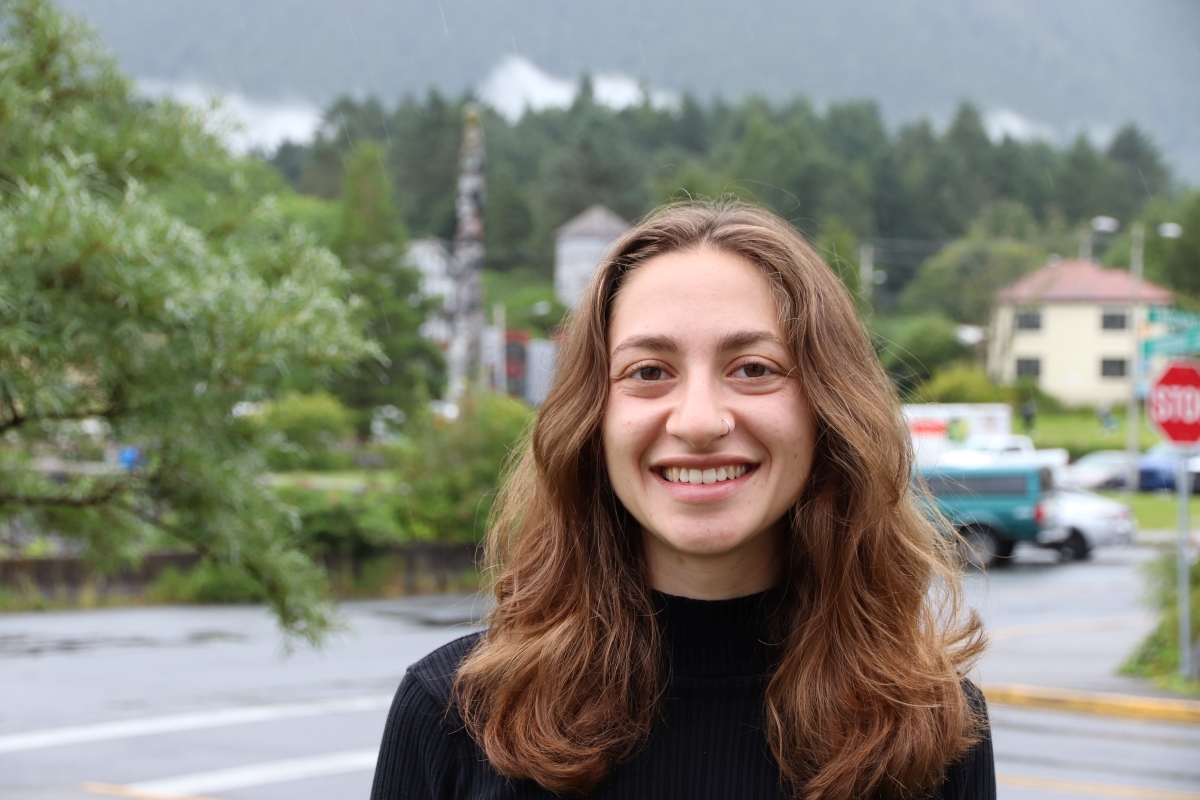
“It’s basically been in me since birth,” said Fatsis, a former Outer Coast student and summer staff member who is leaving Sitka this weekend to compete in back-to-back national Scrabble championships.
Just before she was born, her father, journalist and nonfiction writer Stefan Fatsis, wrote a book about the subculture of competitive Scrabble.
“In the process of reporting for this book, he became a competitive Scrabble player himself, and in the process, fell in love with the game and the community,” Fatsis said.
At just six weeks old, Fatsis attended her first national Scrabble championship. And it wasn’t long before she was competing herself.
“When I was, you know, maybe four or five, six, my dad and I would just form words on the rug,” Fatsis said. “We would like dump a bag of Scrabble tiles and shuffle them around and make words. So this was always something I was kind of being primed for, even though it was not maybe so intentional. And I think my dad feels very lucky that it’s actually something I really loved.”
She entered her first youth Scrabble tournament at 8, and her first adult competition at 9. Since then, she’s been traveling to tournaments around the country, and memorizing the Scrabble dictionary.
“Over the course of the past, oh man, like 14 years of my life, I’ve been slowly chipping away at this dictionary,” Fatsis said. “Once I got to college, I really committed and learned all of the words and rose to the expert level that I’m now at.”
Scrabble is a classic board game invented by an architect in the 1930s. On a 15 by 15 grid of squares, players place wooden tiles with individual letters to spell words and score points. It’s a puzzle in which strategy and memorization, and the right words are key.
“All of the two through eight letter words, those are really the words that’ll be most important to know for Scrabble, because you have seven letters on your rack of tiles, and you’re generally looking to play all seven of those for a bingo,” said Fatsis.
And while it’s a game that deals with letters and language, it’s also a numbers game. To play at an expert level, a Scrabble player might memorize 50,000 to 60000 words, or more. It’s a time consuming endeavor, so, to be efficient, most players focus solely on memorizing the words without the definitions.
At a tournament in New Orleans earlier this year, Fatsis realized the letters on her rack of tiles, played just right, would win her a boatload of points. There was just one problem.
“It was a word that I knew from my Scrabble word studying that I was not sure of. In that moment, I was like, ‘Oh, man, I really recognize this. Why is this word jumping out to me?” Fatsis recalled. “I am not feeling 100% confident that this is a word, but there must be a reason that my brain is, you know, recognizing it so strongly.”
Fatsis took a swing and was right. S-C-R-O-F-U-L-A is a word. It’s “Scrofula” and it’s a glandular infection usually associated with tuberculosis, but that definition wasn’t relevant at the moment. The confirmation of her skill was.
“And that was a really great feeling, not only to have found this very kind of weird and obscure word, to have gotten the ‘triple triple’ as we call it, which is a ton of points, but also to have really trusted my gut and gone with a word that I wasn’t sure of, but felt confident in enough to play,” Fatsis said.
This month, In St. Louis, Missouri, at the Word Game Players’ Association World Cup, she’ll play 31 games of Scrabble in five days. Then she’ll head to Hanover, Maryland, for the NAPSA Scrabble Players Championship. At that tournament, she has a particular goal in mind.
“I am currently rated 1975 in one of the organizations, and the highest rated players get up to 2100 or so. So my goal is to break the 2000 rating. That is kind of a really big milestone in Scrabble,” Fatsis said.
Over the course of two weeks she’ll play 62 games of Scrabble, a marathon that will require a tremendous amount of mental endurance. She says coffee every morning and a good sized breakfast are key to maintaining stamina. But she’s never played this much Scrabble, back to back to back, before.
“When I was younger, I didn’t get tired at all, no matter how much Scrabble I played,” Fatsis said. “But these past few years competing in these tournaments, by the last day I’m feeling super wiped from so much Scrabble and thinking, because you really have to have your brain on and working all the time.”
She’s looking forward to unwinding with fellow competitors in the evenings, though for some it means playing more Scrabble, often lighter variations like “Burrito” where the first player to spell the word burrito wins.
“So it can be silly and not as mentally draining,” Fatsis said. “But still, sometimes after a long day of playing Scrabble, I don’t want to do anything Scrabble related at all, which some players cannot relate to and just can’t get enough of.”
While the nationally ranked player has some competitive goals for these tournaments, she’s not only in it for the wins. Over the years she’s made some of her best friends while competing, bonding over their shared love of wooden words. So when they all get together, she says it’s “like a family reunion.” And for Fatsis, that’s even more true, because her dad will be playing alongside her.
The Word Game Players’ Association World Cup will take place in St. Louis, MO from August 2-6. Stream the tournament live here.
The NAPSA Scrabble Players Championship will be held in Baltimore from August 9-13. Stream the tournament live here.