Over a hundred people are spread out over a wide patch of muskeg, bright and early on a Saturday morning. Locals and tourists stand shoulder-to-shoulder in a single-file line across a gravel trail, buzzing with anticipation for the beginning of one of Sitka’s biggest biannual traditions: the release of rehabilitated birds of prey back into the wild.
“We have put so many months and sometimes years into the care of these rehabilitated birds that have come in to us with varying degrees of injuries, and it’s us up to us to get them back out in the wild.”
That’s Sophie Nilles, an avian care specialist and education coordinator at the Alaska Raptor Center. Having worked here for about three years, she has been involved in over five raptor releases. Yet for Nilles, the excitement that comes with a release never falters.
“This is exactly why we do it… it’s an indescribable feeling, and one that will never get old,” says Nilles.
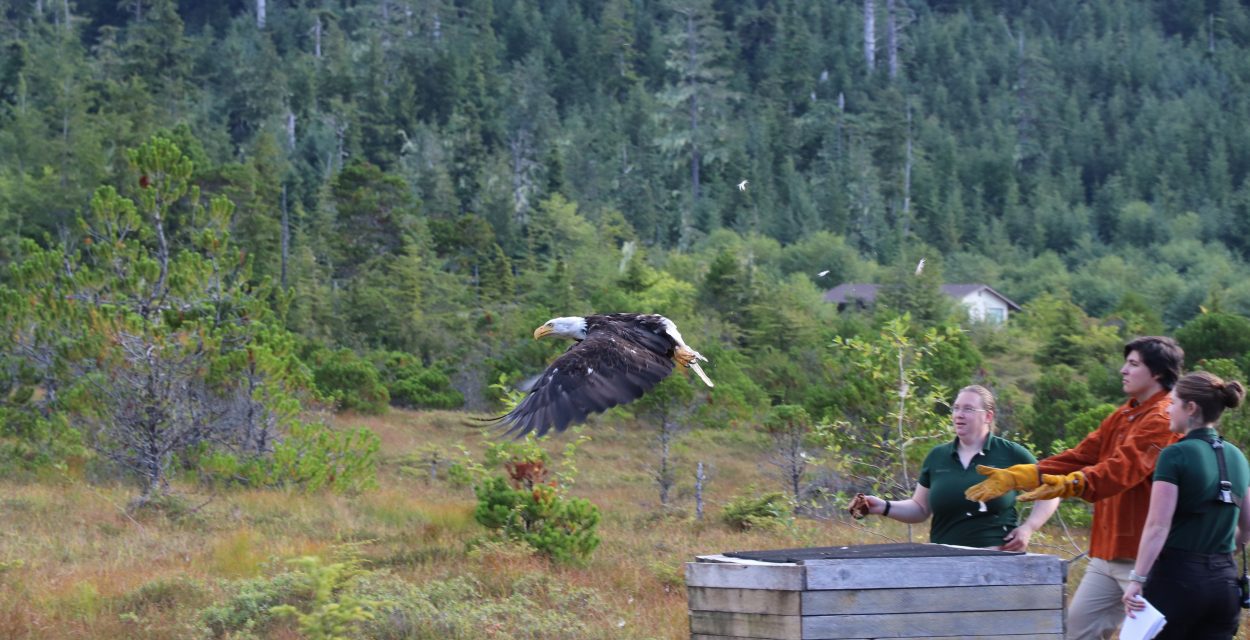
As Nilles introduces the event to the eager spectators out on the muskeg, they stand in quiet awe as they see for the first time the stars of the show: four bald eagles carried onto the field by four of the center’s wildlife interpreters wearing protective jackets and gloves. All four eagles are wearing leather blindfolds known as falconry hoods, which helps prevent sensory overload and keeps them calm as they’re perched on their interpreters’ arms, waiting for their time to take off.
After the audience is lead in a countdown by Nilles, a interpreter removes their eagle’s hood. After tentatively stepping onto a wooden landing box, the newly released and de-hooded bald eagle powerfully flaps its wings up into the sky, much to the delight of the audience in the muskeg below.
One such spectator was Mo Muñoz. She has been working seasonally in Sitka for the past two years, and has been wanting to attend a raptor release ever since. However, this is the first time Munoz had time off work to go see the event, and it surpassed every expectation.
“I don’t really have words to describe it,” said Munoz. “It was really amazing to get to see such a majestic, beautiful creature that had been rehabilitated and given another chance to see them be able to be released and fly off into the wild. It was pretty amazing.”
All four bald eagles came to the Raptor Center from all over Southeast Alaska with a wide array of medical conditions. Having only worked at the center for four months, this event was the first time Wildlife Interpreter Sean Felter ever got to hold a bald eagle.
“It was a great honor. I heard that she had a very, very strong personality, but she was very, very cooperative,” said Felter.
Felter was in charge of releasing the eagle named Agnes. Agnes was originally brought to the Center this past May after being found in a backyard in downtown Sitka, unable to fly. She suffered punctured wings and legs, likely a result of fighting with other eagles. Flash forward to the event, and Agnes bursts out of Felter’s arms, taking off like a rocket into the Sitka sky.
After Agnes, the third and fourth eagles are released, and the show concludes. The audience slowly files out of the field, but Felter lingers on the trail. He stands like a proud parent, tears streaming down his face as he watches Agnes, perched atop a nearby tree. He walks down the trail to take closer pictures of her from below, making sure she is ok until she confidently takes off into the mountains of her native home.
“I’m feeling so many different emotions,” said Felter. “A lot of joy right now. I will say I’m so glad that Agnes can be out there back in the wild where she belongs…. Also a sense of pride, pride in what we do here… Because it’s important that we take care of our wildlife here, because it’s part of what makes this place great, part of what makes the earth great.”
This fall, Raptor Center staff will be hard at work caring for their current raptors in preparation for the spring raptor release, which is scheduled to occur when plentiful herring will be swimming down the river. There, the raptors wait for the day they’ll spread their wings to rapturous applause.
Editor’s Note (9-11-25): An earlier version of this story combined wildlife interpreter Sean Felter’s middle name and surname. This story was updated to properly address Felter.