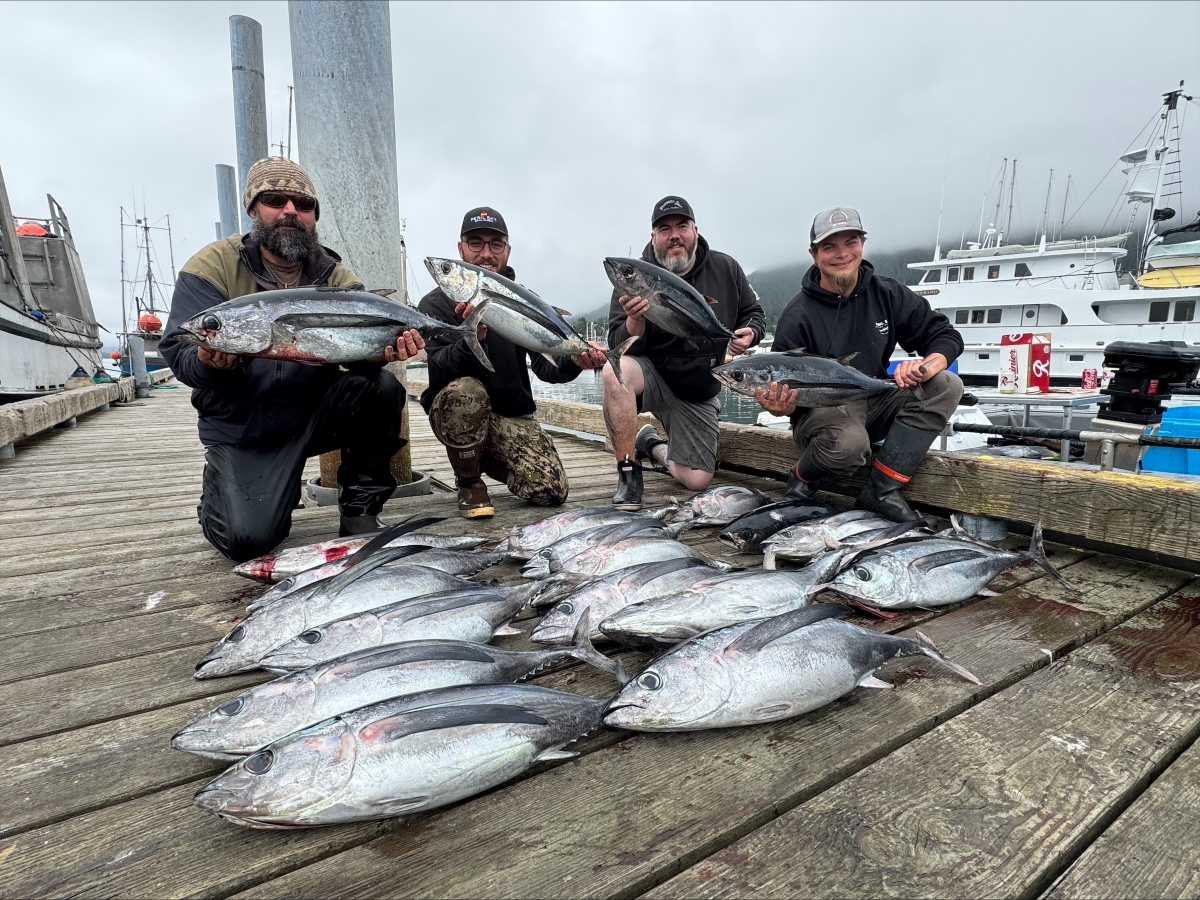
A warm August and early September near Sitka raised water temperatures to over 60 degrees. And those warm waters attracted an unusual fish to the area – tuna. Sitka anglers had historic luck bringing home the fish that usually swim farther south.
Growing up, fishing was a scary prospect for Jason Own.
“I had kind of a bad experience on a fishing trip when I was a kid, and got a hook stuck in my hand and ever since that day, I was very scared to pick up the rod and reel,” Own said.
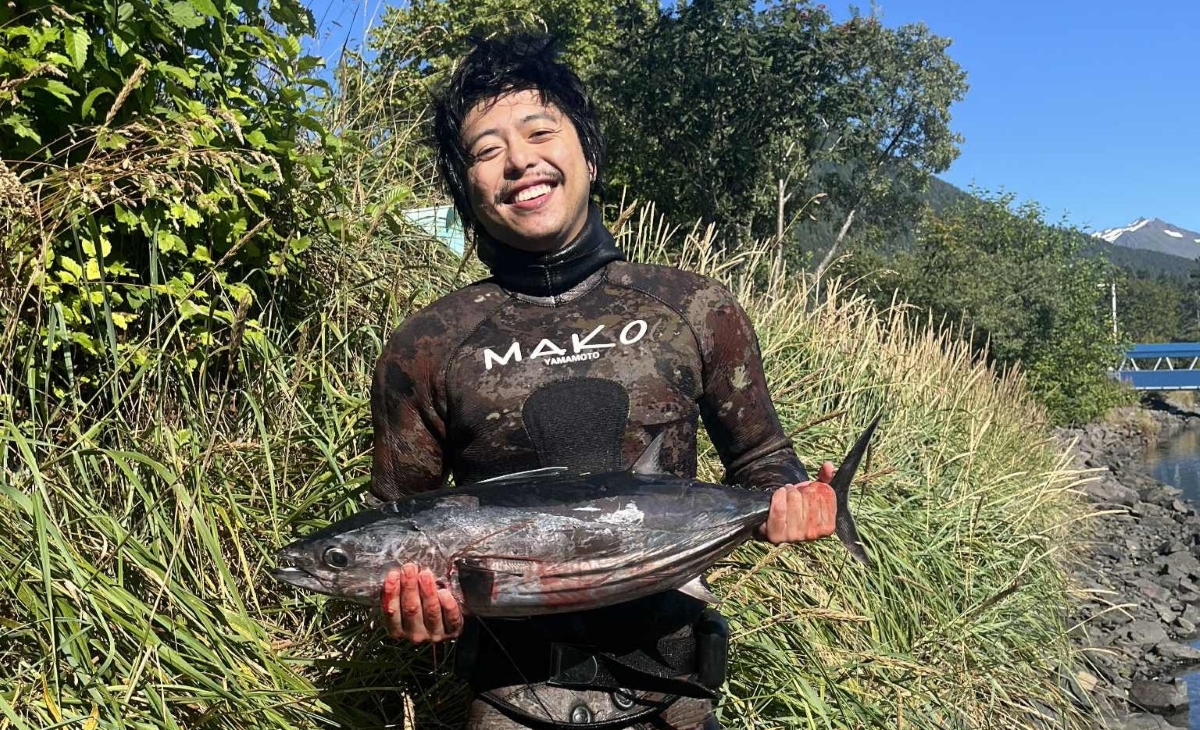
That changed when he moved to Sitka around two years ago, and took up spearfishing.
“After work almost every day, I’d pick up the spear gun, put on a wet suit, and hop into the ocean,” Own said.
Own was busy studying to get into med school one day in late August, when he heard a couple of tuna were spotted in a harbor in downtown Sitka. The highly unusual sighting was enough to pry him away from his books. At the harbor, he watched as folks tried to catch the fish, but they weren’t biting, and fishermen on the dock were getting frustrated. One hollered, “Someone should just go in the water and spear that thing.” Own said he had his spear in the car.
“All of a sudden I was, you know, everyone was egging me on to go in the water and give it a shot,” Own said.
He went down to the shoreline and waded in. There, he waited, suspended underwater for over half-an-hour, until he felt the vibrations of the tuna approaching from the water above him.
“I just was, honestly, just so enamored by how cool that thing was,” Own said. “It’s obviously very shimmery, and, you know, tuna, they’re just built for the ocean, and are really streamlined. And I was just kind of admiring how this thing had evolved over the past thousands of years, to be like a torpedo in the water, and to travel these huge distances, to migrate in such fast speeds.”
Then, Own said the tuna seemed to notice him, and, startled, it turned in the water.
“For a split second, I had a very clean look at its face,” Own said. “Then I was like, ‘Oh, well, if I’m going to take a shot, it’s probably going to be now.’ And I pressed the trigger.”
He landed a clean shot, and the front page of the local paper for the unusual catch– a 30-inch-long, 15 to 20 pound skipjack tuna.
Own’s experience was an early catch in what became an unprecedented tuna harvest in Sitka.
Bridget Ferriss is a research fish biologist with NOAA Fisheries. In an email, she told KCAW that tuna do show up in the Gulf of Alaska, but it’s not monitored by NOAA to know if it’s a rare encounter. There are two stocks of skipjack tuna in the Pacific Ocean. 2025 has brought warm waters to Alaska, and strong warm currents across the North Pacific have provided a route for tuna from one of those stocks to make their way to Southeast.
Ferriss says Albacore are more common in Alaska, but still infrequent. She says they can handle a broader temperature range than Skipjack. As luck would have it, a group of local fishermen were about to find that out.
Until a couple of week ago, RJ Miller had never been tuna fishing. Miller runs a charter fishing business in Sitka. Last summer, he heard about an angler who caught two albacore off the coast of Cape Edgecumbe, more than 20 nautical miles from Sitka. This summer, he was guiding a charter trip, and one of the crew snagged something really fast and strong- likely a tuna. But it was a hard sell to convince visiting charter fishermen to go for tuna when they journeyed to Alaska for something more…Alaskan.
“That thing pulled harder than I’ve ever seen anything pulled,” Miller said. “At that point, we’re beyond excited, irrationally excited.” Miller said he asked the visiting fishermen if they wanted to try for tuna, but they wanted to stick to salmon.
So he started doing more research and learning from other locals with tuna experience, including Steve Ramp. They all agreed to go out on the hunt for tuna. On a Thursday morning in late summer, Ramp got an early start toward the Cape. Miller followed him out a couple of hours later. As Miller surveyed the water, looking for that neon blue warm ocean current where the temperature exceeded 60 degrees, Miller called Ramp to check in, and someone else on the boat picked up.
“She goes, ‘Well, Steve’s fighting a fish right now,” Miller recalled. “We’re all just about to lose our minds. [I say] ‘What? Fighting a fish right now?’ And they get it in the boat, and I go, ‘Oh, what was it?’ And she goes, ‘Albacore!’ and at that point, we’re hysterical.”
Miller, Ramp and the rest of the group brought home 45 albacore tuna that day. Like Own, Miller marveled at their strength and speed.
“Well, you’re trolling at seven to 10 knots. They grab the lines and the reels just start screaming,” Miller said. “And we’re using halibut gear, with probably pushing 10-12 pounds of drag. Pretty tight, not too tight, but pretty tight drag. And they just scream out 100, 200, 300 feet of line, depending on how big they are.”
Their bounty brought more fishermen out to try their luck. ADF&G area sportfish management biologist Troy Tydingco estimated that close to a couple hundred have been caught.
“It happens from time to time down in Prince of Wales, where anglers are kind of watching the sea surface temperature. And when it hits 60 degrees, which is usually kind of a ways offshore, they go out and try,” Tydingco said. “To my knowledge, this is the first time that sport anglers have had success targeting them offshore [in Sitka].
There’s no limit to how many tuna sport fishermen can catch, as long as they have a permit. But the tuna boom in Sitka prompted the Alaska Department of Fish and Game to issue an advisory about commercial fishing, which is also legal, but far more regulated.
Miller said while he’s only recently become a tuna fisherman, he’s trying to share everything he’s learned in the past month with fellow Sitkans.
“I hope that everybody in Sitka can go out and and get their hands on one of these,” Miller said. “Not only for how absolutely delicious they are, but the thrill of the chase and the thrill of the fight.”
More than anything, the experience has piqued his curiosity.
“It kind of feels like Pandora’s box,” Miller said. “What’s really out there? If albacore are out there, what’s eating the albacore? It has me curious. Is there giant Bluefin? Are there Marlin? I mean, we just really don’t know.”
But Miller hopes to find out.