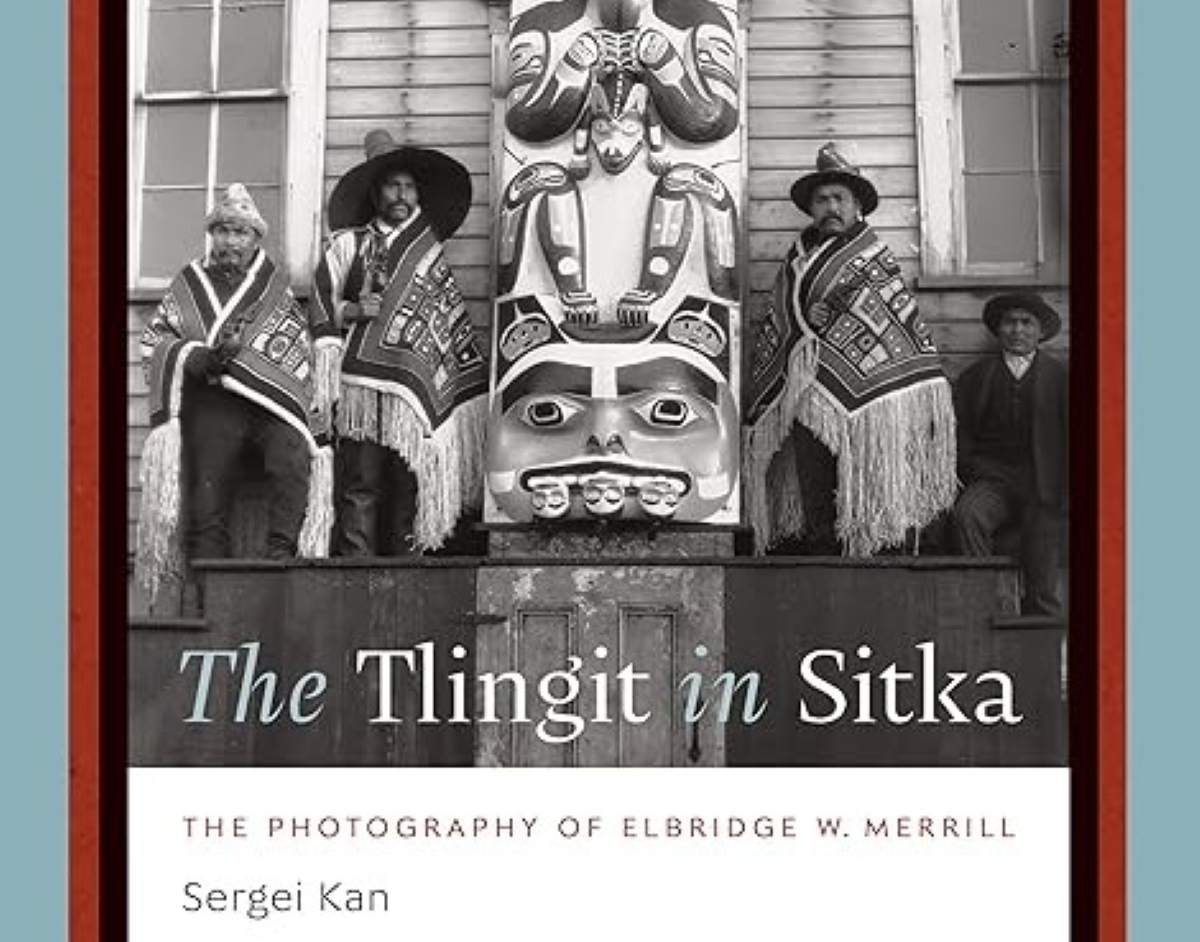
A photographer who documented Tlingit community and culture in Sitka in the early 20th century is the subject of a new book.
Dartmouth anthropologist Sergei Kan gave a lecture for the Sealaska Heritage Institute in Juneau this past Tuesday (11-18-25) on his book covering the works of renowned photographer Elbridge W. Merrill.
Merrill moved to Southeast Alaska from Massachusetts in 1898, and lived in Sitka for 30 years, documenting Tlingit community members and culture in the region at a time when government and missionary efforts to repress Tlingit ceremonies and language were prevalent. Kan says Merrill’s ability to powerfully capture the spirit and life of the Tlingit people through his photos earned him the nickname “the father of pictures.”
Kan says one reason Merrill was more successful with his pictures than other European American photographers at the time is partly because he was able to integrate with, and earn the trust of, the community.
“He was somebody special, highly respected by [the] native and non-native Sitka community,” said Kan. “And then Leslie Yaw, who was the superintendent of the Sheldon Jackson School, who came to Sitka 1923 [and] knew Merrill. [He] reminisced that, unlike quite a few white people in town in the 20s and 30s, who still had a kind of a racial prejudice, Merrill did not. He was known for his openness.”
Additionally, unlike other photographers who romanticized and fetishized Tlingit people, culture, and tragedy under colonialism, Kan claims that Merrill cared to accurately capture the joys, nuances, and lived realities of the people he photographed, citing some of Merrill’s photos to support his argument.
“For example, Edward Curtis, the great photographer whom we admire but … we know that he even sometimes dressed native people in clothing they no longer wore, or used wigs to show that they were, ‘wild’ or ‘savage’ or whatever. ‘Traditional,'” said Kan. “Merrill never did that. And in fact, you could see the couple on the right [in this photo] are very nicely dressed in what was the fashion of the time. And I think those kinds of portraits were equally important.”
Kan says he collaborated with clan leaders, elders, and community members to accurately identify Merrill’s subjects in his book, with many of his friends and collaborators in attendance. For Kan, he felt it was important to do this work so that his book could be interesting and relevant to Tlingit readers.
“And I always cringe when I see a photograph that says ‘unidentified Native American,'” said Kan. “And one time I even saw a picture of Mark Jacobs in some fancy art books of photographs of Southeast Alaska [which] said ‘unidentified American Indian.’ I’m like, ‘that’s a man I know.’”
Kan’s lecture in Juneau was part of a series of lectures Sealaska Heritage Institute hosted for Native American Heritage Month. He will be giving the same presentation in Sitka on Saturday (11-22-25) at the Sitka National Historical Park, as well as another talk titled “Memory Eternal” at the Russian Bishop’s House on the same day.