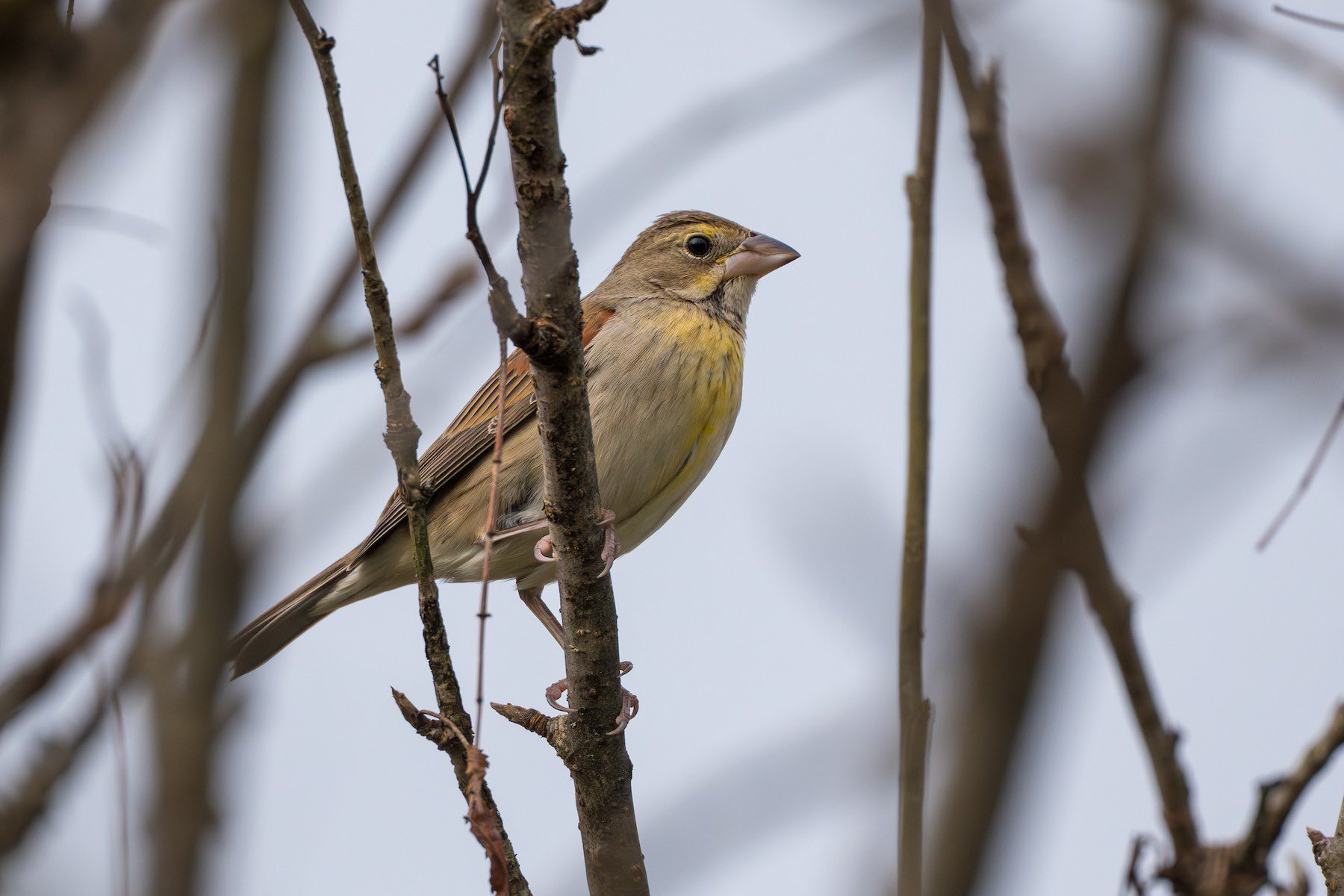
Two different birds rarely seen in Sitka and much of Alaska showed up in Southeast last month. As KCAW’s Katherine Rose reports, it was exciting news for birders leading into a big month for our feathered friends–the Audubon Society’s annual Christmas Bird Count.
In mid-November, the arrival of two rare birds in Sitka caught the attention of birders from around the state. Local naturalist Matt Goff said his son, a fellow naturalist, spotted them back-to-back.
“My son got ambitious about feeding birds this fall again, so [he’s] been putting out a lot of bird food, and he noticed a Harris’s sparrow in the yard, which is a bird that we’ve been looking for for a while,” Goff said.
The small brown sparrow breeds in the boreal forest of Northern Canada, but typically winters in the lower Midwest. Goff had never seen a Harris’s Sparrow in Sitka- the bird was last spotted here in the 1990s.
Just minutes later, his son spotted a second bird.
“About a half hour later, he’s like, ‘There’s another unusual bird in the in the yard,'” Goff recalls. “And he says, ‘I think I remember what it is. I can’t remember its name, but it’s like, it begins with a D, and it’s rare,’ and I said, ‘Is it a Dickcissel? And he said, ‘Yeah, that’s what it was.'”
The Dickcissel was even more unusual. Goff said the midwestern bird that winters in South America was last spotted in Juneau in 2004, and the Sitka sighting is the third on record for Alaska. Its arrival was so unexpected, it brought even more out-of-town visitors. Goff said after he posted about the sightings to the Alaska Rare Birds Facebook group, several birders from Anchorage flew down too…by plane, of course.
“There’s folks that keep track of a list, their Alaska State list, how many birds they’ve seen in the state. Some of these folks have well over 300 species. One of the people that came had over 400 species,” Goff said. “And it’s pretty difficult for them to get new birds these days, because they’ve seen most of them.”
View the group’s eBird checklist to see the birds they spotted on their Sitka visit
For some it wasn’t their first stop- one drove over five hours from Anchorage to Valdez the day before to see a Broad-winged hawk, the first spotted in Alaska.
“Some of us are mad travelers when it comes to birds,” Goff said. “Especially unusual birds.”
While the Dickcissel hasn’t been seen since late November, Goff said it’s possible the Harris’s Sparrow will stick around for the winter. If it does, it could be counted as part of the Audubon Society’s Christmas Bird Count. Victoria Vosburg is a retired Alaska Raptor Center veterinarian, and she said it’s the country’s longest running citizen science initiative.
“Way back in the beginning, people on Christmas Day used to get together and hunt. They called it a ‘side hunt,’ and it was a competition to see who could kill the most living things,” Vosburg said. “So it wasn’t just birds, it was killing everything. And then some people decided, ‘Let’s do something different. Let’s just count birds, instead of kill them.'”
For more than a century, the Christmas Bird Count has documented population declines and recoveries of all types of bird species, and the data collected during the count has influenced policy and conservation efforts. Sitkans began participating in the 1970s, and in just the past couple of decades, Vosburg said they’ve observed a lot.
“I started running the bird count about 20 years ago, and just since I started doing that, we’ve seen swans come back to town. We’ve seen Anna’s hummingbird start spending the winter,” Vosburg said. “We’ve seen Eurasian collared doves come to town, population explosions, disappear, and now we’re watching them on the rise again.”
Sitka’s Christmas Bird Count is December 20, and there are a number of ways to get involved. But if you’re looking to see a Dickcissel or a Harris’s Sparrow, it’ll be a lucky break. Only one of each was spotted. Goff said that’s often the case with lost birds.
“I think there’s some speculation that what might happen, in part, is their internal compass, so to speak, might be off 180 degrees or 90 degrees, or something like that, and they just go the wrong way because they orient differently,” Goff said. “Then they end up someplace that is not at all what their, sort of, biological systems are expecting.”
Goff said lost birds often look for the birds that are local and “in the know” to find food and sometimes they settle in for the winter. Sometimes not. But even if participants at the Christmas Bird Count don’t spot one of the rare birds, there are plenty of other bird species that are counting on being counted.
This Sunday, December 14, the Sitka National Historical Park will host a walk led by naturalist Connor Goff as a warm-up initiative for the annual bird count, which lasts nationally until January 5. A planning event is set for December 17, 6 p.m. at the Alaska Raptor Center, then the official count will happen in Sitka on December 20.