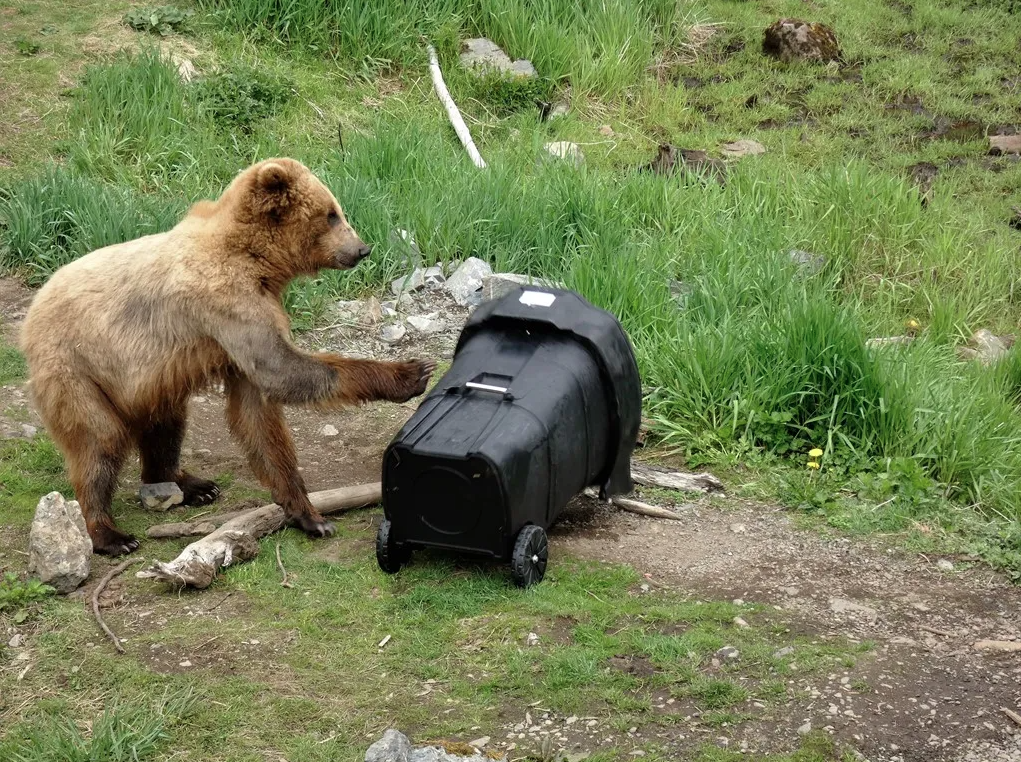
The Sitka Assembly is looking to address an ongoing problem in Sitka: bears breaking into trash cans. But how the body will go about it is still up in the air.
When the Sitka Assembly met on Tuesday (12-30-25), bear trash management strategies were on the group’s agenda. But one of the item’s sponsors, Assembly Member Scott Saline, was hoping for participation from key stakeholders, like residents of neighborhoods with high bear traffic, Alaska State Troopers, and Sitka’s solid waste contractor, Alaska Waste.
“I’ve asked people to show up here and just try to re-emphasize what it’s like to live up Indian River with brown bears squishing on your front doors and kids waiting for the bus year after year with bears in the shadows,” Saline said. “So I’m just hoping that people didn’t show up because they’re shy to come before the assembly.”
Sitka has seen an uptick in bear calls over the past several years, starting in 2021 when a record 14 bears were put down either by law enforcement or homeowners. In response, the city re-established a “bear task force” which recommended bear resistant trash cans as one possible solution to the problem. The preferred cans came with a hefty price tag, and the city did not move forward with the recommendation at the time.
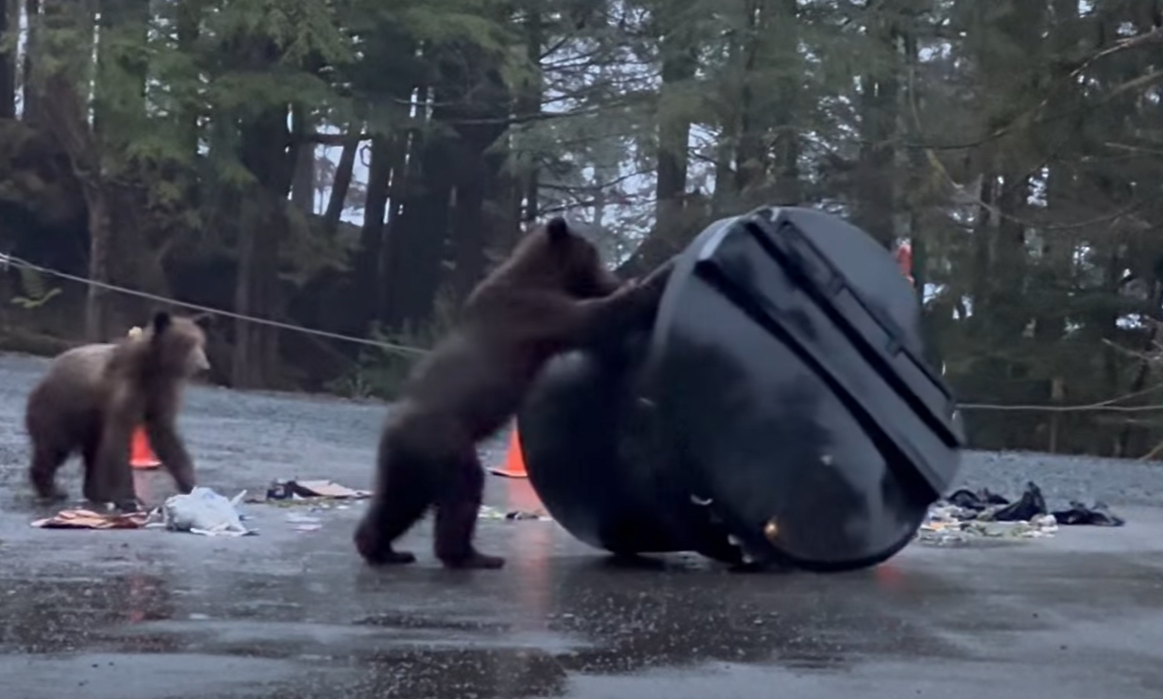
Then this summer, the city started a pilot program in the Indian River neighborhood to see if a centrally located trash bin would reduce bear traffic, but Municipal Administrator John Leach said they still need to check the data to see whether or not the effort was successful.
“I think we talk about a lot about the garbage situation, but we have a bear problem.” said Martha Moses, who sits on the Sitka Tribe of Alaska Tribal Council and was part of the bear task force. “We know bears develop habits, and we know that the bear that’s going over to the Coast Guard housing and to the Edgecumbe school area has got a habit, because he’s been going there for two, three years now. And so there’s more than just Indian River. There’s other areas that we’ve shared at the bear task force. And so when they become a problem, they should be taken care of. That’s what we really wanted to have, not just Indian River, but our community.”
Leah Mason is with the Baranof Island Housing Authority. She agreed that the Indian River neighborhood isn’t the only place with increased bear activity, and that rather than using new cans, the city should look into dealing with organic waste differently.
“I’ve been house sitting in Biorka Street when somebody shot a bear across the road from Market Center,” Mason said. “We’ve had bears getting into the large cans at Monastery [Street]. The bears are currently opening people’s cars. We’ve had a garage door pulled off by a bear trying to get to something in someone’s garage. So there’s a lot of discussion about what would work, and we have a lot of experience of what doesn’t.”
Assembly Member Katie Riley recommended talking to Alaska Waste about cost, and with the Sustainability Commission, which she said has been looking at solid waste management solutions, especially reduction efforts.
“Seeing if we can dovetail some of those efforts to both reduce the amount of solid waste that’s being generated, and figure out if there’s any kind of value added thing that we can do, especially with organic waste, to divert that, as like a particularly bear attractant waste,” Riley said. “And then come up with some of those neighborhood wide solutions like that could be all part of a comprehensive strategy.”
Leach said addressing the issue is complex and might require restructuring solid waste rates, renegotiating with the garbage collection contractor, and adjusting city code.
“Ultimately, whatever the solution is, if it’s going to cost more, it’s going to get passed on to the rate payer in some expense,” he said. “Meaning, if you don’t want the bin at your house and want to use the big one, like, how’s that going to work? Are you going to pay for both of them if it’s in your neighborhood? I don’t know.”
As for the future, Saline said he hopes to encourage more stakeholder participation at upcoming meetings.
“[We] can’t subpoena people, but I’m going to get the paper trail going so that the next meeting, we could have people here and make this come together,” he said.
In other business, the city has allocated more than half-a-million-dollars in additional funding towards its multi-year airport renovation and expansion project.
At their meeting on Tuesday, assembly members voted unanimously to appropriate $650,000 from the city’s General Fund towards the project.
Phase 1 of the approximatly $57 million renovation was mostly completed in September. That included a two-story addition to house a new passenger screening check point and the island’s first-ever escalator. Phase 2 involves remodeling the existing terminal to improve passenger circulation and baggage claim, as well as new entrances and exits for arrivals and departures. Both phases are expected to be completed by next fall.
The majority of funding comes from the Federal Aviation Administration, but city staff are asking for additional funds to cover items they can’t get grants for. Staff say the upgrades are “critical for airport operations,” including a TSA accordion door and a communications room for TSA equipment.
The assembly also authorized Municipal Administrator John Leach to apply for up to $800,000 in additional federal grants.