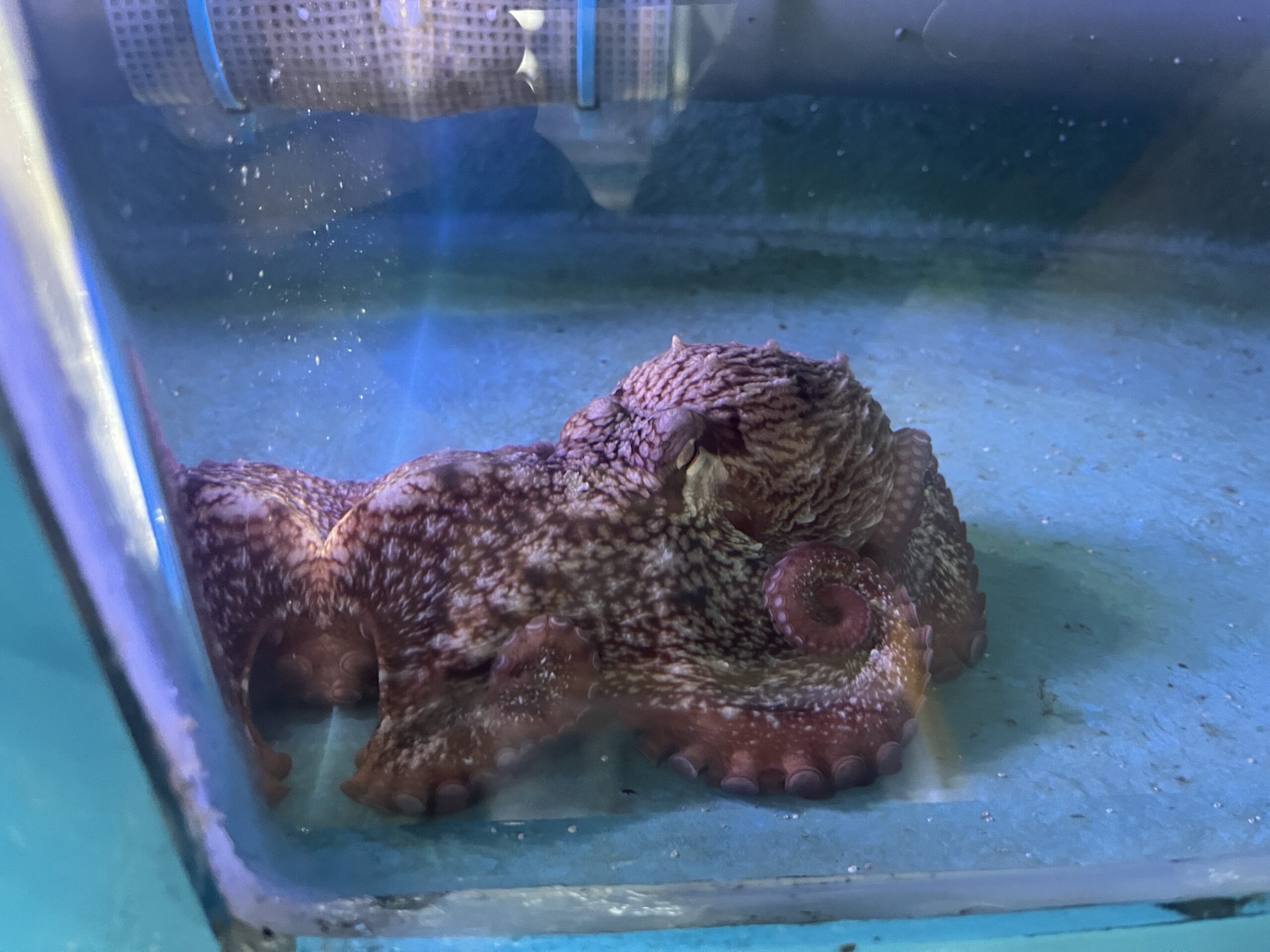
A pink octopus sits squeezed between two rocks in a glass tank, her tentacles unmoving as she watches me through her rectangular pupil.
“Giant Pacific octopus are the biggest octopus in the world,” says Matt Wilson, the aquarist at the Sitka Sound Science Center.
Although this octopus is a member of the largest marine cephalopods, she’s currently the size of an orange. And that’s more than seven times the size she was when a resident of Tenakee Springs found her on the beach in August.
“Currently, she is so small that she could easily fit in your hand,” Wilson says. “But she’ll get to the size that she would be wrapping around you several times with her arms, [with] an arm span of at least 15 to 16 feet, if not even larger.”
But this octopus is a temporary resident, and will likely be a few years old by the time she gets that big. Right now, she’s in a small holding tank. She’ll gradually move to bigger and bigger ones until she gets so big that she needs the aquarium’s largest tank, which holds about 800 gallons of water.
“Right now, none of the bigger tanks that I would normally keep an octopus in is suitable for her because she is so small and we have to be careful with octopus that they can’t climb out and get into trouble,” Wilson says. “We have to make sure that we can ‘octo-proof’ those tanks.”
Wilson says giant Pacific octopus only have a lifespan of three to five years. They’re what’s called “semelparous,” which means they only reproduce once before dying.
“And then it’s over for them,” he says. “So that’s one of the reasons why it’s important that we’re not going to keep her for her entire life. She’s going to get too large for us and is going to exceed what would be good for her and good for us, and we want to make sure that she’ll be released so that she has the opportunity to go continue her life cycle and make babies.”
Wilson says her timeline at the aquarium is dependent on her growth rate and her temperament. He’s worked with a couple dozen octopuses over the years — although none as small as this one — and, he says, it’s a unique relationship with each one.
Because they’re so smart, they need daily enrichment with toys and puzzles, creatures to hunt, and change-ups to their routines. Some love learning to open jars with treats inside. One of his octopuses, he says, would wave a jar at him every time she was hungry. Others don’t like the game, and tear the jars apart. Each octopus is unique. And Wilson says he has to constantly check in on their welfare and recognize when it’s time to let them go.
“Sometimes they hit a point where they’re like, ‘I’m done here,’ and it’s time to release them earlier, and sometimes they’re like, ‘I don’t want to go,’” he says. “So it really depends on that animal and how well they’re doing in that environment, in that situation, and just generally, how quickly they’re going to put on that mass.”
Wilson says he expects this one will be at the Science Center for up to two years. And even though this tiny cephalopod will outgrow Sitka’s only aquarium soon, he says she still needs a name.
“With octopus, it’s almost impossible not to give them some moniker of some kind, because they do have such personalities,” Wilson says.
And that’s where Sitkans come in. The Science Center is holding an octopus naming event where locals can enter names into a 32-seeded double elimination tournament. Participants will vote on the entries until just one name remains.
For Wilson, this is about more than just naming one octopus. He says octopuses, with all their personality and charisma, are a great way to get people engaged.
“Even somebody that might not connect with an anemone the same way is going to see the animatedness of an octopus and go, ‘Oh, that’s something that’s really cool and really interesting,’ and can really serve as a gateway to getting and talking into all sorts of different things,” he says. “Their ways that they see the world is so fresh from what we see that it is just a really incredible way to introduce people to new ways of thought and open up all sorts of talk about how animals are perceiving and interacting with their environments around them.”
Wilson says he also hopes the octopus will inspire stewardship and a feeling of responsibility for local wildlife and their habitats.
While a few names have already been submitted to the Science Center, the only name officially on the bracket so far is Matilda. People can continue to submit names for the octopus through January by making a donation on the Science Center’s website. On Jan. 31, they will host an event to finalize brackets and teach the community about octopuses. The final name will be announced in March.