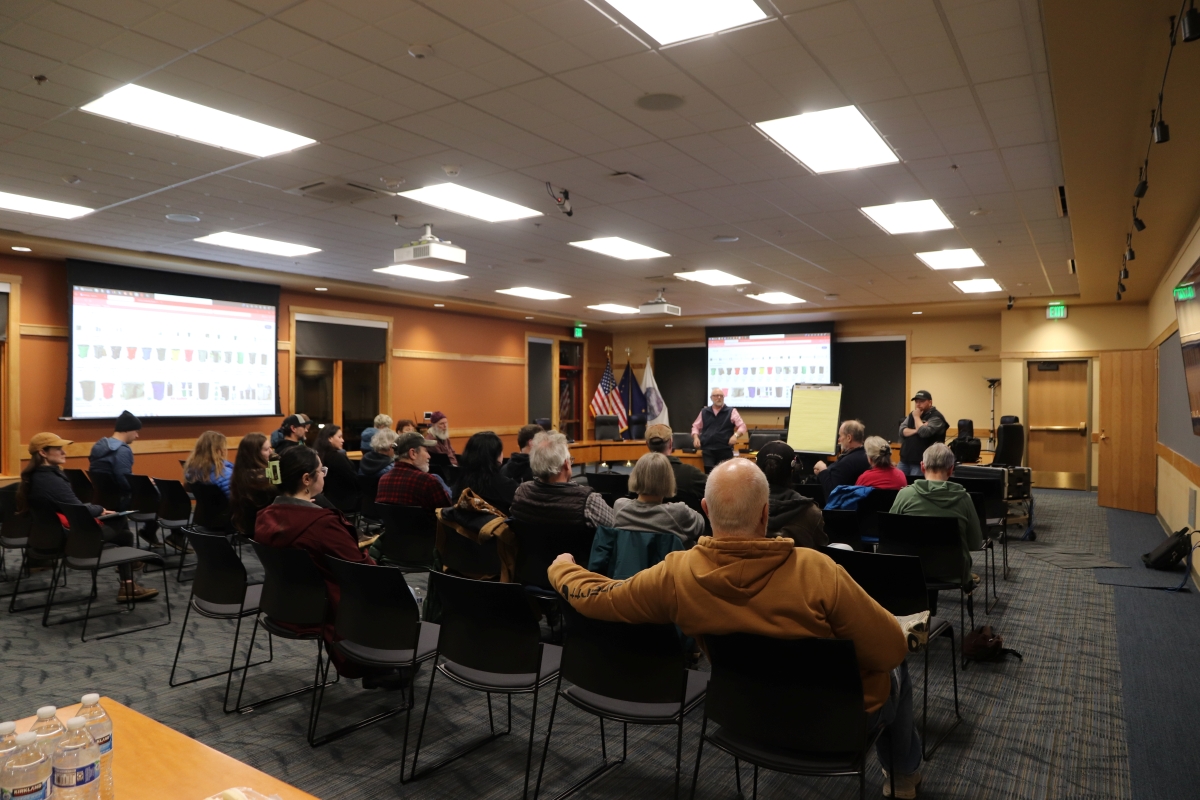
About two dozen community members gathered at Harrigan Centennial Hall on Thursday (1-29-26) to brainstorm solutions to Sitka’s ongoing problem of bears getting into trash. The informal meeting was hosted by Assembly Members Scott Saline and Thor Christianson, who took the opportunity to speak about the city buying bear-resistant trash cans.
“We’re probably not going to have a one-size fits all [solution] in Sitka,” Christianson said. “But we’re kind of hoping that we can come out of this with a recommendation for a pilot project to try something with a can or type of can, to say, ‘Okay, next summer, we’re going to get a few of them and try them out, see how I work.’”
Sitka has seen an uptick in bear calls over the past several years, starting in 2021 when a record 14 bears were put down either by law enforcement or homeowners. In response, the city re-established a bear task force, which recommended bear-resistant trash cans as one possible solution to the problem. But they came with a hefty price tag, and the city didn’t move forward with the recommendation at the time.
On Thursday, Claire Turner, Curator at Sitka’s bear sanctuary, said she was excited to hear the city talk about renewing the effort to get bear-resistant cans and help reduce human/bear conflict. Fortress of the Bear has tested several different cans against their resident bears, and Turner said they’d be interested in putting money towards the pilot program, although the solution will likely need to be multifaceted.
“I think we’ve hit the nail on the head by realizing that bear-resistant containers aren’t going to solve the issue 100% all by themselves,” she said. “It does have to be part of a bigger program, and a big part of that is education.”
Several others also touched on the broader systemic changes needed to reduce bear-human interactions.
Sitka resident Marg Parsons lives in the Indian River neighborhood, an area frequented by bears. She said the city should consider picking up trash multiple times per week in problem neighborhoods to help reduce attractants.
“I see this as a people problem, not a bear problem,” Parsons said. “And I don’t want our people problem to become a bear problem.”
Another proposal was to take organic food waste out of the trash. Jonathan Rubbo works for Totemic Solutions, a company that dehydrates organic waste for reuse.
“I have pretty extensive experience here in Southeast Alaska working with residents and businesses on keeping food waste out of their trash, out of their municipal waste,” he said. “And the key is to get the water out. We got to grind it. We got to get the water out. We preserve it. We can reduce it, and then we get a byproduct out of it [that] we can put towards other uses.”
Christianson said while proposals like removing organics and changing the city’s trash pick-up schedule could be incorporated into a more long-term solution, something like bear-resistant trash cans might be more realistic in the short term.
Christianson said no formal action could be taken during the town hall meeting, but that he hoped the discussion will help inform the assembly moving forward.