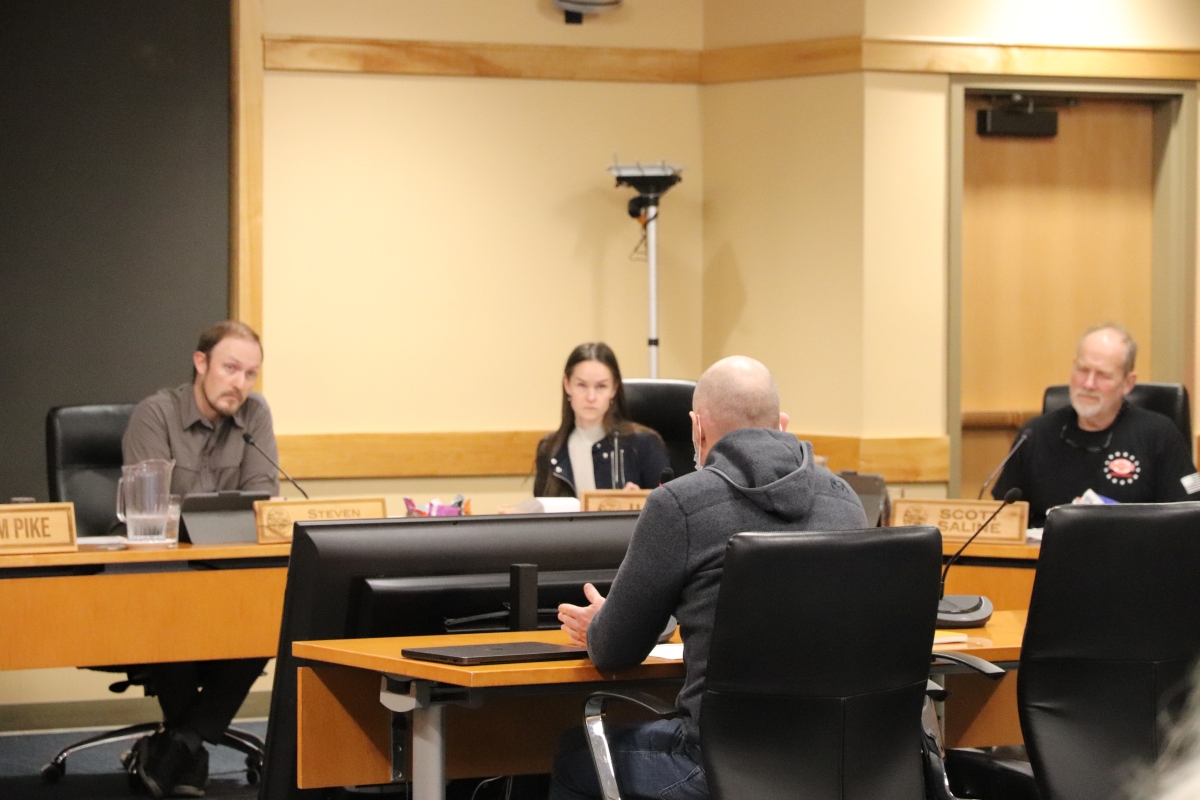
Sitka’s cruise bus stop is staying put, at least for now. When the Sitka Assembly met Tuesday, it convened as the Board of Adjustment, and upheld a permit denial for a new bus depot in downtown Sitka. The appellant, a local cruise dock owner, can now reapply for a conditional use permit, or can make a judicial appeal with the superior court within 30 days.
Sitka Dock Company owner Chris McGraw wants to relocate his downtown bus stop from Harrigan Centennial Hall to Oja Way, and build a pedestrian pathway with commercial spaces, food vendors, and housing nearby. But the Planning Commission denied his permit application, saying his plan doesn’t meet the land use objectives in the city’s comprehensive plan, and that it could introduce hazardous conditions at the site, like unhealthy levels of particulate pollution from bussing operations.
McGraw appealed that decision. In his appeal, he said the total number of buses operating downtown would be reduced under the new plan, and said there’s no evidence that it would cause additional pollution. He also said a lack of standards prevented the Planning Commission from making a fair and consistent decision.
“The new location would allow for a shorter route, reduce the number of buses needed on the road, and reduce congestion in downtown Sitka,” McGraw said. “I’m here asking the assembly to reverse the denial, or alternately, to remand the matter to the commission with instructions to apply the correct legal criteria.”
Planning and Community Development Director Amy Ainslie was at the meeting to represent the Planning Commission’s decision. She said the role of the assembly is to consider whether the commission made a sound decision by “fairly and adequately” considering all factors and evidence.
“We have property owners that have a foundation less than a foot from the property line with windows that face a facility that will bus in 100, up to 150 large buses a day,” she said. “We have horticulture uses in the area. We have an office building with fresh air intake that faces this direction. These are reasonable conclusions that the planning commission drew. And again, the applicant bears the burden of proof to show that this will not be detrimental”
About a dozen people voiced opposition to the project at the meeting, but the board could only take into account comments from neighbors of the proposed development who received mailers, or those who testified at the planning commission level.
Roy Anderson owns a property adjacent to the proposed bus depot. He said he’s concerned about the exhaust from idling buses getting into nearby homes, and increased vehicle congestion in the neighborhood.
“It’s 150 buses back to back coming out, making left turns, people trying to get in,” Anderson said. “What if I’m trying to make the left of my property and there’s buses three deep, somebody’s got to go somewhere. Do I stay there? Do I have the police officer give me a ticket? It’s just not feasible.”
Tess Hayburn has operated a vacation rental business near the proposed site for two decades. She said two repeat customers have told her they won’t stay there again if the bus depot is built.
“Diesel exhaust will be pouring into the cottages,” Hayburn said. “It is estimated that there will be up to 150 trips to the site in a 12-hour period. That is approximately 12.5 trips per hour, or roughly one bus every five minutes. Even with no idling, there will be buses running non stop. This is no mere transport facility. It is an intensive industrial scale operation.”
In his rebuttal, McGraw said the commission based its decision largely on public testimony about possible impacts in the absence of objective evidence.
“The commission’s findings rest on what the neighbors said they expect would happen: predicted odors, anticipated noise, speculated pollution, feared impacts on gardens and outdoor spaces,” he said. “Anticipated harm is not the same as actual harm. Predictions about what a use might do are not substantial evidence that it will”
Assembly Member Thor Christianson said he thinks the Planning Commission explored the issue thoroughly and came to a “legal and common sense solution” when issuing its decision.
“When we started tonight, I had a sheet of paper to write down anything new I heard. It’s essentially blank,” he said. “I have found [the Planning Commission] to be a thoughtful and thorough group. They don’t take their job lightly. They work very hard to look at all angles of problems and whether it’s something comparatively minor or something really big like this. They put the work in, and I believe that they made the right decision overall.”
Mayor Steven Eisenbeisz said McGraw had a hard and high burden of proof to meet and that the issue faces a higher level of scrutiny due to the nature of the project. But ultimately, he said he believes the commission was correct in the majority of its arguments.
“I believe that there are facts that the appellant could gather and then submit along with a new application,” he said. “I think that if they referenced state and federal standards, that could satisfy the Planning Commission in this instance. So I think while it would appear that the denial will continue this evening, I believe that there is a framework for the applicant to continue to work forward to this and prove that there are mitigating efforts that can be had within the conditional use permit.”
The assembly ultimately denied the appeal in full, upholding the Planning Commission’s decision.