There are few people who can say their lives have been heavily intertwined with the history of Mt. Edgecumbe High School like Sitkan CeeJay Johnson-Yellow Hawk. She is a 4th generation Mt. Edgecumbe student enrolled from 2001-2003, with her grandparents first meeting as members of the school’s first ever class. Today, she is a heavily involved alumni, offering beading lessons to all who are curious, and seeing the children of her former classmates now enrolled as students. When she read the news back in December about the mental health challenges many students have been facing, it sounded all too familiar.
“My family and communities have gone through basically childhood trauma, generational trauma,” said Johnson-Yellow Hawk. “I realized that we had some people here who needed community, and a lot of the times when something goes wrong in our communities, we go for our grandmothers and our aunties. And that’s what we kind of saw here. We were like, ‘Oh, maybe they need some Auntie support over there, some grandma support over there.'”
So, Johnson-Yellow Hawk and her gaggle of “aunties” and “grandmother-figures” (many of whom are fellow Mt. Edgecumbe alumni) banded together to launch the Mt. Edgecumbe Arts Project. The project started in January. It aims to connect students with classes taught by artists from their home regions across Alaska, as well as helping raise money for activities and community items the students desire. When Johnson-Yellow Hawk spoke about the project to one of her friends, she volunteered to reach out to a friend of hers who she felt would be suited for the task. That led her to Golga ‘Quki’ Oscar, a well-renowned artist who is self-taught in skin-sewing and beading, and hails from the village Kasigluk in the Yukon-Kuskokwim Delta. Oscar was previously a visiting artist at the Sheldon Jackson Museum back in 2023. He’s now based in Bethel and works as the Native Arts Coordinator for the University of Alaska Kuskokwim Campus, providing Alaska Native cultural arts workshops. After being invited to come to Sitka he responded the next day asking “When do you want me there?”
“For me it’s special because I’m sharing that knowledge to them. I’m giving them this privilege to pass the knowledge to their future generations,” said Oscar. “I think that’s an important factor in today’s generation to learn… because spirituality is so strong in many other indigenous communities….whatever story is being shared, has a spiritual significance behind it, which makes it more intriguing.”
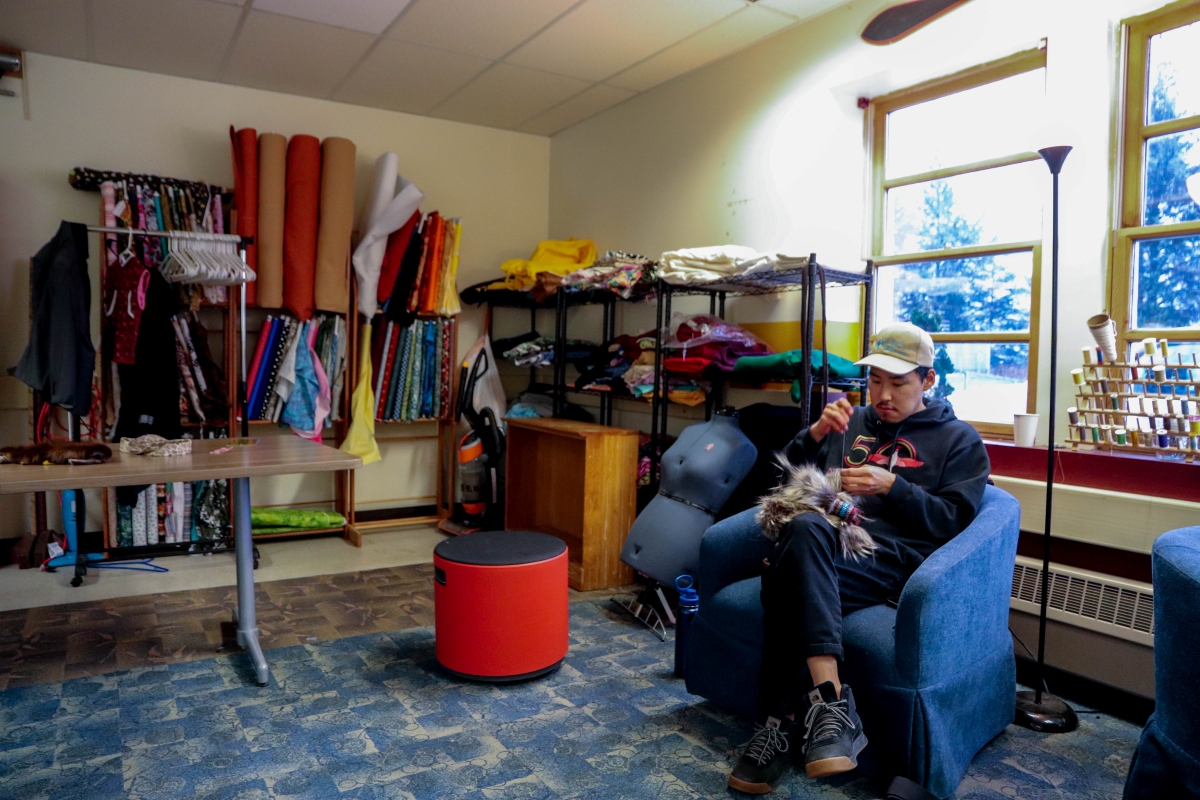
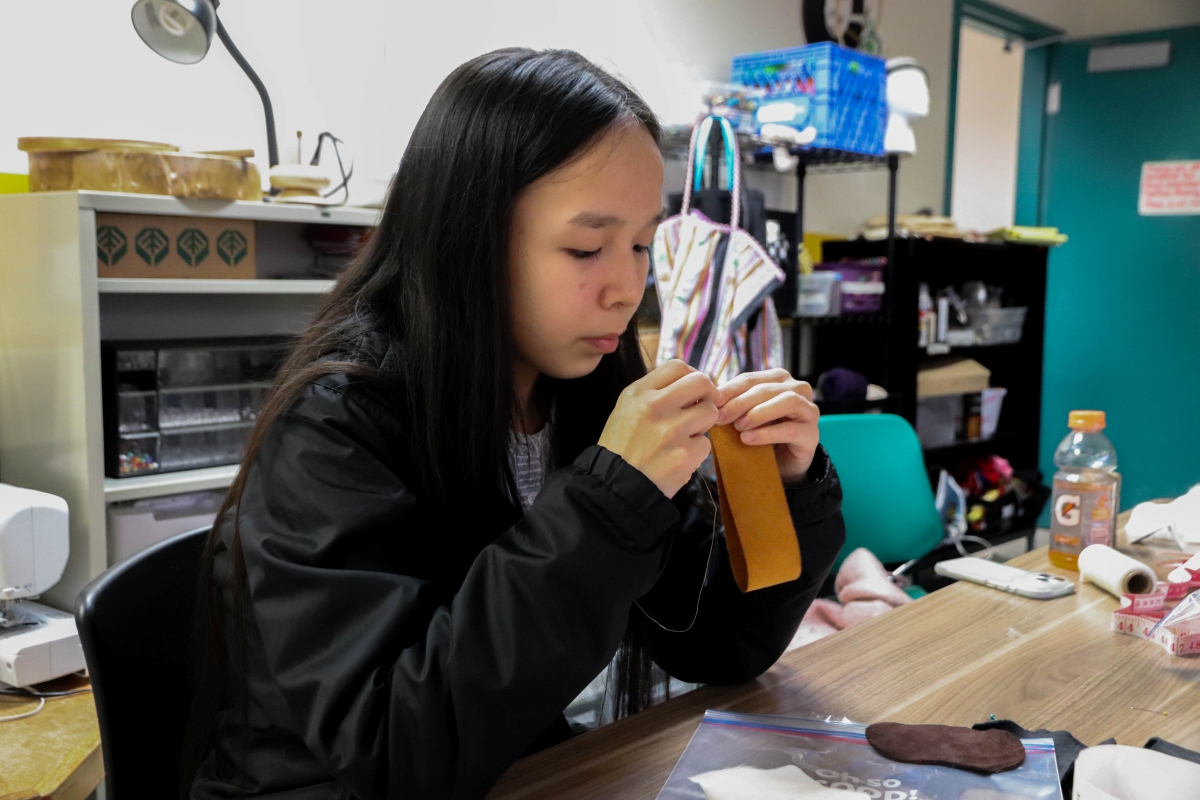
Flash forward to February 19, and Oscar is seated on one of two blue felt rolling chairs in Mt. Edgecumbe’s culture room, which was purchased from the MEHS Art Project’s Amazon wishlist after raising enough funds. New racks of fabric line up the walls besides him, alongside other donated arts supplies to keep students’ minds and hands busy. For the past three days, he has worked with students on how to sew baby boots, which Oscar says is a standard project for beginning skin-sewers.
While the students are hard at work assembling their boots, Oscar is working on a different project, sewing the final details onto dance headdresses for Mt. Edgecumbe’s Yup’ik dance team, an extra gift he is leaving behind for the students. This creates an opportunity for students and staff alike to learn some Yup’ik vocabulary.
One of his students, upperclassman Jubilee Lewis, hails from Kwigillingok but grew up mainly in Anchorage. Having attended every one of Oscar’s sessions, she says she’s found it comforting to hear Yup’ik again, as well as being able to do cultural activities she hasn’t had access to.
“I really enjoyed [the class],” said Lewis. “I grew up listening [to Yup’ik]. My family is fluent in Yup’ik and I’m just comfortable and I feel more connected to my culture as well, because I didn’t do this a lot, and this is a really great opportunity to start.”
As somebody who also attended school outside of home, Oscar can relate to students’ sense of homesickness. A key way that Oscar coped with that was through engaging in cultural arts, which also helped him move through mental health struggles like depression and anxiety he faced as a teenager.
“That’s one of the things that I want the students to know is that cultural arts is one of the forms that can help one,” said Oscar. “Being connected with cultural arts is an important factor, because it’s helped us through hardships. It keeps our mind away from negative thoughts.”
Similarly, Johnson-Yellow Hawk found cultural arts to be a powerful healing tool for herself.
“Beading got me sober like six years ago. Culture and Art was a safe place for me before, until I can learn to be a safe place for myself,” said Johnson-Yellow Hawk. “You have to be very present while you’re doing it. And sometimes that helps take you away from some bad thoughts. And it helps a lot. So, it feels good to accomplish and complete something, and to kind of see your progress as you go along and as you get better.”
Since the MEHS Arts Project first launched, Johnson-Yellow Hawk has been deeply touched by the community support so far, both in Sitka and beyond, from donating to their Amazon wishlist to dropping off traditional foods like herring eggs.
“It’s been a real joy for me, because healing is community, and I’m getting the opportunity to watch communities come together, not just locally, but I’m watching it region wide,” said Johnson-Yellow Hawk. “I’m watching different regions start to show up and be like, ‘No, no, we want to be a part of this.’ And that’s been really exciting for me.”
The MEHS Arts Project team is currently reaching out to Inupiaq artists to bring their own unique wisdom and skillsets to the community, but they are open to working with artists from all Alaskan regions who wish to help however they can. However, Yellow-Hawk hopes that the future of the program is fully determined by student feedback, which they have continued to gather through surveys and in-person conversations.
Editor’s Note (2-27-26): An earlier version of this story stated that CeeJay Johnson-Yellow Hawk graduated from MEHS in 2004. This story was updated in that she actually did not graduate from there, but was a student from 2001-2003.