“She’s adorable. You’re gonna fall in love. It’s kind of hard not to,” says Maia Carter, the Curriculum Coordinator for the Sitka Sound Science Center. She leads me down the stairs to show me the aquarium’s newest resident. Foreshadowing lines the hall on the walk over, from newly purchased octopus plushies on the merchandise table, to a whiteboard attached to a door sharing the Lingít word of the day “Naakw,” which is translated by the adorable octopus drawing below it.
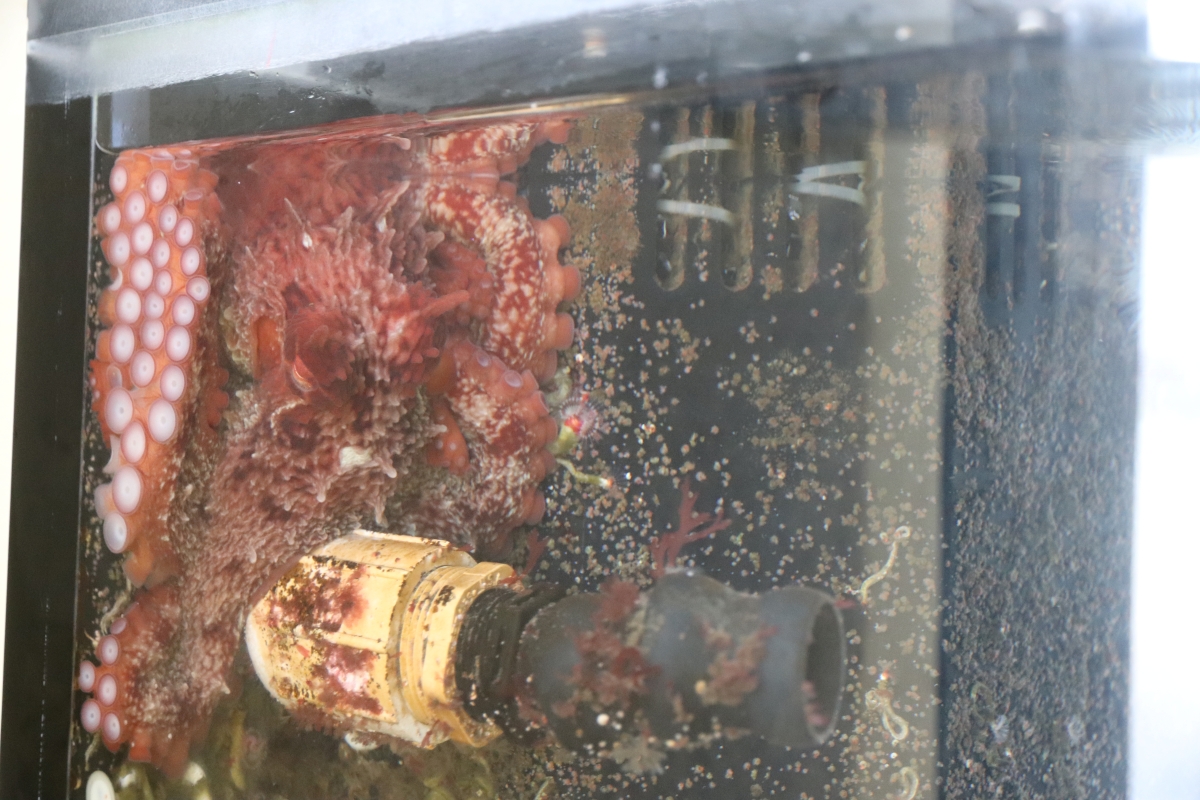
The red and beige giant pacific octopus sits on the rocky wall in the oval tank farthest from the aquarium’s entrance, elevated from her tank mates. Her suckers stick on the glass to help her balance. Since her arrival at the Science Center in January , the octopus has grown to 12 times her initial size, yet she is still nowhere near as large as she will eventually become. An adult giant pacific octopus can have an arm span of at least 15 to 16 ft.
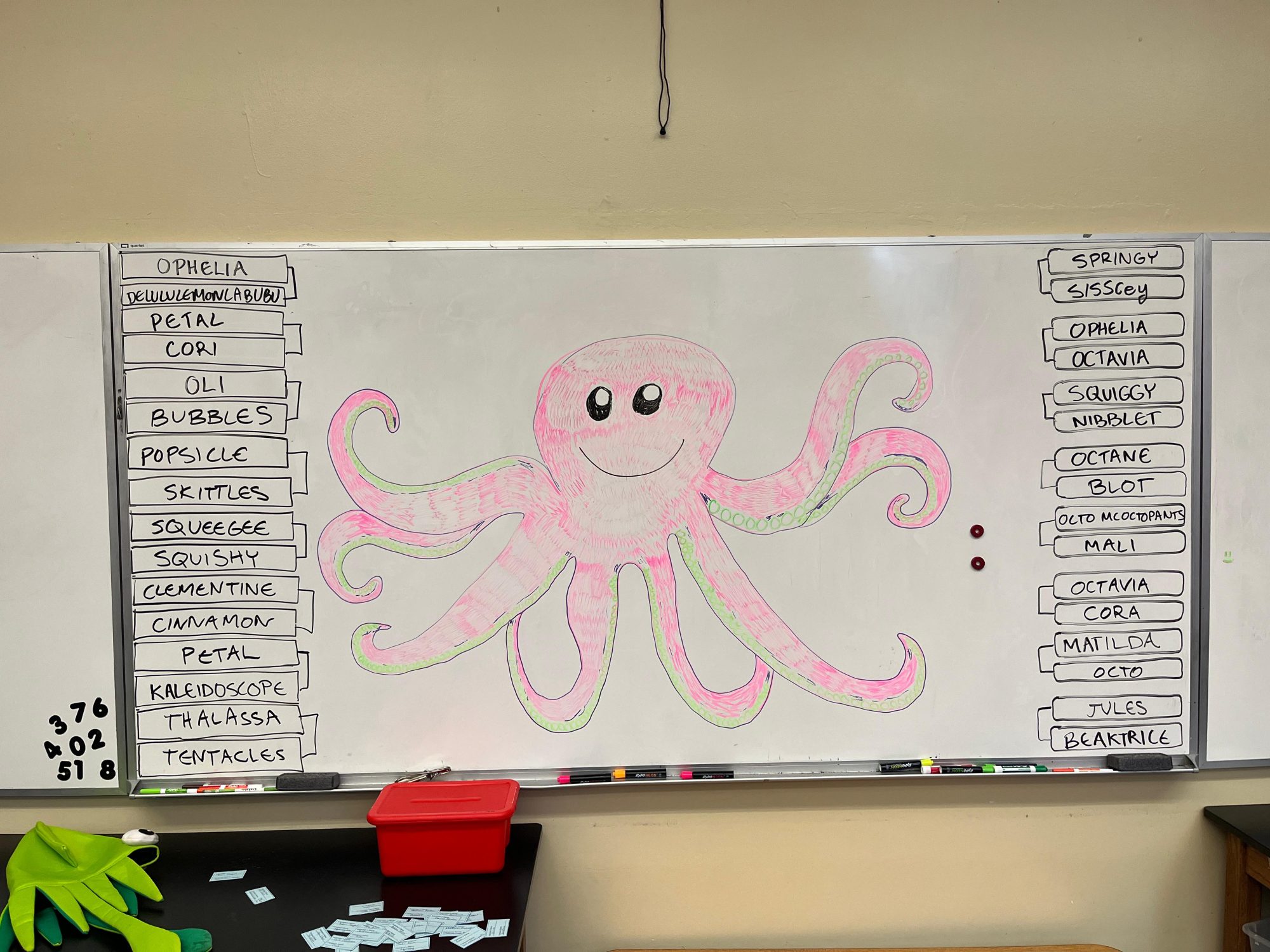
For the past few weeks, the Science Center has hosted a voting-bracket contest to determine what the octopus will be named. 32-randomly selected names from donors, staff, and programming participants were listed for participants to vote off one-by-one. For aquarist Matt Wilson, it was very fulfilling to see how excited Sitkans were during the whole process.
“It’s been really fantastic seeing the community engagement and people stopping me on the street to be like, ‘What’s the bracket this week?’ ‘What’s what’s your pick?’ ‘What’s going on?’,” says Wilson. “Everybody always wants to know, and that’s been fantastic.”
The final showdown came on March 4th, when Sitkans were faced with the top two contenders: Clementine vs Matilda. Carter was pleased with the finalists that Sitkans chose, with each name encapsulating a different valued trait of the octopus.
“Clementine, I think represents how adorable she truly is and what a delight it is to be able to see her and interact with her,” says Carter. “Matilda, I do think, represents her sassier side, or her more stubborn side.”
Carter says that there was a 50/50 divide amongst staff as to which name they hoped the octopus would get. As somebody who has worked closely with the octopus since her arrival at the Science Center, Wilson was firmly on Team Matilda, as he felt the name best captured her “troublemaker” personality. Additionally, the name carries a lot of sentimentality to him.
“That name was pitched by our our aquarium science club, and so that was really nice for us, just because I would love to see those students to be able to get a little bit more out of their time here, even though they’ve spent a lot of time here already,” said Wilson.
As for the final result, with over 100 voters contributing to the final poll, it was a roughly 60%-40% vote in favor of Clementine.
“We’re very excited that she has a reasonable and cute name,” says Carter. “And we’re excited to post it on signage and let people who visit the aquarium know that this is the name that the community chose for this octopus.”
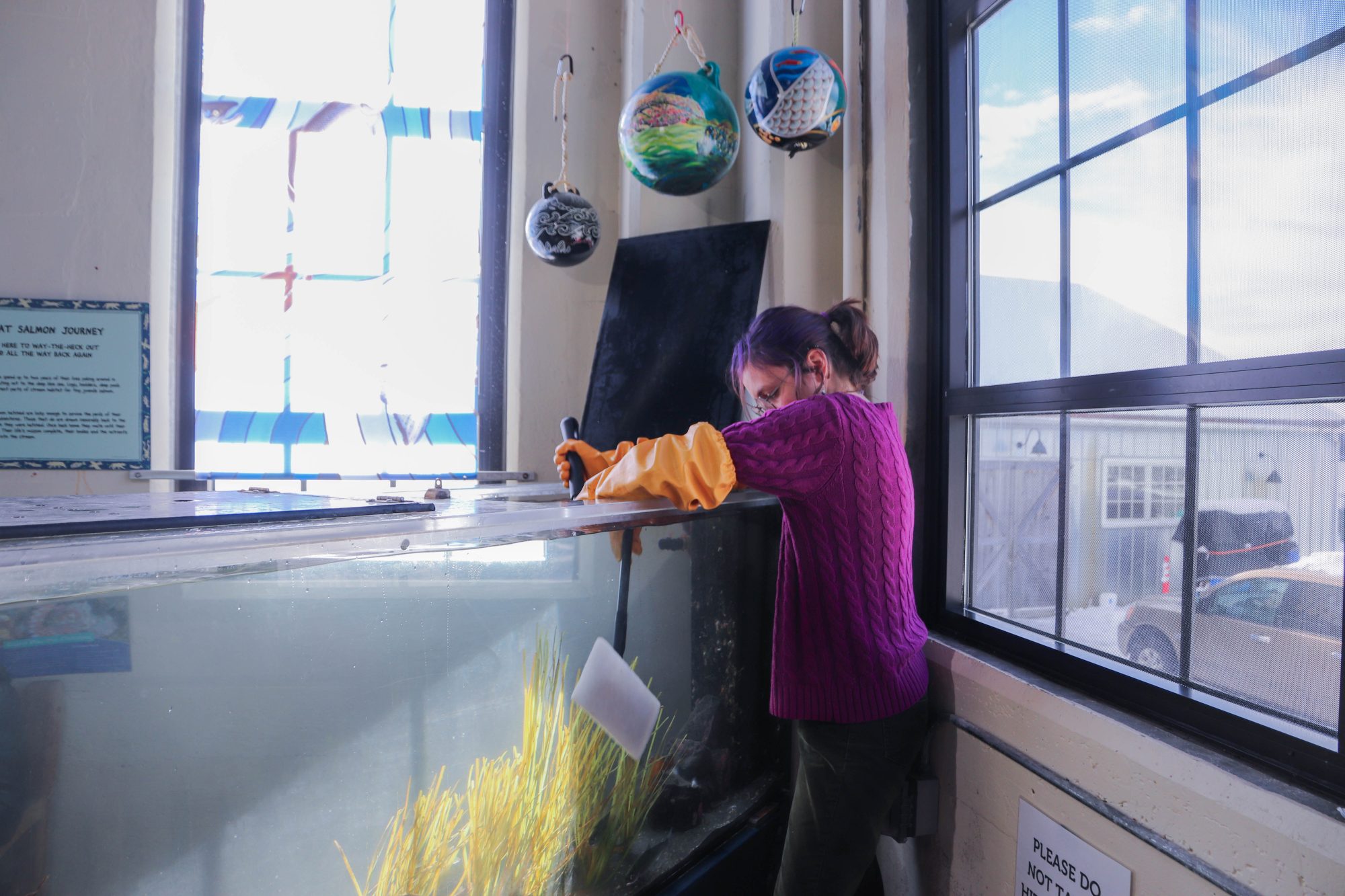
Next to Clementine’s tank, Jesuit Volunteer Stephanie Morris is siphoning the aquarium’s interactive touch tank, filled with a variety of friendly starfish and sea urchins. Morris regularly interacts with Clementine through the education programming they help run, as well as visiting her during their personal time. Given their work with the aquarium science club, Morris was on team Matilda, yet they have a lot of hope for Clementine’s future with her new name.
“We associate that octopus feel emotions very differently than humans, but orange is their happy color, that orange or red,” says Morris. “So hopefully she’s a happy octopus.”
While Wilson didn’t get the outcome he was hoping for, he is glad Sitkans were able to make their voices heard throughout the voting process. Looking ahead to the future, Clementine is going to continue rapidly growing, and will be moved to a larger tank. And while she will eventually grow to a point where she will be released back into the wild, Science Center staff are excited to continue welcoming visitors to meet Clementine and to engage more with learning about octopuses and the qualities that make them so unique.
Editor’s Note (3-13-26): Headline has been updated to reflect how octopuses have arms rather than tentacles