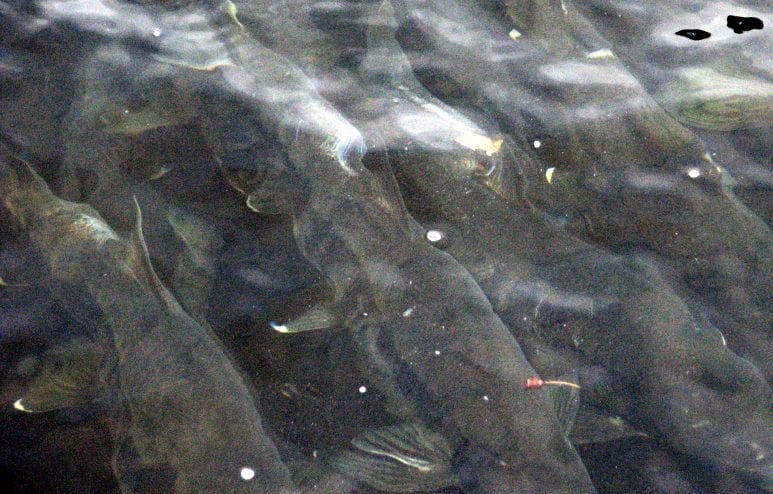
The Alaska Board of Fisheries last weekend voted down three proposals to limit hatchery production of pink and chum salmon. Those hatcheries are mostly in Southeast Alaska and Prince William Sound. They’re run by private nonprofits, and the state manages their permits.
There are currently 11 hatcheries permitted to take 1.39 billion pink salmon eggs and 15 hatcheries permitted to take 939 million chum salmon eggs.
The Fairbanks Fish and Game Advisory Committee sought a 25% reduction in egg production per hatchery permit. That’s a proposal that they’ve recommended before.
Board of Fish member Mike Wood of Talkeetna discussed the pros and cons.
“By cutting 25% of hatchery production in areas like Prince William Sound or Southeast, is the squeeze worth the juice with the impacts that it would have on these small boat fishermen, on an industry that we really need to rely on in this state?” he asked.
The board decided ‘no’ and rejected the proposal 6 to 1.
Board members heard oral testimony from about 150 people over five days and received nearly 1,000 pages of written testimony.
Two other proposals to limit pink and chum hatchery production came from the Kenai River Sportsfishing Association. Kevin Delaney, with the group, said they’re concerned that hatchery salmon compete with wild stocks. A study from 2023 suggests there may not be enough ocean food for all of them.
“We believe it’s overwhelmingly on the side that there are impacts to wild stocks as a result of the magnitude of hatchery production in pink and chum in Alaska,” Delaney said.
One of the group’s proposals targeted hatcheries in Prince William Sound, which failed 1-6. But another proposal triggered a split vote, and a lot of discussion. It would’ve capped pink and chum salmon permits at last year’s levels, by limiting egg take at those hatcheries. Advocates said this would allow the state time to further investigate if hatchery pinks and chums affect wild stocks, and by how much.
Board member, Olivia Henaayee Irwin of Nenana, supported the proposal, saying it would give the state time to research the “potential problem”.
“There is no definitive proof that our wild stocks are not being adversely affected or impacted by hatchery fish,” she said.
But the proposal ultimately received no action by the board with a vote of 4 to 3, meaning it doesn’t advance.
Fish and Game opposed all three hatchery proposals.