It is the week before spring break at Pacific High School in Sitka, and a handful of students are scattered across different tables in a classroom, hunkered down in their final projects. While students often find themselves polishing up their final essays or posters, these teens are working on a different assignment: original comic books.
Sophomore Sydney Lindstrom is making her way through a stack of completed comic spreads.
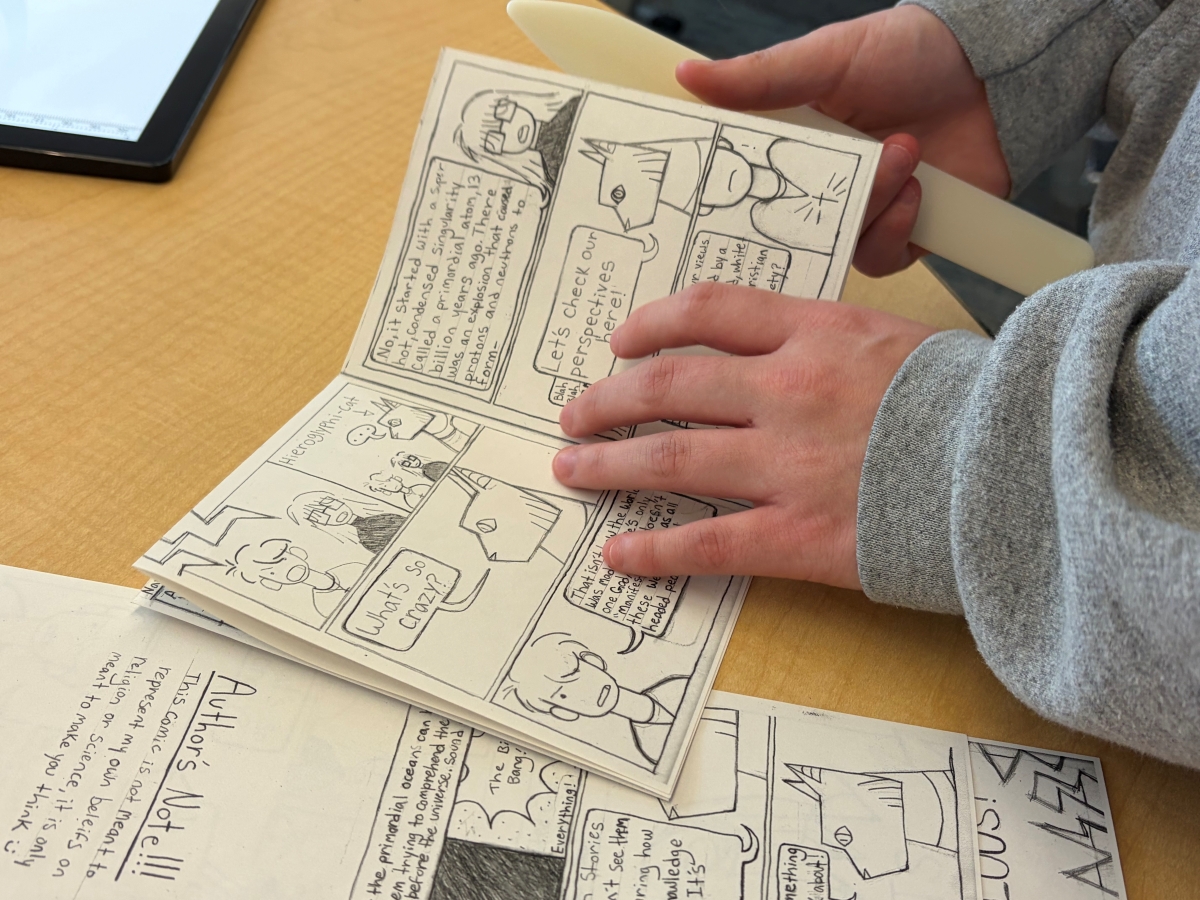
“I’m working on folding my comic because it’s in a zine format,” she says. She layers the printed pages on top of a tablet illuminating pure light to help her straighten out her lines while she folds each paper into a pocket-sized magazine. Her comic summarizes creation stories from various cultures and compares and contrasts them to Western scientific theories she learned about in her physical science class.
Until now, Lindstrom only dabbled in illustration, usually characters from her favorite tv shows. But branching out to a whole comic in a new style was a fun challenge.
“It’s like a style that I don’t really ever draw in. It’s not my style really at all. But it was interesting to try out the new style,” says Lindstrom.
It is this very exploration of ideas and stepping out of one’s comfort zone that English teacher Tristan Guevin hopes to instill in his students during the course.
“Oftentimes, graphic novels and comics aren’t necessarily seen as literature, but if you read them, you analyze them in the same way you would analyze a novel or, you know, a non fiction book. There’s so much richness there,” says Guevin. “Just a great medium for students to explore ideas, to learn about other people, other cultures, times, events, and so I think they’re just really, really accessible and just enjoyable.”
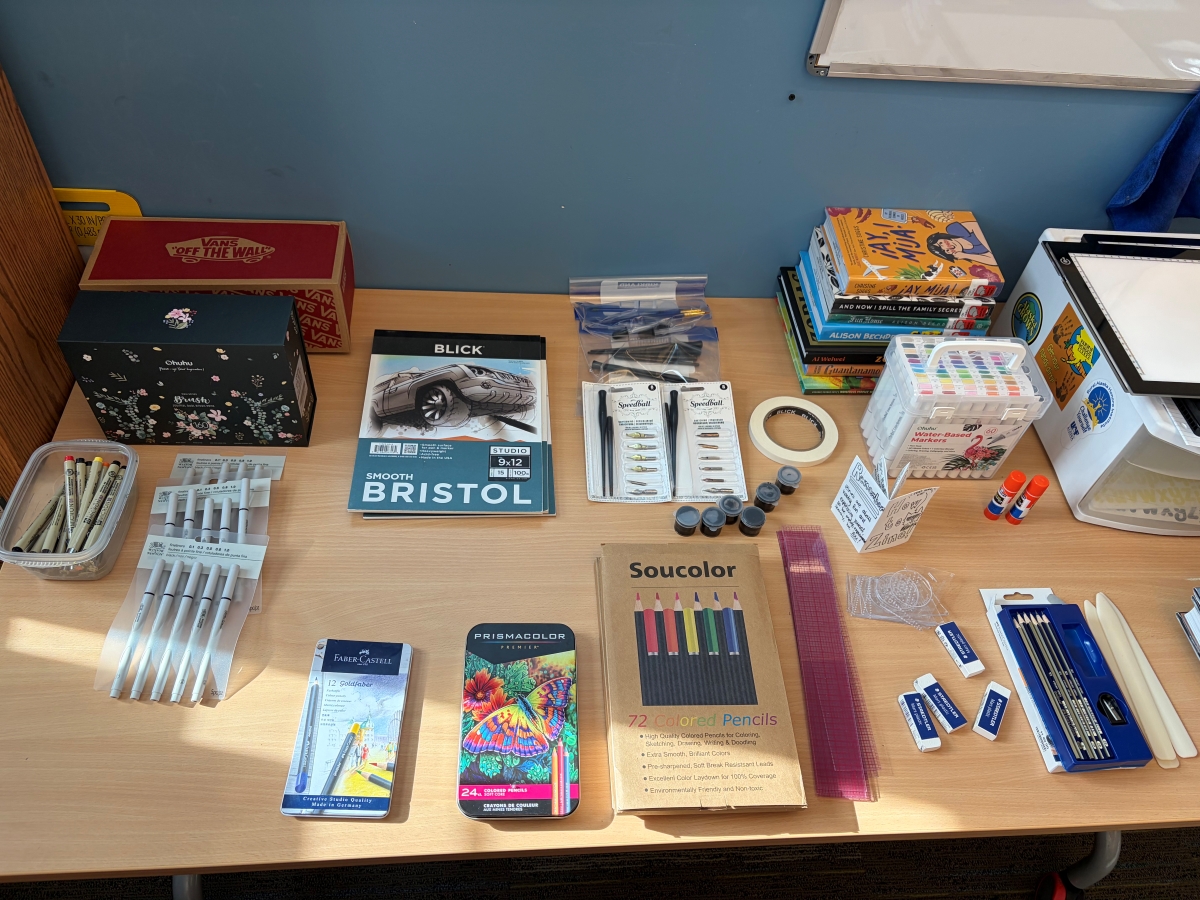
While this is Guevin’s second year teaching the comics course, it is the first time a guest artist helped lead the class, thanks to an Artist in Schools grant from the Sitka Fine Arts Camp, Sitka Public School District, and Alaska State Council of the Arts. The artist in question is Medar de la Cruz, a Pulitzer Prize winning illustrator and comic artist who taught art in Sitka before through the Fine Arts Camp. Chatting over Zoom from his home in Brooklyn, de la Cruz fondly recalls the first day at Pacific High, when he revealed the wide variety of art supplies he gifted to the school, including Lindstrom’s light-up tablet.
“It was really cool to just watch everybody sort of flock through the materials and start using them. It’s a really exciting thing, and it reminds me of my first time,” says de la Cruz. “Every time I come home from the art store… It’s almost like Christmas, and you just really can’t wait to to play with the tool and see what it does.”
As he got to know the students throughout the residency, de la Cruz grew increasingly impressed with how knowledgeable they were about nature and global politics, with the students studying the autobiographical graphic novel Persepolis, which recounts author Marjane Satrapi’s life in pre-and post-revolutionary Iran.
“I don’t know if the average kid would would have these sort of insights on the book. And I really appreciated that,” says de la Cruz. “I noticed that they are very well connected to current events, probably because of Tristan’s guidance, who chose a book, for example, in this situation, about Iran during a war in Iran, or during conflict in Iran.”
Still, de la Cruz said it took a bit of work to bring students out of their shells. He recalls leading them in an activity where they passed illustrations around the room at random, and each artist added something new such as dialogue or another panel. It’s typically a quiet exercise, but making it more conversational allowed students to open up.
“And there was a much more organic approach in this sense. And there was a lot also a lot more laughing and a lot more fun being had than any other time that I’ve ever done this workshop,” says de la Cruz. “So it really gave me an opportunity to reconsider how I go about this in the future.”
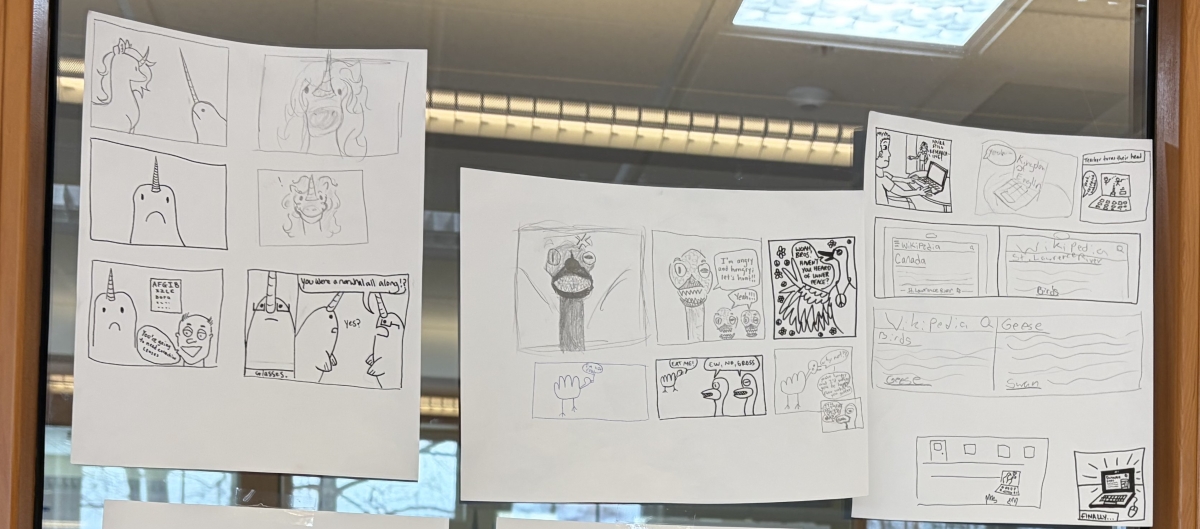
Today, those comics are proudly displayed on the glass walls of the classroom, with different drawing materials and art styles coming together to tell a wide variety of chaotically imaginative adventures, like the origin story of a swan and goose hybrid known as the “swoose”, which became a running classroom gag.
Guevin says the collaborative comic writing encapsulated the spirit of de la Cruz’s residency.
“It was such a great experience. For me, and a collaborative one where students were able to be creative and express themselves through both art and narrative,” says Guevin. “And so I think that’s something that I take from this class, and I hope to build on, is just that kind of spirit of collaboration and creativity.”
Guevin and de la Cruz are planning a second iteration of his residency for the course next year. More than anything, de la Cruz hopes the course will help students gain greater comic and graphic novel literacy.
“Regardless of if they actually walk away with a desire to make comics, I really want them to walk away with a desire to read them more. And I think that’s the biggest distinction between the two right there,” says de la Cruz.
As Lindstrom folds the last of her comics, she says de la Cruz inspired her to elevate her artistry.
“He was really good at free-handing his comics, which was surprising, but I want to try and do that more,” says Lindstrom. “I’m more interested in just getting into comics, because this was my first time making like a legit comic, and it was really enjoyable, and I want to try it again.”
Lindstrom has already given some of her comics to her teachers, but soon plans to distribute her latest completed ones to her family. She says she’ll keep at least one for herself too, and in the future, who knows how many more stories will stand beside it.