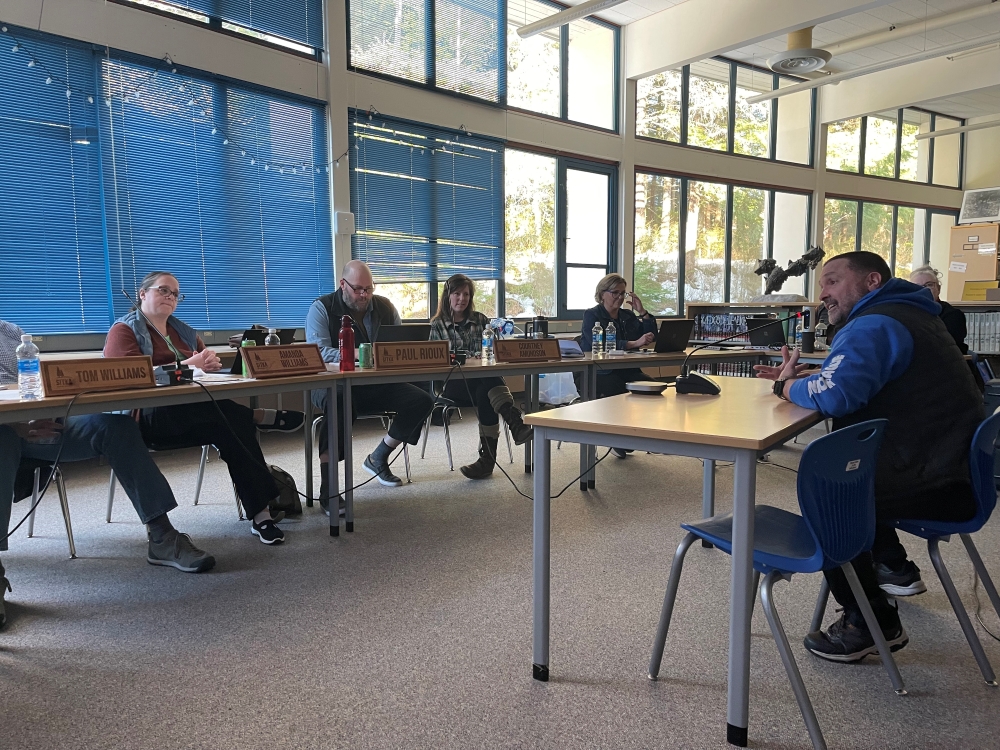
Sitka school leaders say the budget scenario is worse than they thought, which could lead to a reduction of up to 16 staff, depending on which budget scenario the Sitka School Board ultimately chooses. While the board did not make a decision at its meeting on Wednesday (4-1-26), the message from the audience was clear.
The Sitka School Board is staring down the barrel of a budget deficit next school year that has continued to grow.
At a meeting on April 1, the group considered three possible scenarios that would leave them with a balanced budget. The plan with the most severe staff reductions would cut 16 staff, including 10 teaching positions. The best case scenario for staff would still cut 12 positions. Some of those cuts would be teachers who are already retiring, but their positions would not be refilled.
School Board President Phil Burdick said the situation was “dire” no matter what they choose.
“We have no money. There is no money coming from the state. All scenarios look like we can either spend down our fund balance and all of the Secure Rural Schools we think we’re going to get, and the Secure Rural Schools money we have,” Burdick said. “And if we don’t, then we are going to cut deeply into staff. That is a super rough synopsis. No money, staff cuts.”
Cutting more positions could mean keeping some money in savings, depending on how much the district receives in federal Secure Rural Schools money–that’s a federal program that supports schools surrounded by federal lands which don’t contribute to the local tax base.
The budget deficit is worse than what was presented to the board a little over two weeks ago. At that time the district anticipated a status quo budget would leave them with a deficit of between $1.2 and $2 million, depending on whether the district’s health insurance costs increase.
But since then, district staff discovered a “significant error” in their accounting spreadsheets to the tune of around $800,000 in unaccounted for expenses. Superintendent Deidre Jenson pointed to several reasons for the error – a late audit, a rushed budget process, and historical knowledge lost from staff turnover, as well as an antiquated budget system on an Excel spreadsheet.
“[In the] hurried process, then things get missed a little bit. We don’t double check quite as easily or thoroughly. And that’s where some of this has come up,” Jenson said. “[A] hurried process just makes for room for errors.” She said the district does not have an accounting system that actually helps build the budget, and investing in a new program would prevent issues like this from occurring in future years.
The news leaves the district with even less wiggle room in the budget for next year. Sitka’s assembly has already committed to fund schools to the cap or maximum allowed by state law, plus additional non-instructional funds. The district had already instituted a spending freeze, and is anticipating some savings from that- all scenarios suggest spending the full amount, around $500,000. So the question now is whether to spend most of the money the district anticipates it will receive from Secure Rural Schools. The federal funding pool that could be as much as $1.7 million, but 2025 and 2026 disbursement amounts are not yet confirmed, and are still subject to assembly approval.
Educators and administrators advocated on behalf of their schools to the board, calling for them to choose the scenario that cuts the fewest staff. Many, including Blatchley Middle School science teacher Alex Dailey, said more cuts just weren’t sustainable.
“If you look in the last 12 years, you’ve gone from over 100 teachers to 66. You know, that’s a third of the colleagues that I work with,” Dailey said. “I started in 2020, and the number here was 94 when I started. That’s a third of the people that I’ve worked with that I’ve seen go.”
“To cut us down is going to be brutal for our kids. There’s hope on the horizon. We don’t know who the governor is going to be next, but it’s guaranteed it’s going to be friendlier to education, whoever it is,” Dailey continued. “Please, hold out, until then for us and for our kids”
Some board members, including Paul Rioux firmly opposed the scenario that would cut the most staff.
“I’m definitely a hard no on one, and I think that it’s irresponsible for us to not take a look at if we have another $700,000, what would it be possible to keep,” Rioux said.
Keet Gooshi Heen music teacher Susan Brandt-Ferguson said the board should spend the money now and not save it for a rainy day.
“So you might think that it’s risky business to maybe be short on the expenses…It’s risky to not keep these teachers,” Brandt-Ferguson said. “Please understand budgeting with a school district is so different from budgeting for a family, budgeting for a business, budgeting for an assembly. We can’t make money. We are always at the mercy of someone else, and so all we can do is spend the money that you have, or that you think you probably will, maybe, hopefully have. That’s your job. Please spend it.”
But board member Tom Williams felt the opposite approach was the risky one.
“What’s the risk of funding a school year, and we don’t have the money to finish it, and those teachers don’t get a paycheck after December? Is that more of a risk than being conservative and funding what you have?” Williams said. “[If] the money doesn’t come in, what’s the impact to that family? I think it’s worth being honest up front with what you have, not necessarily what you hope to get.”
Both he and board member Amanda Williams voiced discomfort with building a budget on Secure Rural Schools money the district has not received yet.
More numbers are still up in the air, like where health insurance costs will land. The board did not make any decisions at its meeting, and agreed to meet again on April 23 to discuss the budget further. The board is required to finalize its budget and submit it to the assembly by May 1.