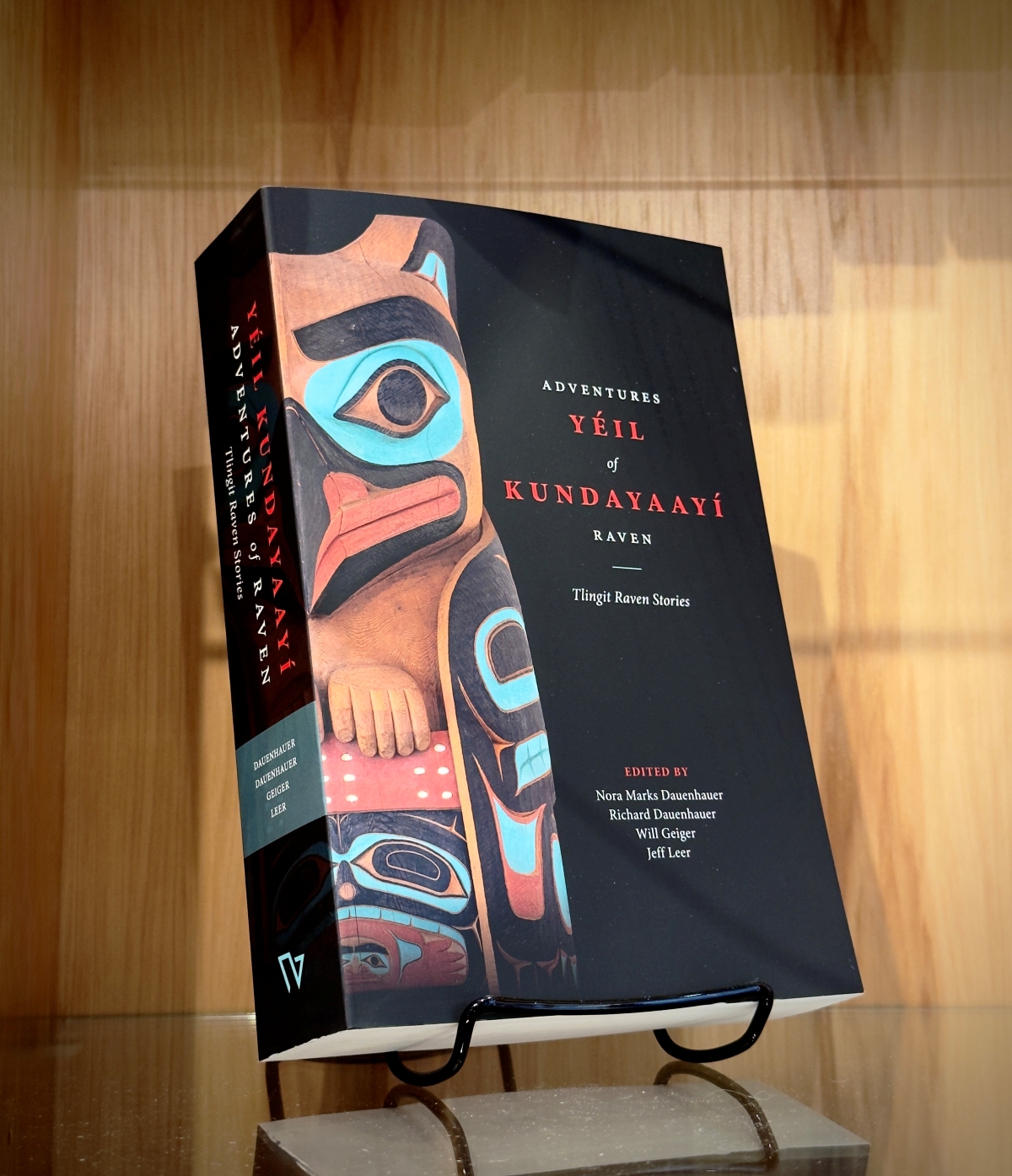
Nonprofit tribal organization Sealaska Heritage Institute has published a new book that presents Tlingit Raven stories for the first time in the original language with English translations.
The 860-page volume brings together 50 stories by seven Tlingit storytellers born between 1870 and 1915 across Southeast Alaska. The stories were transcribed from recordings of oral performances and include some of the oldest known recordings of these stories told in Lingít.
75-year-old Ḵ’ashgé Daphne Wright grew up listening to her aunt, Katherine Mills, tell her stories of Raven, a cultural hero, world-maker, and trickster figure among the Tlingit of Southeast Alaska.
“I can just remember we’d be sitting in the kitchen, around the kitchen table, and it was maybe in the evening, with everyone just kind of sitting around and just listening,” Wright said. “[It was] kind of a warm feeling, just listening to my aunt’s voice.”
Growing up, Wright spent school years in Juneau and summers with her family in Excursion Inlet, a cannery near Hoonah. Her mom and aunt spoke Lingít with her grandmother, but she says she and her sisters and cousins never learned.
Wright says reading this book, which features stories from her aunt who was born in 1915 and died in 1993, is like hearing her aunt’s voice again.
“I miss her so much, and I miss my mother,” she said. “They were fluent speakers. They were the generation that went to school and didn’t know English. And so they suffered. They suffered greatly. That was the reason why their kids grew up not speaking. And we never thought about it. We never said, ‘Teach us Lingít.’ We were just kids. We just ran around. And so it just means so much that there’s something here and an actual physical book that has her stories in it.”
This volume has been more than four decades in the making. It’s the fifth in a series of books from Sealaska Heritage Institute called the Classics of Tlingit Oral Literature, and is the first in the series to be exclusively focused on Raven.
Will Geiger is a research specialist with the Southeast nonprofit, and has been working on transcribing, translating, and editing the stories for this volume since 2017.
“The intention of this series is to present standout examples of the Tlingit oral tradition in a written form that gives them a pretty high level and serious treatment, so that people, whether you do speak Lingít or not, you’re able to appreciate the depth and the artistry and the history and the richness of ideas that have been carried through the Tlingit oral tradition,” Geiger said.
This book features a transcribed version of the original recording on the left hand page that tries to reflect exactly what was said and the rhythm in which it was said. Featured on the facing right hand page, there’s an English translation.
Geiger says Raven is probably the most highly developed character in the Tlingit oral tradition, with stories ranging “from the sacred to the scatological.” In one story, Raven steals the sun, moon, and stars to bring light to the world. In another, Raven constantly bothers an octopus digging for clams. She finally grabs him with her arms and holds him underwater, where he almost dies and learns his lesson about disrespect.
“Mostly, he appears in the form of a person,” Geiger said. “And he can change forms. At minimum, he’s a little rock, a person. He puts on the skin of this kind of snipe-like bird with a long bill, and flies around like that. He turns into a woman, a little hemlock needle. Oh, and a raven. He turns into a raven too.”
Geiger says while there’s a long paper trail of writings about Raven, up until this book, they’ve all been in English, with the exception of a paperback from the 1970s from Tlingit Readers, Inc. that was published only in Lingít to be used by those who already spoke and understood the language.
“That is the one text I believe in all of history until this one, to actually reflect a Lingít Raven story as told in Lingít by a Lingít person,” he said.
For Lgeik’i Heather Powell Mills, a Lingít language teacher in Hoonah, hearing or reading these stories in the original language leads to deeper understanding. And now, she says, people will get to experience these stories from the mouths of their elders long gone, with the same cadence and the same emotion.
“Hearing our language is like medicine to us,” she said. “And hearing the stories of creation helps us to better understand and explain to our children how important it is to coexist with the animals, to have a strong connection to the land, to understand where you come from, in order to know where you’re going.”
Mills’ great grandmother Susie James and her husband’s grandmother Katherine Mills are both included in the book. She says throughout her life, she’s seen many drafts, and she’s grateful people spent the time to sit down and record their elders’ stories so that they can be shared for generations to come.
“We don’t have the time we used to have to spend the winters together, sitting and transferring that knowledge,” Mills said. “I think this is a great way for us to learn, and to be able to not only learn with these wonderful, ancient ways of being, but learn through our language. It was their dream for us.”
The book, Yéil Kundayaayí, Adventures of Raven, is currently available through Sealaska Heritage Institute’s website. Geiger says they also hope to make the original audio recordings of these stories available in the near future.