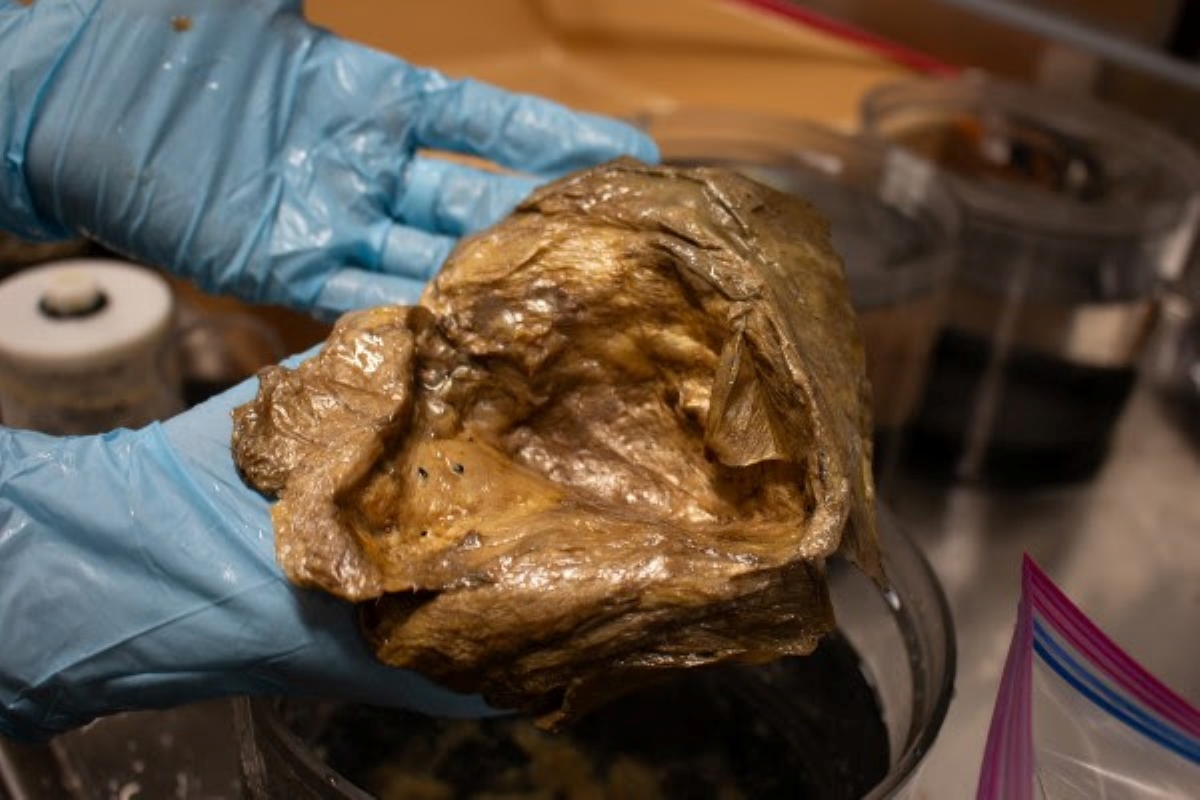
Remember that mysterious “golden orb” government scientists found at the bottom of the Gulf of Alaska in 2023? Was it an egg? A sponge? Remnants of a space alien?
Scientists were baffled. Two-and-a-half years later, they say they’ve figured it out.
So picture this. Some scientists aboard the research vessel called the Okeanos Explorer are huddled around a screen that shows a remote underwater vehicle prodding at a shiny, golden mass.
“I just hope when we poke it something doesn’t decide to come out. It’s like the beginning of a horror movie,” one scientist says. “I’m pretty sure this is how the first episode of the X-files started,” another responds.
The “golden orb” was discovered two miles deep by the National Oceanic and Atmospheric Administration research ship while mapping the ocean floor in the summer of 2023.
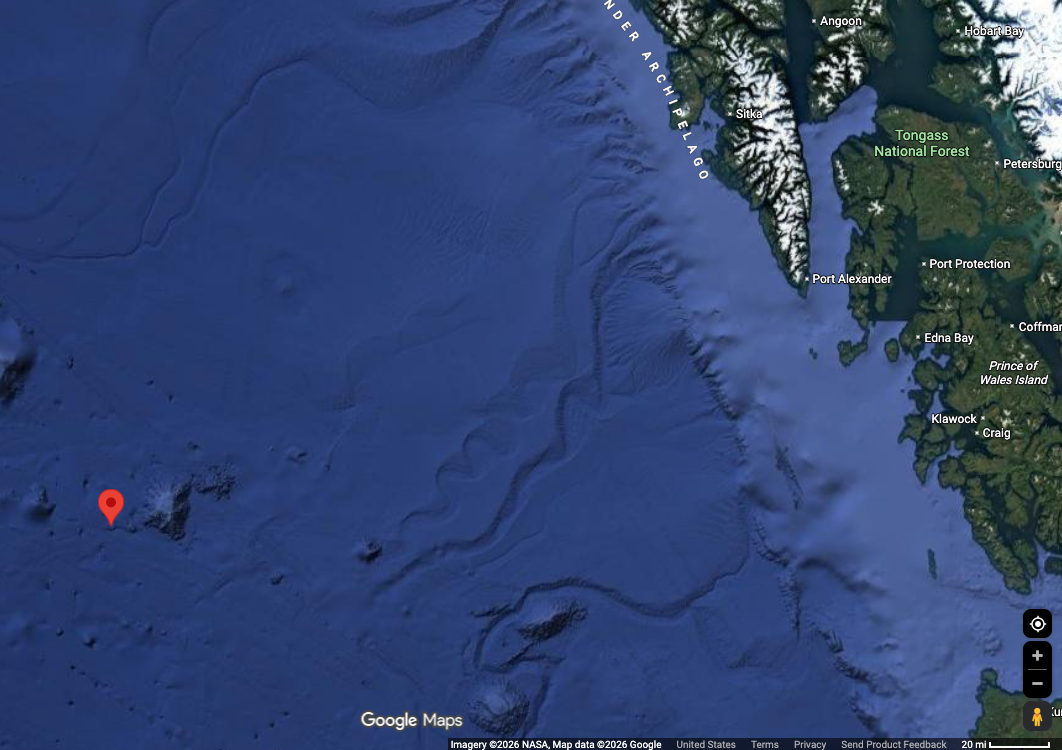
“There were jokes about it being a mermaid’s egg or things that also don’t make biological sense, like a dolphin egg or stuff like that. “I think there were some alien hypotheses too,” said Dr. Allen Collins, the director of the NOAA Fisheries Lab at the Smithsonian museum in Washington D.C.
He’s nibbled away at the mystery for two-and-a-half years.
“It just spawned all these kind of crazy ideas, and then media interest,” Collins said. “I was shocked, but it’s always nice when people are interested in the deep sea.”
Collins said the team on the Okeanos Explorer, as well as scientists all over, were baffled when they first spotted the four-inch-wide golden lump stuck to a rock. But they collected it for further investigation.
“That’s not the first time that people have been looking in the deep sea and said, ‘What’s that? I have no idea what that is,’” he said.
But, Collins said, it was a bit unusual how long it took to identify. It required what he calls “morphological, genetic, deep-sea and bioinformatics expertise” to solve. Eventually, his team was able to compare it to two other specimens collected by deep sea biologists in other parts of the world.
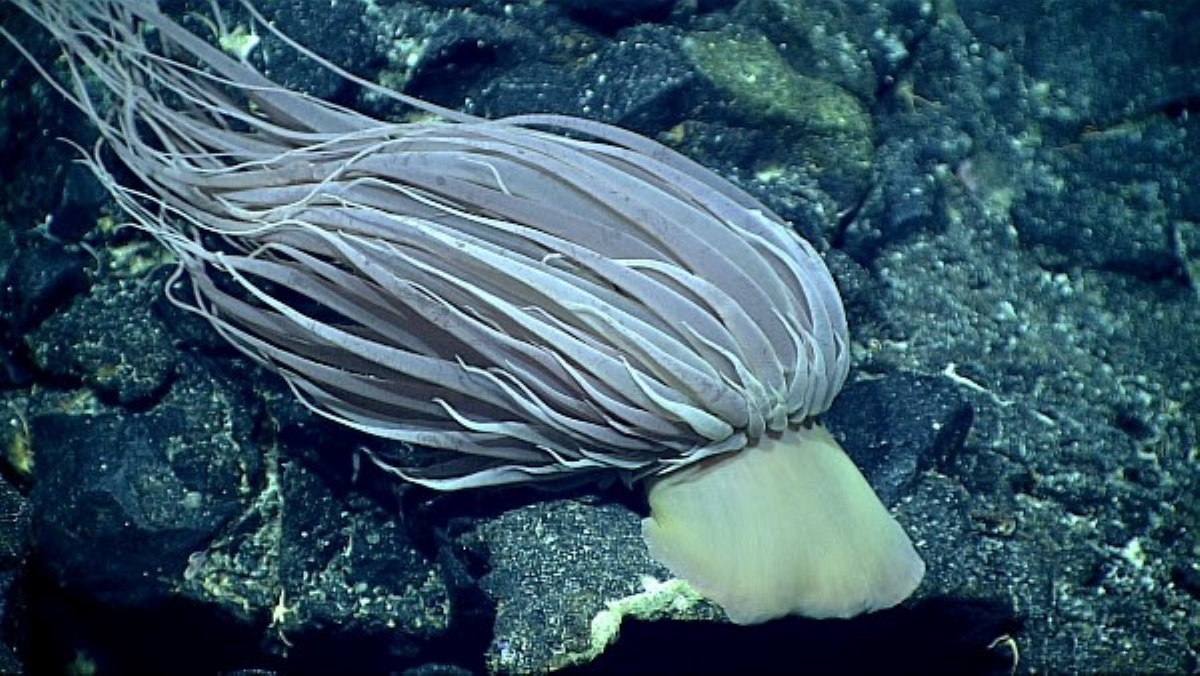
The conclusion? The “golden orb” is the base of a giant sea anemone called relicanthus daphneae. The anemones have a deep-colored trunk about a foot wide and pale pink and purple tentacles that can stretch up to six-and-a-half feet. Collins said scientists have documented about 30 sightings in the deep sea, from the Antarctic Ocean to the Aleutian Islands to the Central Pacific.
“If you look under the base of the anemones, and right on the side, often, you can see this golden colored cuticle sticking out from the bottom,” he said. “We were like, ‘It was right in front of us, kind of like the whole time. [We] never even noticed.’”
He was happy to finally solve the mystery, but also a bit disappointed.
“I was sort of like, ‘Oh, man, now no one’s going to care,’ because it’s not as interesting as a mystery,” he said. “Now, it’s an anemone.”
Collins said the discovery has opened up other questions about the species, like whether the golden base is related to reproduction, and whether the anemone died or let go and reattached itself somewhere else.
He said they’ve submitted a paper on the “golden orb” to a scientific journal for review. But the relicanthus daphneae is just one specimen out of hundreds he works to identify.
“What we want to do is contribute this and say, ‘Hey, let’s collect more of these weird things and see what they tell us about the deep sea.’”
Next on his plate? The formal scientific identification, naming, and documenting of a carnivorous sponge species and a new jellyfish species, also found in Alaska waters.