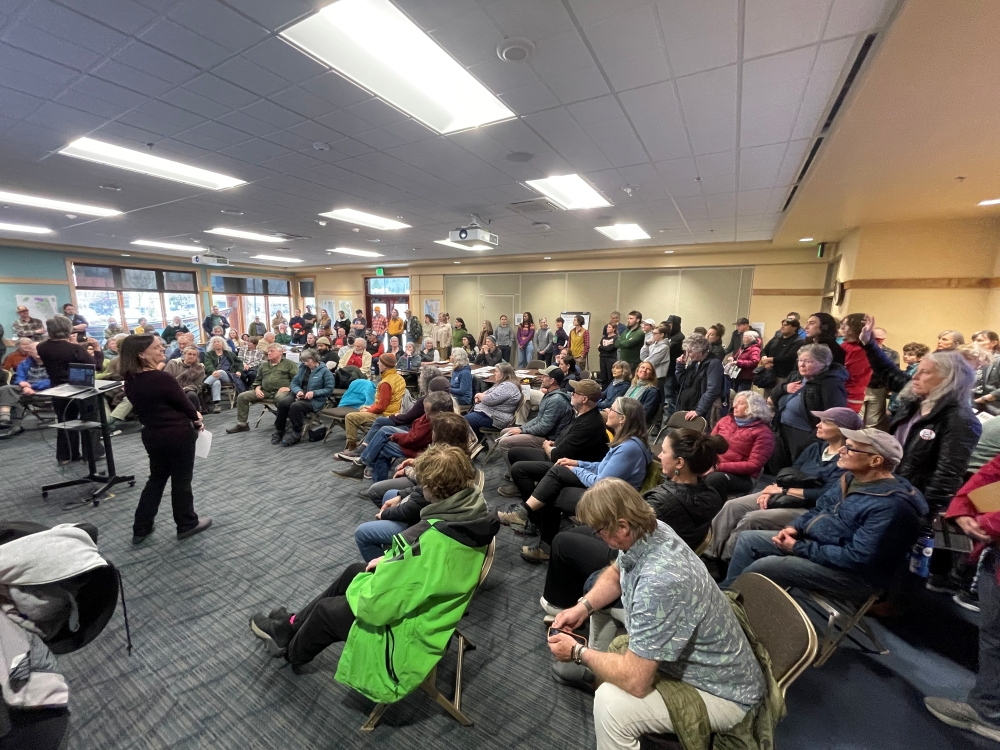
More than 100 Sitkans turned up at a community listening session earlier this week (4-27-26) to give input on the Tongass National Forest land management plan. For the first time in around 3 decades, the United States Forest Service is in the midst of revising the plan that shapes how the agency makes decisions on the forest. Some pushed back on the methodology and speed, as well as the proposed maps, which include designating parts of nearby Kruzof Island as “high commercial use.”
The room was so packed in Sitka’s Harrigan Centennial Hall, that some community members asked organizers to remove a temporary wall on one side to make more space. Folks squeezed in to share their thoughts on the land management planning process for the Tongass National Forest.
The draft plan is not out yet- that will be released later this year. But the Forest Service is looking for feedback on some preliminary content. Here’s Deputy Forest Supervisor Barb Miranda:
“I fully expect that our forest plan will end up not looking anything like the maps up there,” Miranda said. “We want to hear what you think about these ideas, and we want your reaction to them.”
Miranda noted posters lining the walls around the room that illustrate a potential “rezoning” of Tongass into fewer management areas. Some of the same designations like “old growth habitat” are still in use, along with some new ones, like “community use” and “high” and “low” commercial recreation.
“So how did we come about drawing these lines on a map? It was a geospatial exercise. Commercial recreation was only drawn for towns with large cruise ship docks, and the thought was that maybe we should, maybe, and these are all just conversation starters, maybe we should have some places where you can expect there to be high amounts of commercial recreation,” Miranda said.
There wasn’t an opportunity to provide public testimony at the event. Instead the audience was asked to share feedback through various surveys and activities set up around the room. Still, during a quick question and answer session after Miranda’s presentation, several community members raised concerns about the content that was shared. Some flagged the map designating parts of nearby Kruzof Island, the location of Mt. Edgecumbe volcano, as “high commercial recreation.”
Charlie Skultka Jr. wanted to know who made that proposal.
“My question, who did that? How do we find out who suggested that internally?” asked Charlie Skultka Jr.
Caroline Hodur reiterated his concerns.
“The reason why it’s so important is that we want to be comfortable with these decisions and who is driving them, because if there are groups who are driving them, that we all kind of know, then we also know that our opinions don’t matter,” Hodur said.
“And there’s groups that are even higher than the city and the state that are driving this deregulation,” Skultka said.
“So that’s that’s why we’re animated, because this is very, very important to us,” Hodur said.
Miranda said there was no outside influence on how the map lines were drawn.
“That was just like, ‘What can we put out there so that you guys can react to something?’ We got you here,” Miranda said. “If there is a place where…you want protected, then please. That’s what, exactly what we want to hear.”
Concerns were also raised about how Alaska fisheries were prioritized in the plan material – and about the speed and methods of the process itself. Tory O’Connell Curran said the maps should be born out of the community first.
“Could we just make a gray map for each of these communities, redo these community groups, and ask people, like Charlie, to draw the map that he would like?” Curran suggested. “And sure you’re going to have disagreements, but the final product of that map will reflect the actual community use and their concerns about fisheries, their concerns about surfing, their concerns about how we’re trying to get by in this changing climate.”
Miranda said they wished that was an option, but they’re on a tight timeline. Linda Behnken pushed back.
“Is it true, though, that you are moving this at a faster timeline than you’re required to by law? I mean, this is a rush job, right?” Behnken said. “And I think that’s what you’re hearing from communities. You’re pushing this through too fast, and these are huge changes being proposed, and our communities don’t want it changes way, and we certainly don’t want to be rushed through a process that has this big impact on our livelihood.”
Miranda said, “There are some things that are in our control and some things that are not.” But they want the public involved.
“I want you to continue to look over our shoulder, and we’re going to be as transparent as possible,” Miranda said.
The Forest Service will take comments on the draft plan’s initial content until May 6. The draft plan will be released in November, which will be followed by a 90 day comment window. The final plan will be released next summer.