Wielding a pair of large scissors, Sitka High School biology teacher Stacy Golden, encouraged by University of Alaska Southeast mascot Spike the Whale, cuts a ribbon made of paper circles.
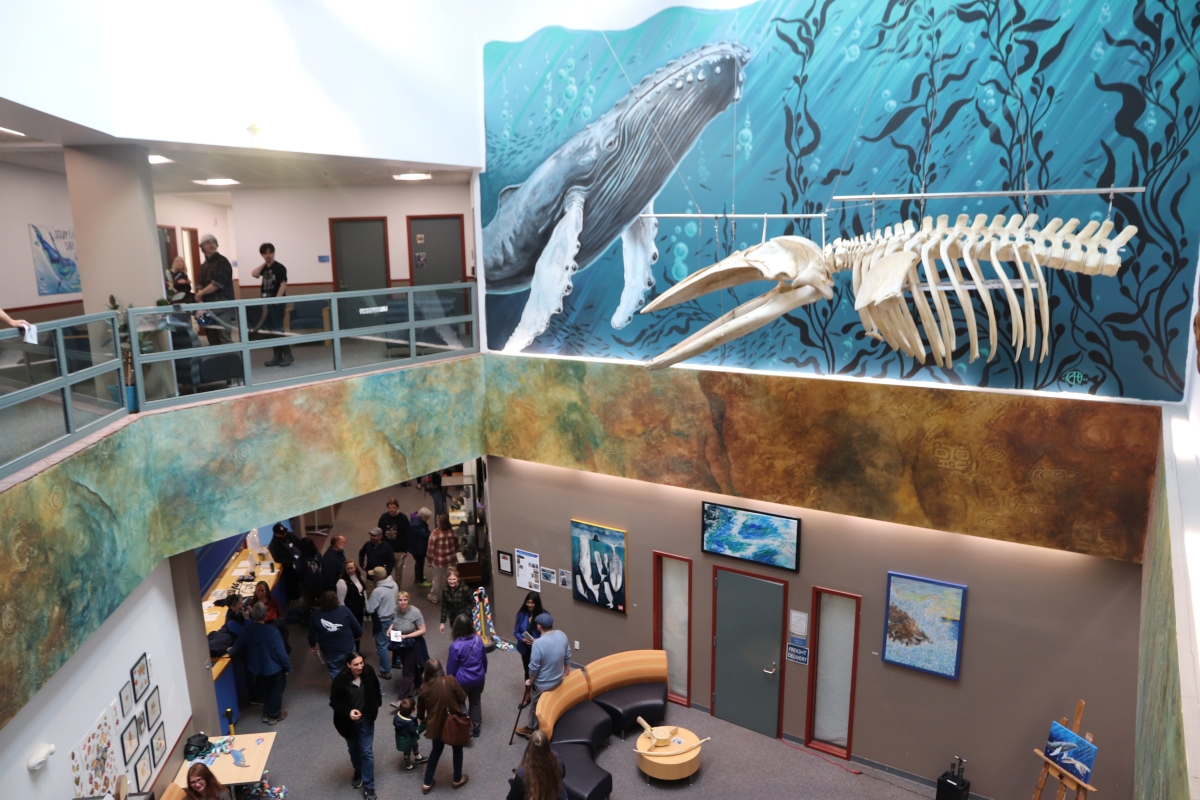
Over 100 attendees file into the atrium of UAS’ Sitka campus and crane their necks to look up at its newest permanent resident. Suspended from the ceiling is a skeleton of a baby humpback whale (sorry, Spike).
Golden co-led the process of rearticulating the whale’s skeleton alongside marine biologist Lauren Wild, an Assistant Professor of Applied Fisheries at UAS Sitka. The project began in the spring of 2023, when Wild told Golden about a dead humpback whale that washed ashore on Brent’s Beach.
“I just happened to mention if anybody was ever going to re-articulate a humpback whale, this would be a good one to do, because it was a small whale, and her eyes got really big. And I was like, oh no, that’s a lot of work,” says Wild. “And then standing next to her, Alex McCarrel, who was at the time at the Sitka Sound Science Center, her eyes also got really big, and she was like, ‘Oh, let’s do it!'”
Over the next few years, more than 700 volunteers, from whale experts to Golden’s own high school students and even tourists from the lower 48, assisted in assembling the whale’s skeleton. Experts helped guide the bone placement process, but first, the volunteers had to brave the whale’s “pungent marine oil smell” as they cut out the baby’s fragile bones and boiled the oil out of them.
“And we went through, let me look at my number here, 124 gallons of propane that we used to get all of the boiling done on the bones. Several different boilathons,” says Golden.
The baby won’t be alone in the atrium. Its skeleton is suspended in front of a mural of a mother humpback whale, swimming alongside a school of herring and giant kelp under the ocean waves. The mural was completed by Traz Hill, who was approached by Golden to take on the project. It was the first mural for the painter and tattoo artist. But, with the encouragement of his former teacher, Hill was eager to take on the challenge.
“It was a little scary. Honestly, it was definitely different. I’m used to just sitting in a chair with my easel in front of me painting, so getting up in a scissor lift, I think at the tallest point, I was about 36 to 37 [feet] in the air, which was a little nerve wracking the first few times,” says Hill. “But after that, it would just become a lot of fun, honestly.”
While the project is a huge accomplishment, there is one piece of the puzzle that’s left to be done. In a nearby empty classroom, the bones of the whale’s flipper are spread out on a piece of cardboard, with smaller pieces inside a neighboring cardboard box, waiting to be assembled. At least, most of them are bones.
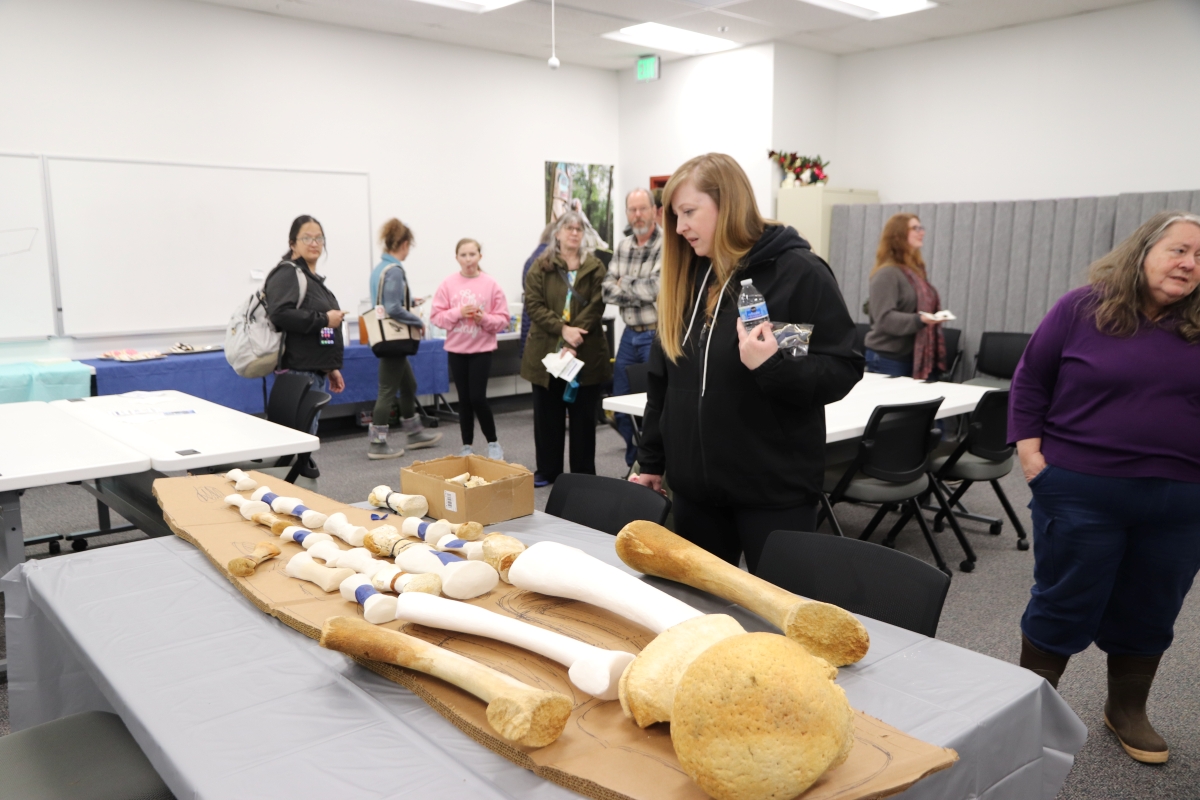
“All the 3D-printed bones are just almost exact replicas of the other bones, and a lot of the other bones sitting here are damaged and couldn’t be put up.”
That’s Sitka High School senior Calder Prussian. After learning how to 3D print from a class at Sitka High, Prussian was game to contribute his skills to the project.
“And so I use this program called Polycam to scan the bone and then the small ones,” says Prussian. “I used the 3D printers at Sitka High School, and the big ones are too big to print here, so we used a company online that prints them, and then they shipped here.”
Prussian says that he has recently printed about 10 bones at Sitka High School, and only has five more bones to print.
Surrounded by enthusiastic community members and former volunteers, Golden is optimistic about what’s in store for the project.
“It’s super exciting, because in some ways I struggle with the fact that it’s not totally done, or that it’s not totally all there, but in other ways, I’m excited because this is the first massive part, and we have ideas for other bones and other projects,” says Golden. “We’re going to do a display at Sitka High. I’d like to get some art done on some of the things. So it’s fun to think about what can come next, and how we can continue to use the bones from the whale to educate in other ways.”
While it’s not alive anymore, the project leaders hope that the whale skeleton inspires a spirit of awe and curiosity as the latest ambassador for our underwater neighbors.