In 2022, shortly after Sitka’s privately owned marine haulout announced it would close, voters overwhelmingly approved city funding to construct a new one. When the facility opened its doors last September, it was a relief for many in Sitka’s fishing fleet. They now had a local option to haul boats for repairs.
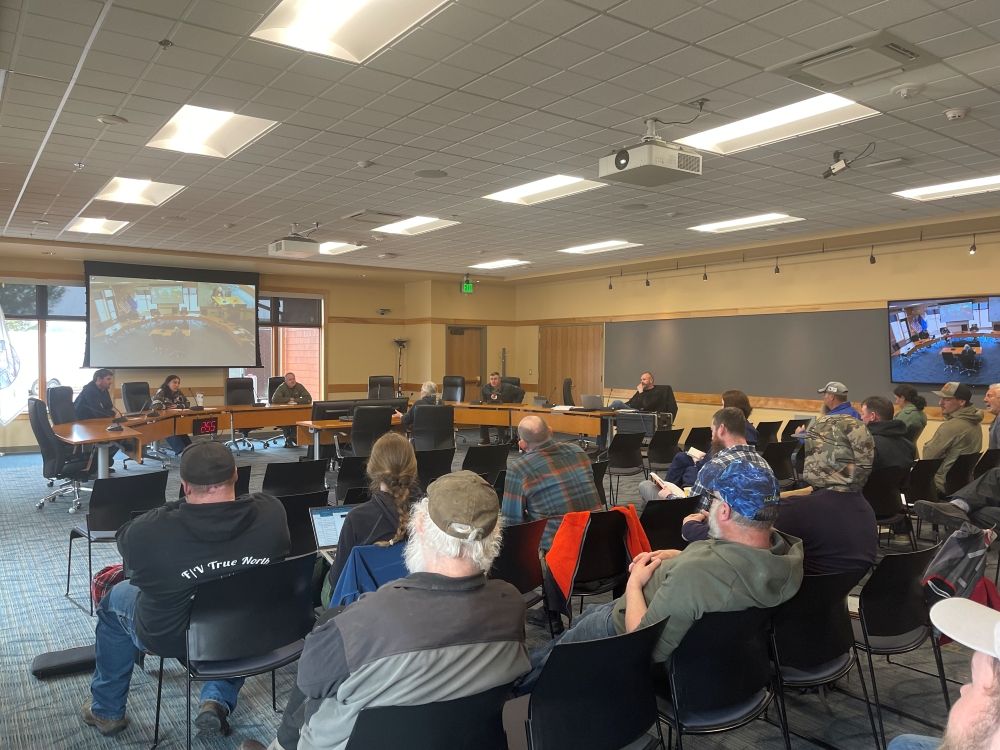
Since then, Highmark Marine, the contractor that operates the city-owned facility, has pulled more than 56 boats out of the water. But some of Sitka’s fleet is out of luck, because their vessels aren’t insured. Either they can’t secure a policy, or it’s too expensive. At a meeting on May 22, Denise Klinger told the Gary Paxton Industrial Park board that she owns an uninsured vessel, but prefers the term “self-insured.”
“It’s a decision we made, like 30 years ago, after putting money out for insurance, that every time we did something to the boat to improve it, the premiums went up. You put a new engine in, the premiums went up. You put new planks in, the premiums went up,” she said. “So we finally said, ‘You know what, we can set aside the money and have this in a fund…if something happens, we have that to fall back on.”
Klinger said she was excited when the haulout opened, but soon found its insurance policy kept them from hauling locally. So they went to Wrangell’s haulout instead.
In addition to working uninsured vessels, Eric Calvin said there are derelict or abandoned boats in Sitka that pose a risk to local waters if they’re not hauled. Calvin urged the park board to support waiving an insurance requirement for those.
“I’ve helped raise several boats here in the harbors over the years, and you’re either going to pay for it on the front end or you’re going to pay for it on the back end, and I would suggest getting them out of the water before they sink, even if the people can’t afford it,” Calvin said. “We’re going to end up paying for it.”
Park Director Garry White said Sitka has the same insurance requirements as many other haulouts it’s modeled after. He said the difference is Sitka’s haulout operators are double-checking for coverage.
“We’re doing our own due diligence and we’re checking to make sure you do have your certificates of insurance,” White said. “Every single lease back in the day, people just say, ‘Yep, I got the insurance.’ Now we have to have a certification of insurance to verify that.”
Insurance requirements are a part of the contract agreement between the city and Highmark Marine. Jordan Young is a project manager with the marine fabricator, which is in the middle of its busy season.
“Basically, right now I’m focused on holding up our end of the contract and doing it in an ethical and honest way,” Young said.
While Young said he believed there was a path forward toward hauling uninsured boats and was eager to work with all parties to find a solution, for now the company’s insurance broker recommended against it.
“They don’t want to see us get pulled into a scenario of compromise that could basically, like, it could ruin the company if things were to go wrong,” Young said. “We don’t keep a fire extinguisher under our sink because we, you know, plan on not having a fire. You do it just in case.”
At the work session, several options were explored in addition to an insurance waiver, like requiring uninsured vessel owners post a $5000 refundable bond before having their boats hauled, or charging a flat fee that would go into a city fund. Municipal Administrator John Leach told the board that city staff had begun developing a waiver for consideration, but ultimately it comes down to a policy decision and who wants to accept the risk.
“If a waiver is put in place, that is an option that the city could waive that requirement, but the city would eat the risk at the same time,” Leach said. “The unique situation with this is the operator would get the benefit of it, while the city would would take the risk.”
Because the facility is city-owned but operated by a private contractor, establishing a policy is more complicated.
“Simply waiving the insurance requirement doesn’t mean we wave a magic wand and it’s done,” Leach said. “Since it is part of a contract, we need to negotiate and determine what the modification of that contract is going to look like.”
Board member Lauren Howard said working toward a solution is essential because the problem extends beyond the fishing fleet.
“It’s a community-wide issue, and so it’s just, it’s a decision of whether we want to serve our fleet,” Howard said. “We want to get people to, you know, be able to work on their boats so that they don’t sink at the dock, because there’s a lot there.”
“Annual maintenance is what preserves a vessel, period,” she continued. “If you’re not taking that boat out of the water and doing the maintenance, it’s only a matter of time. So, it’s a huge importance to get these boats out of the water.”
At a meeting immediately following the work session, park board members asked staff to continue working on an insurance waiver. White, the park’s director, said he would bring a draft back to the board for review at their June meeting. Once the park board makes a recommendation, it will go to the assembly for consideration.