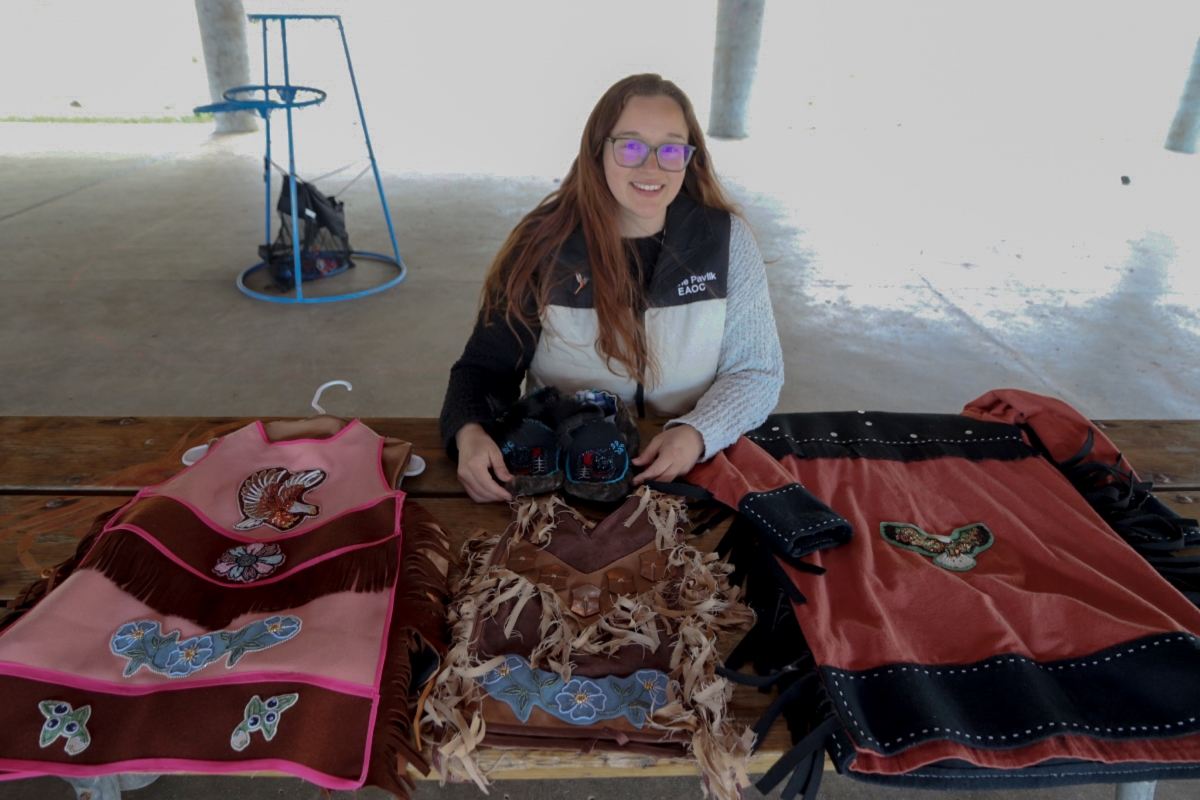
Reine Pavlik meets me at a pavilion wedged between Yakutat’s elementary and high school. While its roof shields Pavlik from the glaring sunlight above, the space offers little protection against the wind blowing away discarded cans.
She’s carrying armfuls of fabric, brought from a nearby classroom she’s working in. She spreads the garments out across a table, revealing a variety of nearly-completed Tlingit tunics – regalia she designed for herself and her two daughters and moccasins she made for a friend as part of an art trade. She’ll soon pack these items up to take with her to Celebration in Juneau, a biannual gathering of Indigenous communities across Southeast.
Each piece tells a story about its wearer, from beaded animals signifying the wearer’s clan, to hidden details commemorating her daughter’s love of blueberries and her friend’s passion for the Seattle Seahawks.
While she puts the finishing touches on each piece, she’s also preparing to begin construction on her next project. Last December, Pavlik was one of fifty artists across Alaska awarded a $10,000 grant from the Rasmuson Foundation to complete a short-term artistic project of their choice. As a first-time applicant who was initially hesitant to apply, Pavlik was thrilled with the opportunity.
“I was so happy and shocked that I had gotten it,” says Pavlik. “You don’t really have too many opportunities where you get money to do projects that that have been in your head for so long.”
As an experienced seamstress who has created collections for a wide variety of fashion shows across Alaska under her brand Alaska Soles, Pavlik knew she wanted to develop a 12-piece collection. Initially, she wanted to recreate what Tlingit communities wore pre-colonization, outside of regalia. Over the course of a three month research project, she found that the historical knowledge of everyday clothing was really limited, which made drawing inspiration for the collection challenging. So, she shifted her focus to adapt Tlingit regalia into everyday wear, providing a modern adaptation of Tlingit formline and patterns.
“I’m looking at doing a coat collection,” says Pavlik. “I’m feeling like coats might be the most relevant to Yakutat, but also Southeast and Alaska in general, because I really want this to be a collection that people can wear in every day attire, and not just for ceremonies or one-time events.”
Pavlik says the research she put into developing her tunics came in handy as she brainstormed how to accomplish that.
“Some things that I’ve done in the past, like this V right here [on a tunic], that’s really traditional in Tlingit tunics for Yakutat, because of the Athabascan influence that traditionally Yakutat has had,” says Pavlik. “I’ve made a graduation stole that had sort of the V that looked reminiscent of the tunic in the V, and then I made this black leather piece with seal skin where the V was on the top right here on the shirt portion.”
As she moves to the design phase of her project, Pavlik hopes to gain further inspiration at Celebration, from talking with elders to observing how attendees represent their cultural pride through clothing outside of traditional-wear.
“So much of Celebration is going and being proud of who you are,” says Pavlik. “So if you’re not wearing your regalia because you’re dancing, you’re wearing a awesome bandana because it’s got formline all over it, or something like that.”
Throughout her artistic career, Pavlik has prioritized making pieces out of traditional materials like sealskin and sea otter pelt, as well as second-hand materials, like old clothes and tablecloths gifted from community members. She says this approach not only prevents her from contributing to the negative impacts of fast fashion, but also roots her pieces in her hometown.
“I feel like Yakutat is so artistically talented. We have so much talent, left and right, everyone here is doing a craft almost at any given point in the day,” says Pavlik. “And so I feel like a lot of my work is a reflection of the community that I come from, and I’m constantly inspired by the people around me.”
She hopes her collection will enable folks to easily rock their pride in Indigenous resiliency year-round, with each piece held together by her love for her Yakutat community, stitch by upcycled-stitch.