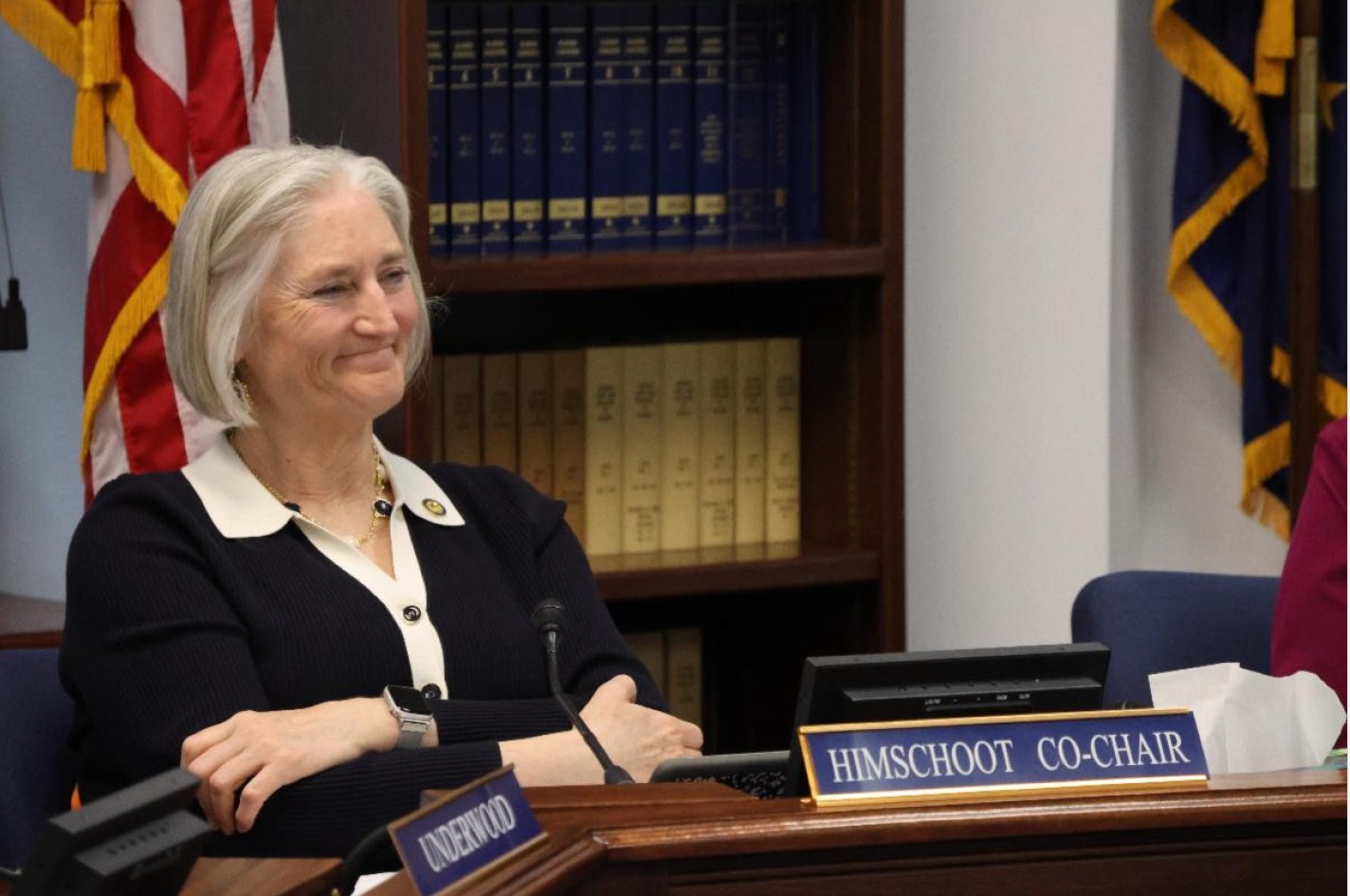
The Alaska Legislature is in a special session, and most of the work is being done by the finance committees. The regular session ended on May 20. Independent Representative Rebecca Himschoot of Sitka says she’s glad Southeast’s Senator Bert Stedman, who co-chairs the Senate Finance Committee, is part of the special session negotiations. They’re focusing on a gas pipeline, and she says the senator, quote: “has our back.”
Himschoot represents Sitka, Petersburg, and small towns from Yakutat down to Prince of Wales Island – 22 in all. In an interview with CoastAlaska’s Angela Denning, she says there was a lot of teamwork in the regular session. But she’s frustrated that two bills that were supported statewide were vetoed by the governor – the pension bill for state employees and the election reform bill. Now, she hopes the omnibus crime bill does get the governor’s approval.
This transcript has been lightly edited for clarity.
Himschoot: I have no complaints about how the session went. I think there was a lot of teamwork going on and good alignment between the two bodies for the most part on most issues. What I’m most proud of is the three major bills that passed, and what I’m most frustrated about is that two of those were vetoed and we were unable to override those vetoes. So, the one that I have been deeply engaged with is the Public Pensions Bill, House Bill 78. Since 2006, we have not offered any kind of competitive retirement system for state employees, so those are emergency personnel, teachers, etc. And we finally got a bill across both bodies that would restore a pension that is not, as I’ll just say, not as rich as the pension that a Tier One person would remember getting, or even a Tier Two, which is the pension I’m in. But it would make Alaska somewhat more competitive with other states, and we have a really tight labor market in a lot of those state positions, and I’m, of course, most familiar with teaching. So, anything we can do to make our teaching positions more competitive with other states, we need to do. And we did pass a pension bill, of course, it was vetoed, and we did not have the votes to override that. And the other bill that got vetoed that I think was a really positive bill for Alaska was Senate Bill 64. It took about 10 years to come to agreement across party lines on an elections bill that would tighten up our voter rolls a little bit. We have the automatic enrollment with the dividend, and so we’re over-enrolled, and so looking for ways to clarify who’s actually a voter in Alaska. It also had a ballot tracking system. I was especially excited about having a rural liaison who could make sure that rural voting places were open and had the right ballots. We’ve had issues with that in the recent past, and so when that got vetoed, it was painful to see all that work, I guess, go down the drain. And the third one is the Omnibus Crime Bill, which is really made up of, I think, a dozen different small crime legislation. And so, the big deal in that one is changing the age of consent from 16 to 18, except for close in age exemptions. And that’s been, I think, a tricky thing to do in Alaska, and it’s, you know, it’s a different number in every state, but 16 is on the low end, and so to move that up, I think, will help with some of our high rates of sexual assault and domestic violence. It also makes it so that AI-generated child sexual abuse material is criminalized, and then there are a whole bunch of other little things that are in there, but I think the huge victory in that bill is changing the age of consent. So, I hope it will get the governor’s support.
CoastAlaska: How does that feel to have dozens of representatives across the state affiliated with different parties, and they come to this more or less consensus on months of this work? And then this governor, he’s vetoed a lot more than other past governors.
Himschoot: I think, in short, the word is frustrating. I talked with a gubernatorial candidate who was recently in Petersburg, and I asked if that person would be interested in changing the override threshold, because Alaska has the highest in the nation threshold for overriding on appropriations, and I asked if this person would be interested in lowering that threshold and giving the Legislature more of a say, and I loved the answer, which was, ‘If I’m doing my job, there won’t be vetoes’, and I like that model of governance where the governor is present and actively engaged in helping to form ideas. You know, we talk about the 61st vote, 21 of 40 in the House, 11 of 20 in the Senate, and then you’ve got that 61st vote, and if you don’t have that vote, you end up with all these vetoes, but it’s really difficult to negotiate a direction that would make a bill agreeable to the governor if the governor is not there, and not engaged, and so the short answer is, it’s incredibly frustrating, and it makes it difficult to want to keep working on things, because you just really don’t know what’s going to happen in the end.
CoastAlaska: And kind of along those lines, moving on to education, which is, you know, you, your career was in education for decades. At this point, we have what the Legislature approved, right? What you, as lawmakers, agreed to. So, first, like, how do you feel about what you agreed to? And then, secondly, we don’t know at this point, right, what the governor might do or not do.
Himschoot: I’m excited about what was approved with the caveat that one-time funding is just generally not as reliable for school districts. So it, you know, it helps in a pinch. No district is unhappy to get the additional support, but it isn’t something you can go to the bank on. You can’t retain programs – you can for a year – but you can’t really build your bench, you can’t really retain teachers and work with them to help them become better teachers, because you just don’t know, you don’t know how long you’ll be able to keep them, so that’s a continuing frustration, but the overall 144 million, if the price of oil stays high, it’s about a third of our budget comes from oil, and so when the prices go up and prices go down, it has a huge impact on what the state can do. But if that price stays solid, it’s, you know, that’s I think it’s about, something like $470 per student when it runs through the formula, so that will be certainly helpful, and the other wonderful thing. House Bill 28 is a bill that does a number of different things in education, but I think the part I’m most excited about is it sets up a formula for funding energy, and so this year I think it’s about 29 million that’s going to go into reimbursing districts for their energy costs, so that’s heat and electricity, and then in the future, the idea, the intent is to fund 100% of those costs, so right now districts are having to pull the money for heating their buildings and the electricity that they use out of the money they get for educating students, the base student allocation, they take that money and they use it for everything in the district, including energy, and this formula allows the Legislature to target one thing and take one thing out of the other funding stream. So, if we’re unable to raise the BSA [Base Student Allocation] significantly, at least more of what we are providing through the BSA will go to classrooms, educators, programs.
CoastAlaska: Is there anything you wanted to touch on for the specific communities that you represent in terms of this year’s session?
Himschoot: You know, there’s $105 million going into the 33 top school major maintenance projects, and that has, I think, funding for two projects in Petersburg, and funding for a project down in Craig, finishing up their middle school remodel, I think, is where that money is going to go in Craig. And then there’s quite a bit of funding for Mount Edgecumbe High School, and I think everybody can agree some upgrades are needed there, and I think Senator [Bert] Stedman did work with Governor Dunleavy to kind of make sure that the money will go where we’re hoping it will go, and then there’s renewable energy projects. I can’t remember how many we funded, but Petersburg, and I should say, the SEAPA third turbine is in that list, so that was something that they were very worried about. That is included. There’s funding for Stratton Library in Sitka to go to the court system. I think a lot of people in Sitka are curious what’s happening with that building. It’s been sitting empty for quite some time, so it’ll be interesting to see how that develops in the future. The Alaska Seafood Marketing [Institute] is going to get 6 million, and then there’s going to be 6 million, also going to the ATIA, the Alaska Travel Industry Association, I think, and so trying to grow markets, right, trying to grow that seafood market and our tourism market as well. So one of the great things about having a little bump in oil prices, as difficult as that makes things for everyday Alaskans, right. Our cost of living is going to go up, and we feel that in individual household budgets a whole lot. But one of the things that I think is good about our budget is we’re trying to – about the Legislature’s budget this year – is we’re trying to target where the needs are. So, while it’s only $1,000 dividend, that is a kind of a historic average, but then there’s also a $200 energy relief check that will go with that. We also are increasing funding to senior benefits and to heating assistance, so we’re trying to make sure that a little bit of that windfall of funding goes to people who most need it. We also expanded the infant learning program. We’re one of the last states to change our criterion from 50% delay to 25% delay. So, until we made this change, an Alaskan toddler, say a two-year-old, has to be functioning at a one-year-old level to get support through the infant learning program. We’ve now made that a 25% delay instead of 50% so kids who really need it will get help sooner. There’s one other great thing for Sitka: if the price of oil stays above $80 a barrel up through the first half of FY 27 – so that would basically be the rest of this calendar year – we’ll be able to finish up with the request for the Mariculture Training Facility that they have there, and say, I think it was half funded last year, and the other half will come this year, if that price of oil stays strong. And then there are some upgrades, also for the Craig to Klawock bike path, the Kake Ferry Terminal Rehabilitation, Kake Road resurfacing, Sitka airport lighting, and the Klawock Master Plan update. So, again, that relief or that help support is being shared across the region. I’m really grateful for that, and then my personal legislation that got through, I had a few get through, but for well over a decade, the Alaska Invasive Species Partnership has said the number one thing the state can do, apart from funding – funding always helps – but apart from funding, the number one thing we can do is provide, create a state council on invasive species, and that bill was a Senate bill that was in companion to my House bill, got through, and so that will be pending with the governor very soon, and that will, I think, you know, we have Elodea and Northern Pike, not where it should be, but for us here in Southeast, it’s definitely going to be green crabs are something that we’re really needing to take a closer look at.
CoastAlaska: All right. Well, is there anything you wanted to touch on with fisheries in the session?
Himschoot: Yeah, something that I’m really excited about is a bill that, when I first came to Petersburg and met with the Petersburg Vessel Owners Association, I was learning my way in fisheries – I still am – but they were very clear that the conflict of interest bill would be beneficial, and that bill passed and was signed into law this year. So that means that when you have somebody with expertise on the Board of Fisheries, they will be able to deliberate, which they couldn’t previously. They just will not be able to vote, and I think there’s a bit of a question mark on whether they’ll be able to amend, but for right now, we know that they’ll at least be able to stay at the table, so that the entire board can benefit from their expertise, experience. So, that, I think, was a really big deal, because that bill’s been around something like a decade, so that was a good one to get through. And then we have somebody on the Board of Fisheries again from Southeastern Alaska, it’s somebody who worked for EC Phillips and Ketchikan and is now in mariculture, Paul Cyr. So I’m really excited to have another Southeast voice on the Board of Fisheries again.