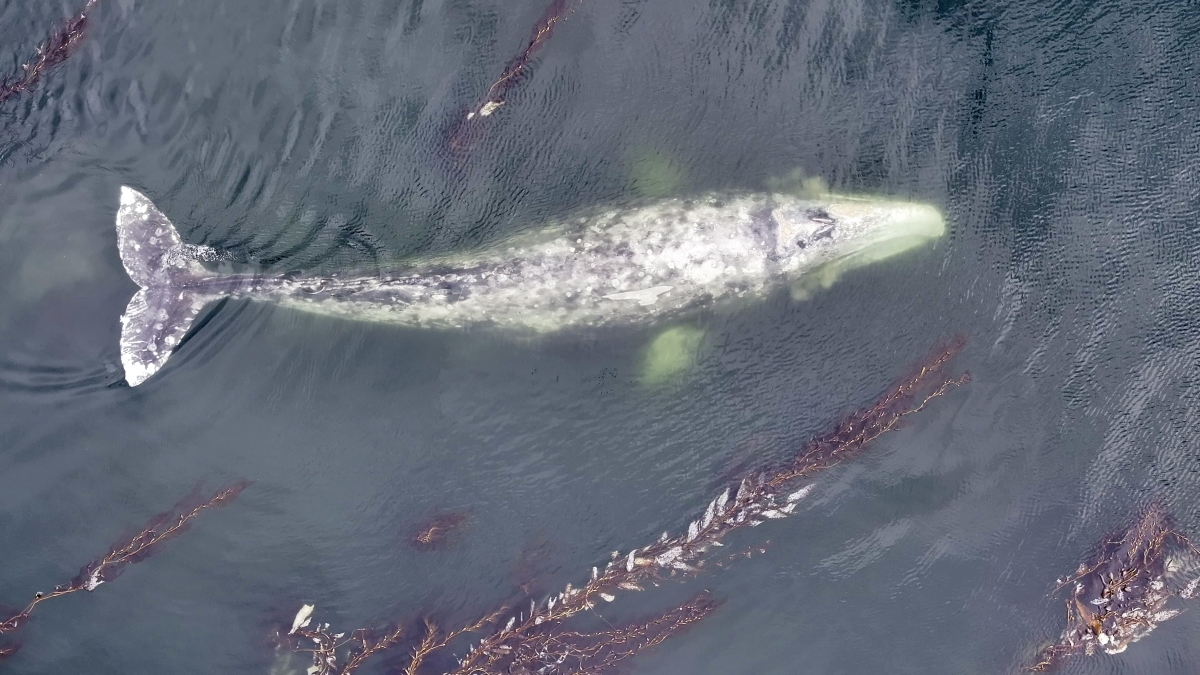
It’s early May, and five gray whales weave between the kelp as they feed on herring eggs in the water around our 20-foot inflatable boat. Researchers are taking photos to identify individual whales and measure how much weight they’ve gained since they arrived in the Sitka area about a month ago on their yearly migration north.
“These whales are foraging, and it’s probably 10, 15 feet of water right there, and they’ve got their heads down in the sediment, probably rolled over on their right sides, and they’re kind of picking off herring eggs,” says Liah McPherson, a PhD student who is leading the ecological data collection for a research project through the Alaska Whale Foundation.
McPherson and her research team are looking at the relationship between gray whales and herring around Sitka. The baleen whales have had a massive population decline in the past decade, but their presence in Sitka Sound has skyrocketed in recent years, coinciding with the Pacific herring spawn. Now, the team and community collaborators are asking why that is and what the downstream effects might be.
“My favorite whale, we call him White Spot,” McPherson says, getting ready to launch a drone into the sky above our boat. “This particular animal I’ve seen in 2023, 2024, 2025, and this year, in 2026, we’ve seen him a couple times as well. So it’s like seeing an old friend. It’s like, ‘Oh, there you are. I’m glad you’re still coming here.’”
The Eastern North Pacific gray whale population has declined by more than 50% — from roughly 27,000 whales in 2015/2016 to 14,000 whales in 2022/2023 — since a marine heatwave known as “the blob” hit the Pacific ocean about a decade ago. Since then, there have been increases in gray whale strandings along the west coast and widespread reports of whales in poor condition.
But it appears that some whales are adapting to the ecological change by migrating to forage areas where they didn’t used to go. Around 2019, McPherson says, gray whales started showing up in Sitka in massive numbers, just as the herring spawn got underway.
“They have always kind of had a presence here, but in very small numbers, like five to 10 gray whales,” she says. “And then local community members, organizations, scientists, they really started to see these numbers spike and go up about tenfold. Now we see about 150 to 200, maybe even more, gray whales coming in between March and May to take advantage of herring eggs.”
Gray whales have the longest migration of any mammal, traveling roughly 10,000-12,000 miles every year from their feeding grounds in the Bering and Chukchi seas to their breeding grounds off the coast of Mexico.
Lauren Eckert, a conservation scientist based at the University of British Columbia in the Centre for Indigenous Fisheries and a board member of the Alaska Whale Foundation, says scientists think gray whales are unable to get the food they need to make their long migration, so they’re pivoting to find new foraging grounds and new food sources.
“The big picture, what we’re seeing is adaptation in a very curious and intelligent species that’s struggling with the impacts of climate change,” Eckert says.
And other new behaviors are being documented. Researchers are starting to see gray whales, who traditionally forage on sea-bottom organisms in the Arctic, , lunge feed on adult fish off the coast of California, and feed on krill swimming through the water.
So, informed by these observations, community experts, Tribal and regional managers, and these researchers are asking: How important are herring, as prey, and Sitka Sound, as a foraging ground, for gray whales? And what impact, if any, are gray whales having on the ecologically, commercially, and culturally important Sitka Sound herring stock?
“These are sort of like canaries in the coal mine, if you will, signaling changing ocean conditions,” Eckert says.
Back on the water, McPherson and her team of interns are continuing their survey using drones, cameras, and suction cup tags to build out their catalog of gray whales coming to Sitka and later extrapolate how much blubber they’re putting on by eating herring eggs.
Intern Adelle Wilkin climbs a ladder to get a closer look with her camera as a whale comes to the surface, and calls out the names of various seabirds she spots around us. Wilkin is trying to get photos of a specific part of the whale’s side near its dorsal ridge (a series of small bumps between its dorsal hump and tail flukes), which she says makes it look dinosaur-like.
“I started [my work] in acoustics, and I could have gone either way: birds are whales,” she says. “But there is just something about whales. They’re so special and they’re so intelligent, and birds are too, but there’s something about studying such a long-lived group of animals that have so much economic value, and [are] so culturally important in so many places that it had to be whales for me.”
Wilkin says it’s special to be part of a project that is so important for both humans and whales.
“Being a part of researching a species as it’s struggling, you are really, really rooting for it, and that’s probably, at the end of the day, why I love gray whales so much,” she says. “They’re resilient and they’re adaptive, and their food is declining in the Arctic, so they feed on fish, and they feed on benthic invertebrates in unique places, and they feed on herring eggs, and they’re just a species that will find a way to survive. They’ll like find a way to make it, which I love about them.”
This is the team’s second full-fledged season out on the water, and even though they’ve only recently started collecting data, Eckert says they’ve had some telling initial findings.
“We’ve learned very preliminarily that whales, even though they’re in Sitka Sound for a short amount of time, are gaining body mass quite quickly as they’re eating,” she says. “An early estimate puts it at about a bread box worth of body volume a day while they’re in Sitka Sound, each whale feeding. And so that is starting to be the first steps of getting us to understanding how much whales are consuming in order to gain that sort of weight while they’re here, and potentially how important this halfway-to-their-foraging-ground stopover point is for whales that are skinny and struggling.”
The other piece of the puzzle, regarding the impact on Sitka’s herring population, is still far from being figured out.
Andy Szabo is the executive director of the Whale Foundation. He says the team is slowly building out an energetics model — based on historical whaling data and knowledge about how much energy it takes for a whale to put on blubber — to extrapolate how many herring eggs gray whales are removing from Sitka Sound each spring. In turn, he hopes that data can help inform management decisions moving forward.
Szabo says they’re studying a really complex system and complex species interaction, and their research and data is one piece of a much larger environmental puzzle.
“There was never any question that the data we were collecting from the moment we started collecting it was important and impactful, and that there was going to be stakes and rights holders who could really use and value the data that are coming from this,” he says. “And that’s not always the case.”
Szabo says they hope to run the study for as long as they have funding and as long as there’s value in the data they’re collecting.