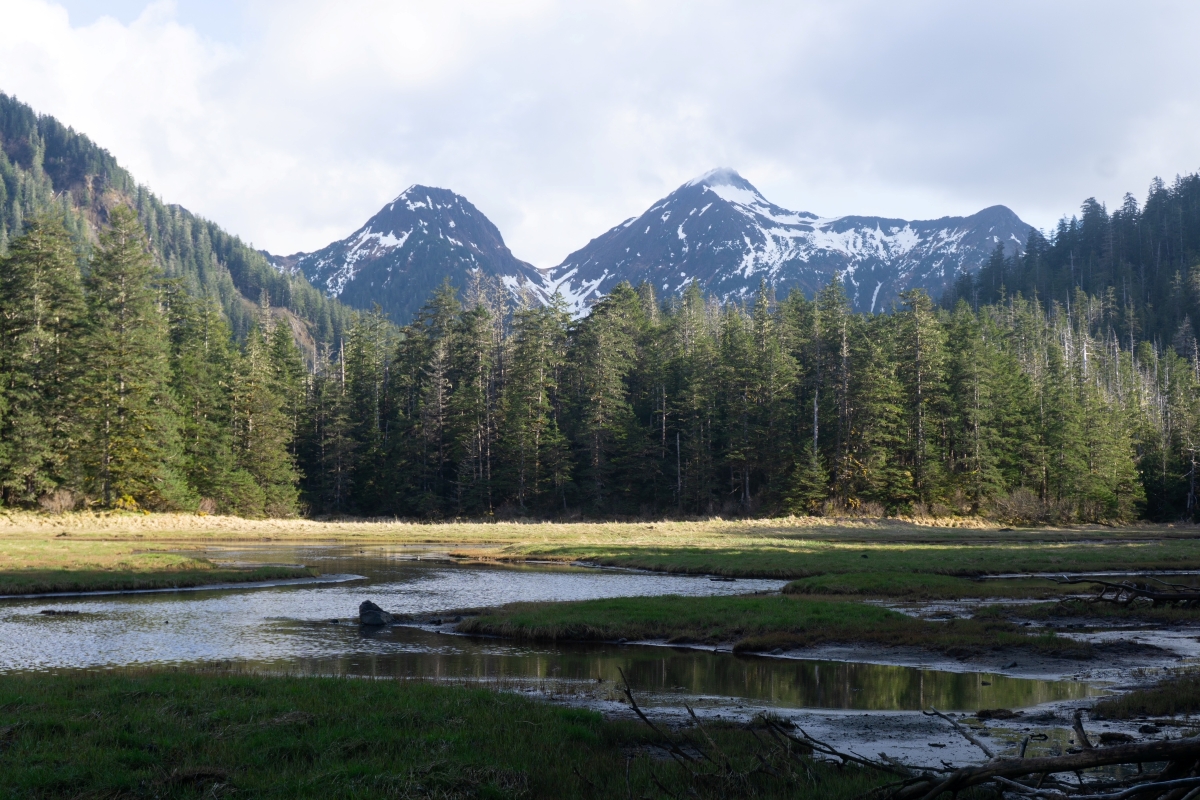
The U.S. Department of Agriculture last month announced its plan to repeal the Roadless Rule, a 2001 environmental conservation law that protects national forests from logging. That includes about half of the Tongass National Forest’s 16.7 million acres. Subsistence users in Southeast Alaska are concerned how the potential rollback could impact their resources.
Public hearings were held in Sitka in 2019 the last time the Roadless Rule was in limbo. With a repeal back on the table, the U.S. Forest Service will once again hold hearings for subsistence users to comment on how the change would impact the land they rely on.
Jeff Feldpausch, the resource protection director at Sitka Tribe of Alaska, said seven years ago, a vast majority of commenters were opposed to rescinding the protection.
“But it was already a done deal, and they move forward with it anyway,” Feldpaush said. “I don’t know that it’s going to be much different this time.”
The U.S. Department of Agriculture said unrestricted road construction would help with wildfire management and forest health. Feldpausch said more roads won’t help mitigate wildfires. Especially in a temperate rainforest like the Tongass.
“We don’t have those forest fire dangers here,” Feldpausch said.
According to the National Park Service, roughly 85% of wildland fires are caused by humans. Feldpausch said more roads will give people greater access to forestland in states where that’s a bigger concern.
“For every positive that they can point out, there’s a negative on the other side. It just depends on which group you’re focusing on. If you’re focusing on the money side, yeah, there’s a lot of positives. If you look at those impacts again on the subsistence side and long term, there’s some negatives there,” he said.
But Feldpausch said some subsistence users can benefit from increased road access. Like Thomas Smith, who said he used logging roads to hunt when he was in Kake on Kupreanof Island.
“We would use them to drive around, look for signs of moose, and hike around and call them, and we did get a moose,” Smith said. “But simultaneously, while you’re driving around, you look and you see stumps of old growth and really skinny, skinny small trees and forests that almost look impossible to navigate.”
Smith said the land has provided for his family for generations, and time spent harvesting outdoors can reveal how things have changed over the years.
“You have to see your resources leaving. You have to hear your elders and listen to the days that they would writhe over 50 pound king salmon and look at the fish now and be like, ‘Okay, that’s not the same, and frankly, that’s not healthy,'” Smith said.
Smith isn’t the only one who’s seen how development has impacted the land they hunt and harvest on. Jim Phillips is a long-time subsistence user and hunting guide in Sitka. He said timber harvesting has altered tree cover and the flow of the Katlian River on Baranof Island.
“Every year you went in there to hunt it, you’d have to find a new way to get up the valley because the banks were basically gone, and the river would flood out and go all over that valley,” Phillips said. “It changed that valley completely.”
The deadline to submit public comment on the proposed repeal has been extended to Oct. 6. The Sitka Conservation Society will host an event on Wednesday (9-30-26) at 4:30 p.m. at ANB Hall to help Sitkans craft and submit comments.
Dates and times for the upcoming hearigs, both in-person and virtual, are listed below:
Tuesday, Sept. 29, 2026
5:00 PM – 7:00 PM
Southeast Alaska Discovery Center, 50 Main Street, Ketchikan, Alaska
Wednesday, Sept. 30, 2026
11:00 AM – 1:00 PM
VIRTUAL: Microsoft Teams CLICK HERE TO JOIN MEETING
Call-in number: 202-650-0123, Passcode: 844934670#
Wednesday, Sept. 30, 2026
5:00 PM – 7:00 PM
VIRTUAL: Microsoft Teams CLICK HERE TO JOIN MEETING
Call-in number: 202-650-0123, Passcode: 844934670#
Thursday, Oct. 1, 2026
5:00 PM – 7:00 PM
The Loussac Library, 3600 Denali Street, Anchorage, Alaska