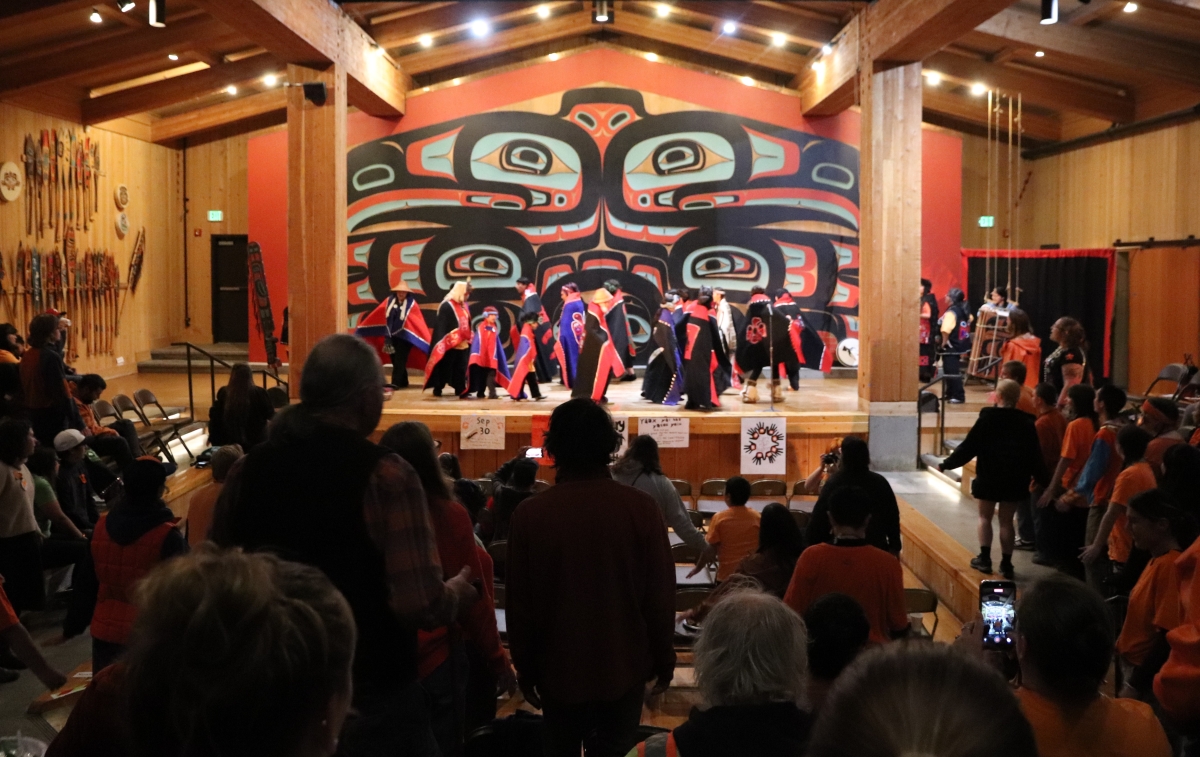
Sitkans gathered Wednesday evening (9-30-26) for Orange Shirt Day to honor Indigenous children impacted by residential schools. The community filled the Sheet’ká Ḵwáan Naa Kahídi Community House for speeches, reflection, and dances.
Robin Smith is a student at Outer Coast, a liberal arts undergraduate program in Sitka. He acted as the master of ceremonies for the event. Smith explained that Orange Shirt Day was started by Phyllis Webstad who was sent to St. Joseph’s Mission in British Columbia as a girl.
“On the very first day, her grandma got her this nice, beautiful orange shirt, and it was stripped away from her as soon as she got to the school and she was put into a uniform,” Smith said. “So it’s used as a symbol to remember what happened to those kids who didn’t make it home, and to those who did make it home and still fought for their culture to stay, even though they went through all of that. “
From the early 1800s to the mid-20th century, tens of thousands of Indigenous children were involuntarily removed from their communities and forcibly assimilated at residential schools across North America. There were over 400 schools in the U.S. where many children lost their lives.
Yeidikook’áa Brady-Howard is the tribal council chair for Sitka Tribe of Alaska. She’s a long-time educator and currently teaches at Outer Coast. She said many people’s education has excluded the history of residential schools in North America.
“Now, more than ever, we have people who don’t really want to tell any aspect of our history that might reflect badly on the people who came before us, but yet it’s a really important part that more people need to learn to understand where Indigenous people are coming from,” Brady-Howard said.
Community members were invited on stage to share stories of relatives who attended residential schools. Brady-Howard said it’s important for people to understand how the institutions affected generations of Indigenous people.
“We need to approach one another with love,” Brady-Howard said. “We need to approach one another with understanding, and we need to approach one another with support on Indigenous land as we learn these indigenous languages, as we do these indigenous songs and dances, and as we, as a community, work to keep Haa Ḵusteeyí, our way of life, alive.”
Brady-Howard said teaching language, art, and history will make sure the residential schools never succeed at erasing Indigenous cultures.