



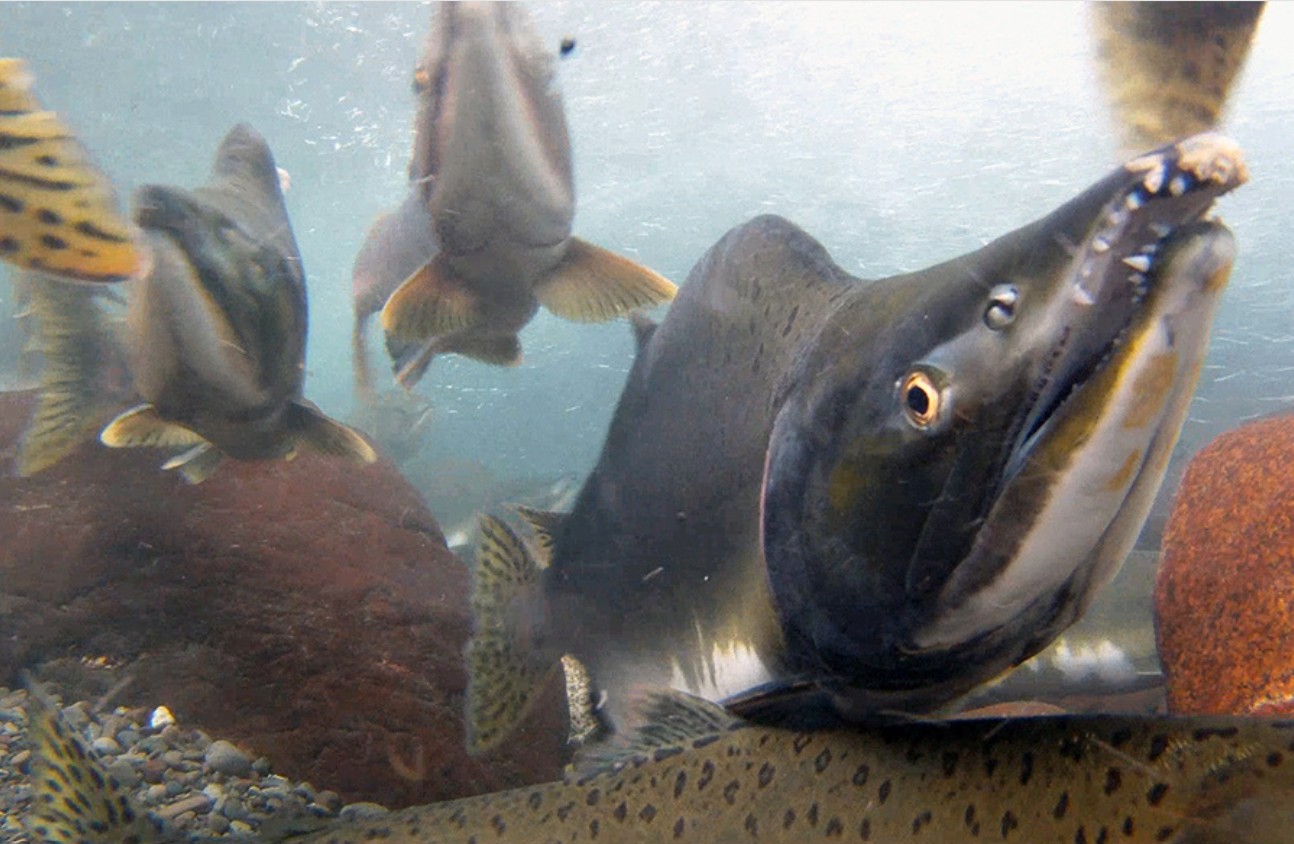
The state Department of Fish and Game forecasts each year how many pink salmon the commercial fishing industry in Southeast Alaska can harvest, beyond the number needed for spawning to support future generations. At 67 million fish, next year’s forecast is the largest in decades. This number helps fishermen, processors, and managers plan ahead.
Listen to the story:
“It is a large forecast, and it would be one of our largest harvests since statehood,” said Andy Piston, the Southeast salmon research supervisor for the Alaska Department of Fish and Game.
The last few years haven’t seen big pink returns, but with a relatively short, two-year life cycle, the pink population can bounce back.
“Pink salmon have the ability to rebound rapidly,” Piston said.
Since the late 90s, state biologists have forecast harvest numbers by taking catch samples of one-year-old juvenile pink salmon that are migrating out to sea. Piston said the correlation between how many juveniles they catch and how many adults return the following year is very accurate.
“The juvenile catches this year were the best I had ever personally seen on a survey,” he said. “And so, as long as early marine survival is good, you can produce an incredible amount of fish.”
That kind of abundance happened in 2013, a year that Piston will never forget. Managers knew it would be a good year and forecast a harvest of 54 million pinks, but the harvest ended up at over 90 million fish. That massive return was obvious during stream surveys.
“It seemed incomprehensibly large how many fish returned,” said Piston. “I remember walking Hidden Inlet, which is in Portland Canal – we were trying to count chum salmon but there was a quarter million pinks in the stream, which is mind-boggling. And then there was a school of pinks in the bay that just went as far as the eye could see.”
The marine survival must have been astronomically high that year, he said. And that’s always a possibility.
At the same time, ocean conditions can throw a curveball, according to Phil Doherty, a retired Southeast salmon biologist for the state.
“I look at forecasts with ‘Okay, we’ll see what happens’,” he said.
Now, Doherty oversees the advocacy group Southeast Alaska Seiners Association. The seine fleet takes over 90% of the pink salmon harvest in the region. Doherty has seen many forecasts over the decades and said some just don’t work out, like in 1987.
“It was the largest forecast the department had ever come out with,” Doherty said. “I can’t remember exactly what the forecast was, but it was big — it was 40, 50-plus million pinks. We ended up catching about 3.5 million pinks.”
The state department used different forecasting methods back then. Although that’s an extreme example of missing the mark, it’s not the only year that saw a harvest well below the forecast.
Still, Doherty said that if 67 million pinks were harvested next summer, it would most certainly be among the largest harvests in history.
“I’m keeping my fingers crossed that it’s a big harvest,” he said. “I’m keeping my fingers crossed that the prices will be good, and that everyone will be happy, and off we go. . .we’ll be off and running.”
The price of pinks is another piece of the puzzle for the salmon fishery and what the harvest will mean to the economy. It has its own set of variables, including how pink harvests turn out in other areas in Alaska.
So, until the salmon start returning to their spawning grounds next summer, the harvest will remain just a forecast.


