



For the past 30 years, Sitka’s annual WhaleFest has celebrated marine life through art, storytelling, and science education every November. This year, a small group of scientists got to take a closer look at a deep-sea species that mysteriously washed ashore this summer.
A content warning to listeners, this story describes, in detail, an animal autopsy.
Huddled around a long metal table, a group leaned in to see what was suctioned into a syringe.
“Only a bunch of nerdy biologists would get excited by something like this,” Maggie Castellini said.
“It’s beaked whale poop, are you kidding me?” Aurora Randolph responded.
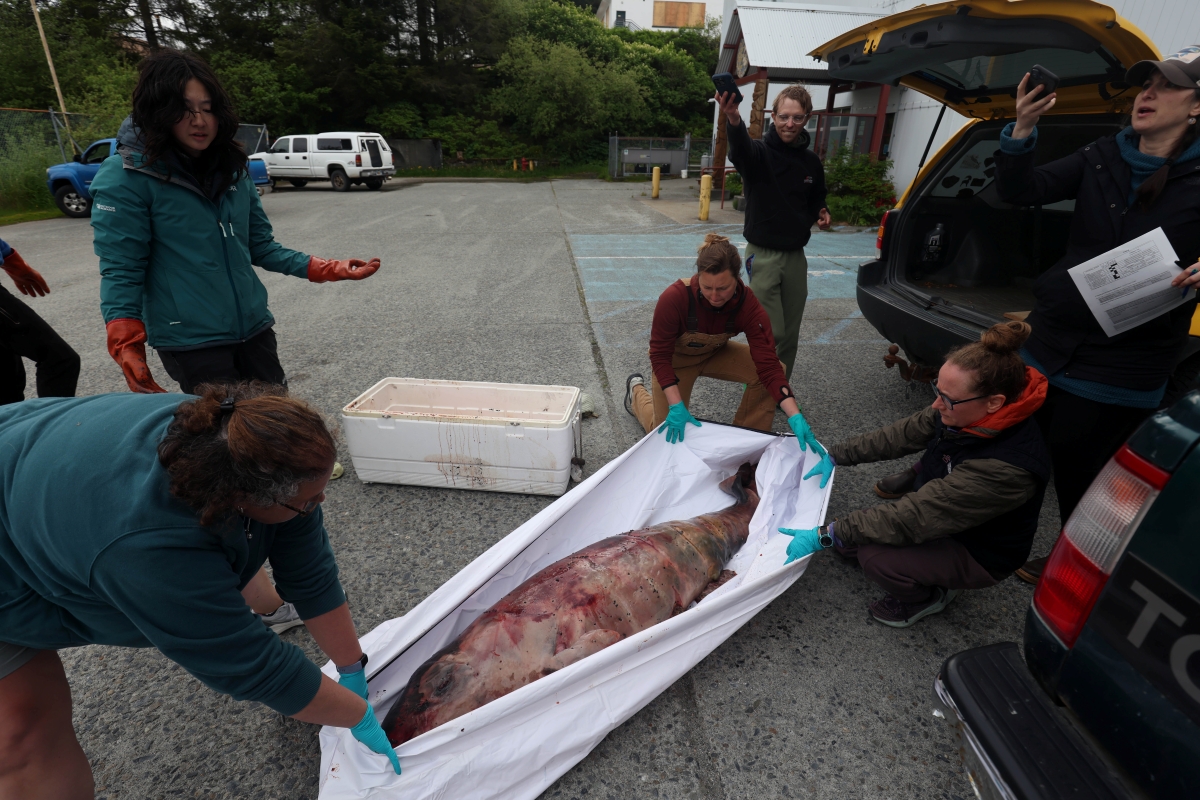
Feces were just one thing being collected from the 6-foot-3-inch Cuvier’s beaked whale, sometimes called a goose-beaked whale, fetus lying on its side.
In June, campers stumbled upon a pregnant beaked whale on Kruzof Island near Sitka. Researchers removed the fetus, and kept it in a freezer to preserve for a necropsy, or animal autopsy, during WhaleFest.
After months of waiting, these self-proclaimed “nerdy biologists” said they hope to gather data on this poorly understood species and try to figure out what caused the mother and baby to wash up.
To get intestinal access, Stacy Golden, a science teacher at Sitka High School, used a knife to cut the length of the baby whale.
“I’m gonna go as far down past the anus as I can. We don’t know what to expect. We could have a gush of fluids,” Golden explained.
Scientists and curious Sitkans who came to observe wore safety glasses, rubber gloves, and plastic aprons. Some dabbed Vick’s Vaporub below their nose to mask the smell of the months-old fetus. Golden warned that the odor might get worse when she cut it open.
“Breathing through your mouth is nice in terms of smell, but also if your mouth is open, things can go in,” Golden said.
With the help of a few university students, Golden pulled the skin, blubber, and muscle up to reveal the whale’s insides. The rib cage was soft, so Golden’s blade easily slid through the baby’s bones.
“This guy was definitely not ready for birth yet,” Golden said.
She peered into the whale’s mouth for another sign the seal-lion-sized fetus wasn’t fully developed.
“While they’re a toothed whale, you’ll notice that our little guy here doesn’t have any teeth,” Golden noted. “Part of that’s because of age.”
For every item Golden cut out, the team snapped a photo on their phone.
“I’m sitting here taking this picture, and a text comes up from my son who’s at the Utah [vs.] BYU football game, and he’s asking me if I can hear the chanting on TV, totally forgetting what I’m doing right now,” Golden said.
Lauren Wild, an assistant professor in applied fisheries at the University of Alaska Southeast in Sitka, said not much is known about beaked whale populations in the Gulf of Alaska. So when one washes up, it’s like a “gold mine of data.”
“We just see them at the surface. They breathe. They go back down. We could put things externally to look at food they’re eating, but if we can get inside one of them, we can do all these anatomy and physiology studies and take samples that help us better understand,” Wild explained.
The scientists cut out both of the whale’s eyeballs and chunks of muscle and skin. They also measured blubber thickness. Golden noted the layer of fat was almost an inch thick.
“It goes back to that like, how much energy moms have to put into raising their young. Because opposed to some of the seals, this guy’s got to come out fully blubbered,” Golden said.
Measurements are important to compare against existing data. If this fetus was bigger than those previously studied, then scientists could better estimate what size the beaked whale grows to before it’s born.
Anya O’Neil, a student in the aquaculture program at UAS, said there have been numerous necropsies on humpback whales and seals, but cutting up a beaked whale isn’t as common.
“I got to see it up close and more personal than like most people on Earth, even most other experts,” O’Neil said.
Blood and oil from the fetus drained through a hole at the table’s end into a bucket on the floor while Golden continued to slice through blubber, muscle, and bone to remove the whale’s heart. She cupped it in her hands to show the room.
“This is so cool, guys. We were so afraid,” Golden said. “I was like, ‘Oh my gosh, is this just gonna be all mush and liquid?’”
The scientists classified the fetus’ level of decomposition as code 3. That means it was decomposed, but its organs were intact.
They placed the dark red heart on a scale. It weighed just under a pound. Researchers then stuck syringes into the heart’s valves to slurp up thick, coagulated blood.
Golden sliced the heart in two to peer inside and see if anything looked abnormal. She explained that beaked whales are one of the deepest diving marine mammals. A few adaptations make it possible for them to dive thousands of meters below the surface, like having easily compressible ribs and slowing their heart to less than 10 beats per minute.
“Essentially, that bulbous aorta works to control so that there’s a slow and steady amount of blood constantly going to the brain, so that you don’t get these massive whooshes,” Golden said.
Golden and Wild were looking for signs of barotrauma, or damage caused by a sudden change in water pressure. It could be a possible cause of death if the whale aborted its dive and came to the surface too quickly.
Golden removed the lungs and sliced them like a loaf of bread. She said lungs that look like Swiss cheese could indicate barotrauma.
“There’s lots of bubbles on this lung, you guys, and it’s going to be Swiss-cheesed!” Golden exclaimed. “Look at it’s all bubbly in there.”
Wild said while barotrauma was one possibility, it’s hard to pinpoint why the whale died.
“What I do know is that the mom looked healthy, had good blubber thickness, didn’t have any signs of scar, rope, or line entanglement,” Wild said.
For now, they collected as much information as possible to pass on to veterinary experts with the NOAA Alaska Marine Mammal Stranding Network who can better gauge what might have happened to the fetus and its mother this summer.


