Odess Theater typically draws in Sitkans for celebrations big and small, from barn dances to concerts and weddings. Last Friday (5-8-26) is no exception – over 200 Sitkans are packed together for the first ever graduation ceremony for Outer Coast, a two-year liberal arts program honoring its inaugural undergraduate Class of 2026.
“What this group of students have done, whether they knew what they were getting themselves into or not, was to step into a two-year experiment, which was and remains absolutely and unequivocally impossible to predict or optimize,” says Caroline Daws, the Chair of Environmental Science at Outer Coast. She stands behind a podium in her academic regalia, addressing the crowd.
“This group of students in particular, in a way that no class that came before or will come after, stepped into the unknown here and have had the grace to live in uncertainty, in the real every day, in between messy moments,” says Daws, through tears. “Our relationships are forged in moments of conflict, monotony, joy and grief. Each of them has shaped the whole. Our spirits and lives are interwoven.”
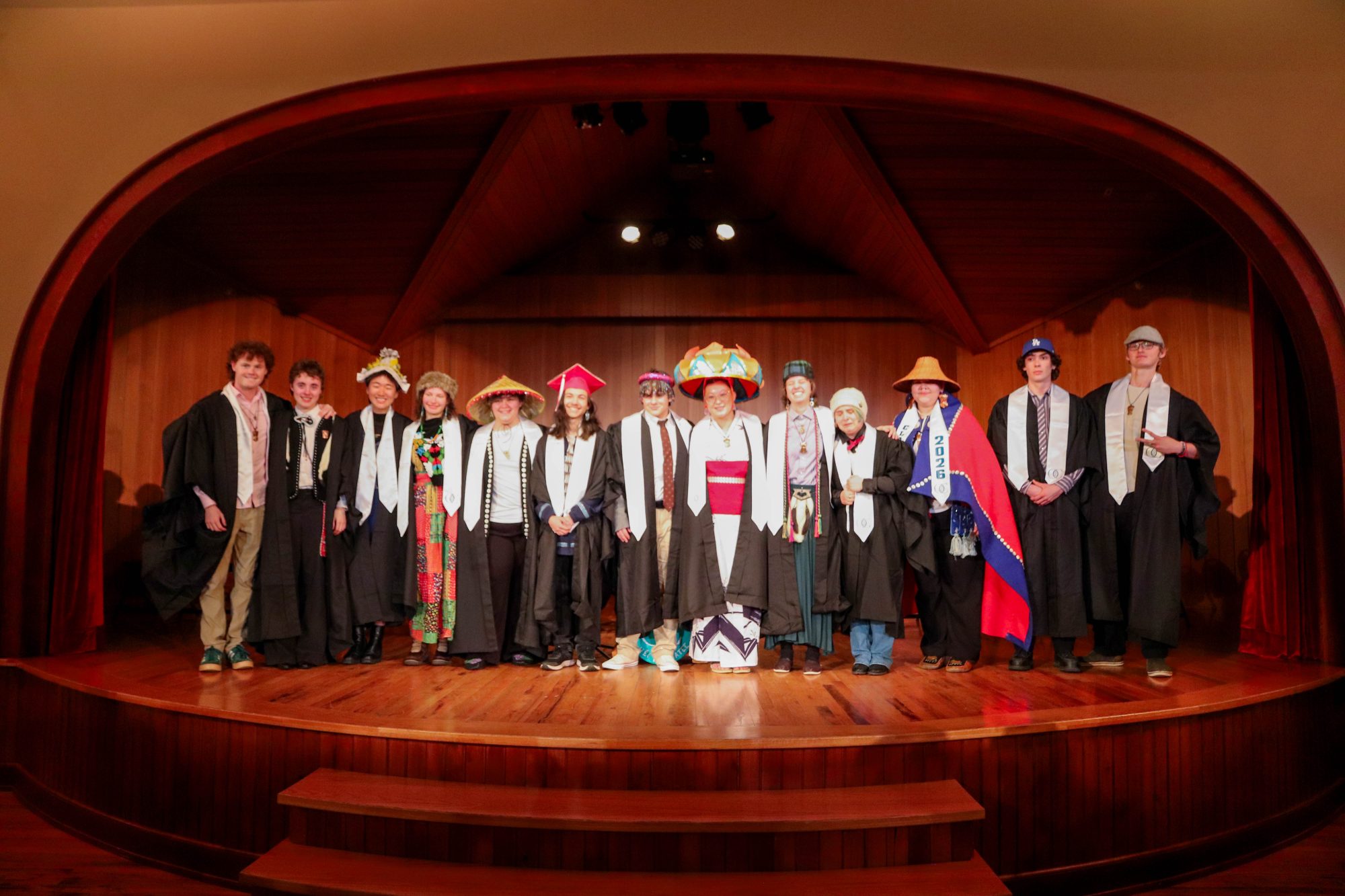
The 13 graduates, who hail from across the United States and even Canada, sit in the front row, beaming up at their beloved professor. Their graduation garb is customized to reflect their individual cultures, with regalia vests, kilts, and kimonos peeking through their black graduation robes; yet all are connected with their white Outer Coast stoles.
The two-year undergraduate program’s home is on the historic Sheldon Jackson Campus, which was from 1878 to 1967 home to a Presbyterian mission school that worked to erase Indigenous cultures and language in Sitka. With that history in mind, Outer Coast was founded in 2015 with the goal of creating a college model that centers Indigenous histories and knowledge alongside Western academia. And this goal was reflected throughout the graduation ceremony, from students and “staffulty” performing various Tlingít songs and dances throughout, to speaking the Lingít that they learned throughout their time at Outer Coast.
Sitting among the staffulty on stage is elder L’eiwtú Éesh Herman Davis, the clan leader of the L’uknax.adí Coho People. After the graduation ceremony concluded, the class of 2026 gathered around him to hear his gratitude for their efforts to learn the language.
“Just when it was the sound of the Tlingít language was going away from us. But now all your students and all the teachers that [are] bringing it back to us. It’s time to come back [to] our language,” says Davis. “Our language is coming back. It’s getting louder and louder and louder.”
As she put together her graduation outfit, Cathy Li knew she wanted to represent the communities that have been most impactful for her. She wears a cap made out of the Daily Sitka Sentinel newspaper, where she worked as a reporter while attending Outer Coast. The hat is adorned with freshly-picked dandelions and bits of paper curled up to look like fiddleheads, a nod to the various musical groups she joined in Sitka as a violinist. During the reception break, Li takes pictures with community members she befriended during her time in Sitka. She says she has been deeply touched by their support, and has worked to thank them in the best way she knows how.
“I’ve been using baked goods as my method of gratitude. So far, I made a crepe cake and I divvied up every single part of it as a vessel of gratitude,” says Li. “I feel so honored that they came out to support me, and I have no idea what I did or how I earned their willingness to befriend me. I feel really grateful.”
As many members of the Class of 2026 prepare to transfer to other colleges and universities across the country, Outer Coast’s Executive Director and Co-Founder, Bryden Sweeney-Taylor, hopes that students hold on to the intrepidness and sense of humor that helped them navigate the rough patches and uncertainties as the school’s first ever class.
“[The students are] going to go on to lots of places where failure is really something to be avoided at all costs. And I think here at Outer Coast, we are encouraging students to embrace failure, to try things and see if they work and if they don’t, then to pick themselves back up and dust themselves off and go at it again,” says Sweeney-Taylor. “And that is really something that I hope that they carry with them into the rest of their lives, the rest of their educations, and where that will take them.”
The ceremony concludes with the staffulty performing an original Tlingít song in response to the graduates’ earlier song and dance performance. The graduates and other attendees stand up and dance along, smiling as they bounce their upward-turned hands. As the Class of 2026 prepares to enter the unknown once again, many feel that Outer Coast and Sitka have given them the tools they need to make anywhere they go feel like home.