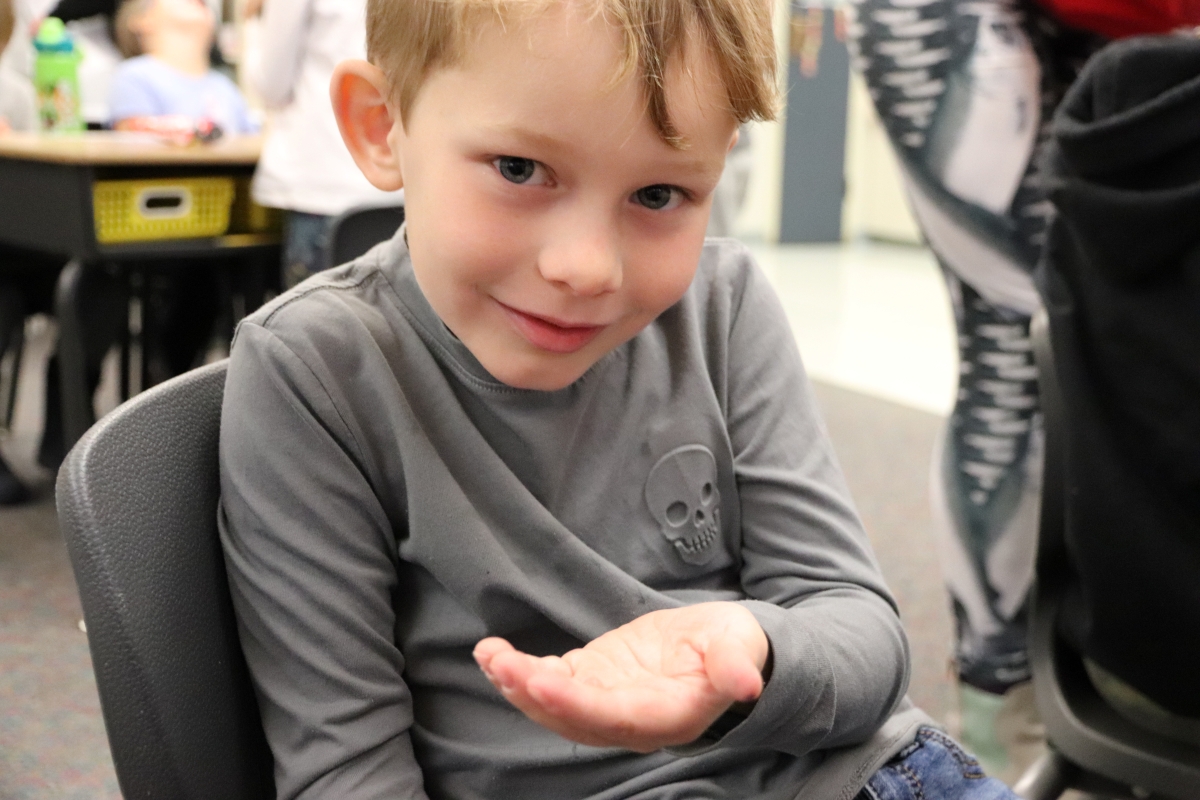
Evidence of snack time lingers on a couple of desks in a Xóots Elementary School classroom. First grader Justin is cradling what could be a tiny cheese puff in the cup of his right hand. A closer glance reveals the petite orange ball is translucent, punctuated by a tiny black dot the size of a pen tip.
Justin is holding a salmon egg, a highlight of today’s lesson on the salmon life cycle. The course is part of a near decade-long program, a partnership between local schools and the Sitka Sound Science Center
One day the egg will hatch. And years from now, when he’s a bit older, Justin will get to touch many, many more salmon eggs. For now, this egg is heading back to its incubator at the science center.
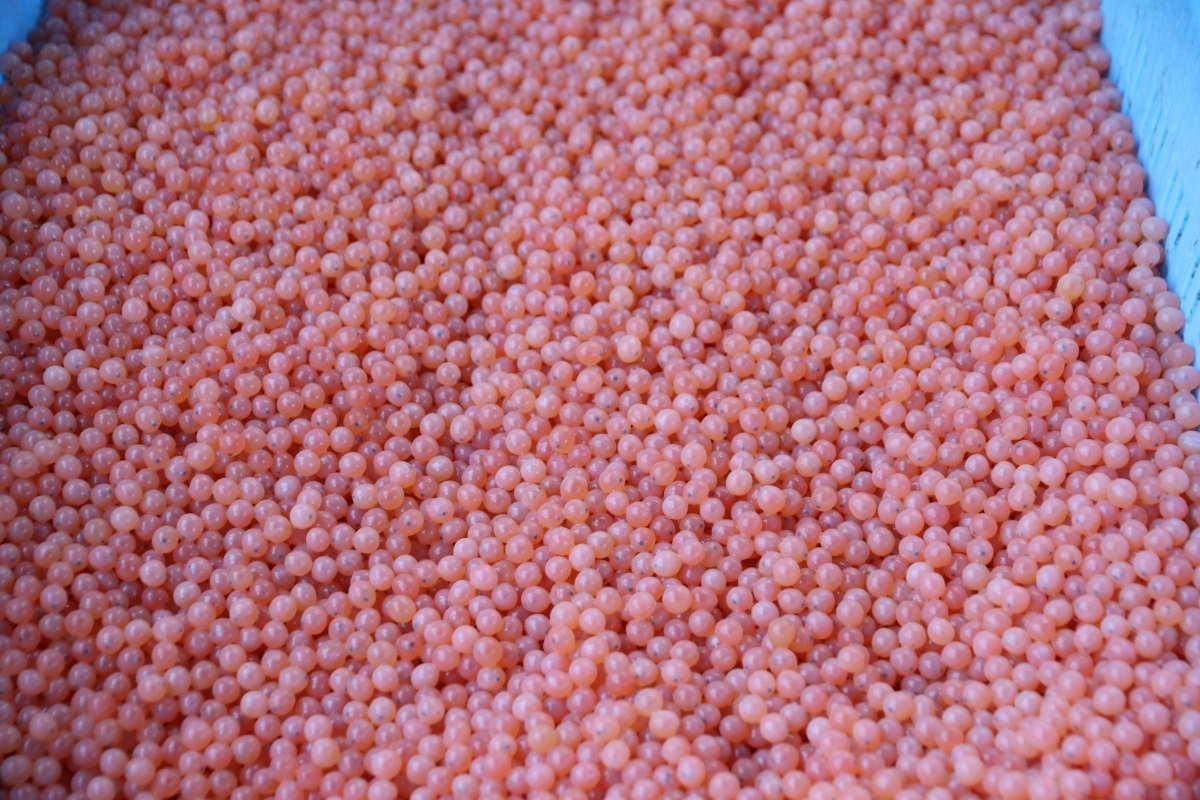
Buckets filled with hundreds of thousands of eggs like Justin’s line the walls of the hatchery’s incubation room. In the center of the room is a large metal box, full of removable trays. This is the incubator keeping millions of pink and chum salmon eggs warm and safe.
Haley Jenkins manages the science center’s hatchery. She’s wearing beaded salmon egg earrings today as she leads a group of students in the high school counterpart to the first grade salmon cycle class. This one is scaled up.
“This field science class gets to see it the whole process, and we don’t make up a lesson for them. Like, they’re doing what we’re doing when they come here. We take them on the net pens to feed fish with us,” she says. “They feed our Coho fry with us…they really get to be hands-on.”
Sitka High School science teacher Stacy Golden, donning matching salmon egg earrings, says the year-long salmon aquaculture course introduces students to salmon from a different angle.
“A lot of them are surprised at how much hatcheries actually do for our state. They’re surprised that this much science goes on with a hatchery,” Golden says. “And a lot of them remember their elementary adventures at the hatchery, but don’t actually remember what a salmon hatchery does.”
So what is the hatchery doing today? Jenkins says until fertilized eggs have developed their eyes, they’re incredibly fragile. Once that little black dot appears, they go through a round of hatchery processes to ensure they stay strong and healthy. Next to the incubators, two students are “shocking” the salmon eggs. Not with electricity, but with impact.
They pour the eggs from a bucket, a six inch drop into a metal box below them.
Jenkins says that impact shock will literally make or break them.
“If they’ve developed properly genetically, they’re going to be fine,” Jenkins says. “If they didn’t develop properly, or they didn’t fertilize, or whatever, they’ll break.”
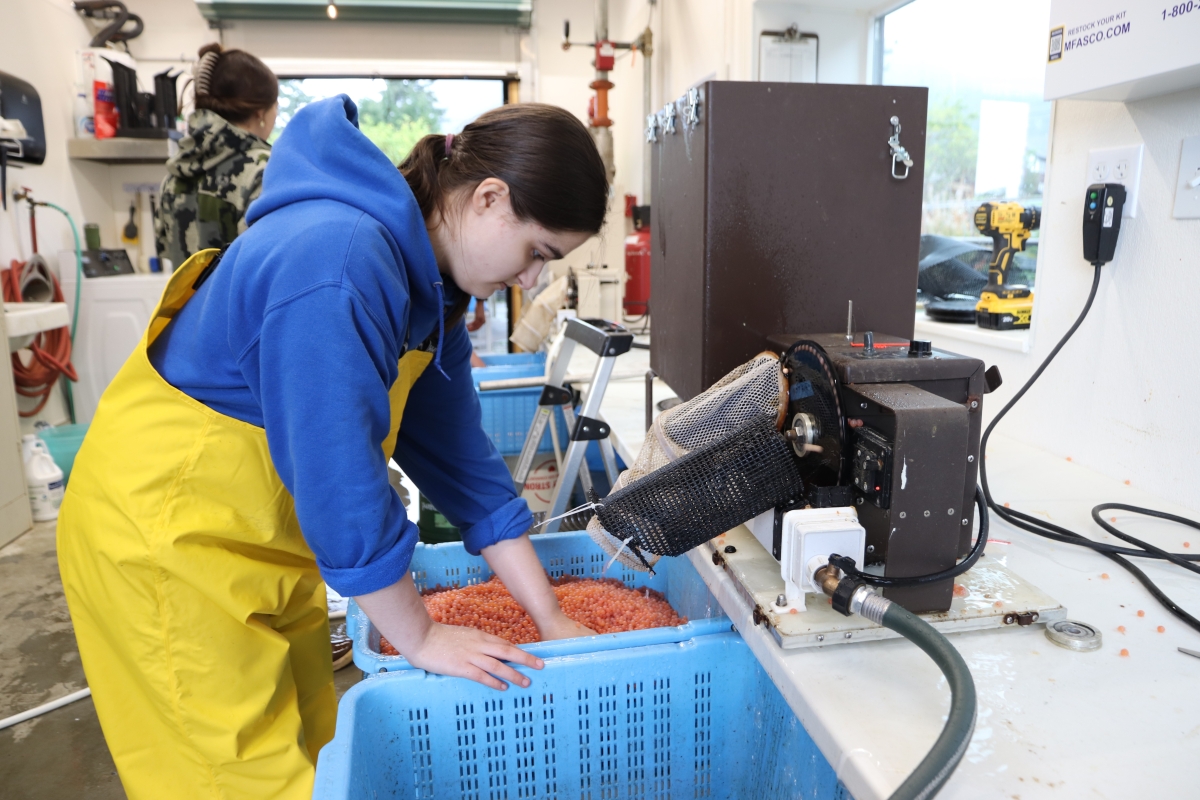
Around the corner, Sitka High School senior Carter Conatser is manning one of two “egg pickers.” He pours a scoop of eggs into a hopper on top and the picker begins to spit eggs out into a plastic tub on the floor below.
“It’s picking out the bad eggs that make it through the machine, and just making sure we’re only left with the good eggs,” Conatser explains.
Conatser runs his hands through the eggs. He says they feel like the sensory children’s toy “Orbeez,” little balls that expand with water.
“I think it’s kind of satisfying,” Conatser says. “I think I’d enjoy it better if my hands weren’t freezing, though,” he adds and laughs.
After the good and bad eggs are separated, which prevents the spread of fungus, it’s time for a math lesson.
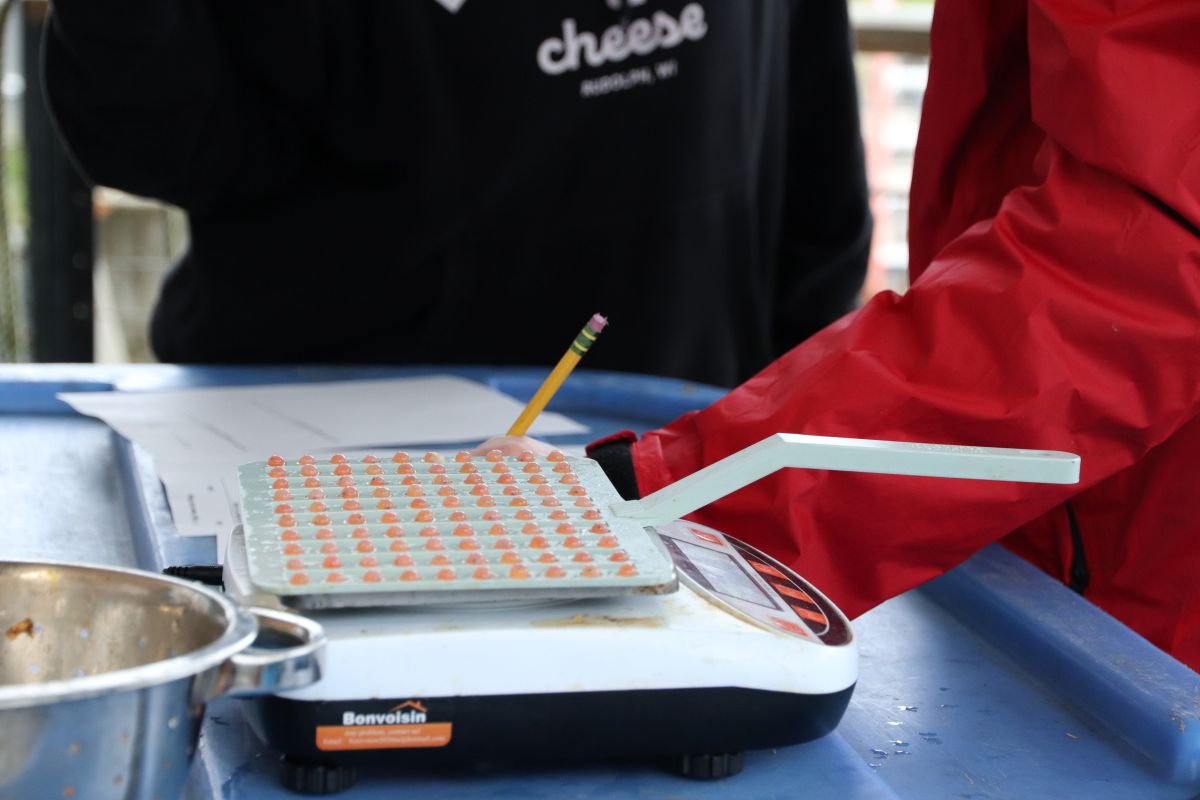
“We are picking up dead eggs and putting them on a tray to be weighed,” says Logan Schrantz, as he carefully measuring out a handful of pink salmon eggs. The weight he records will help the team determine the number of eggs that survived.
Schrantz visited the hatchery as a first grader over a decade ago, when he was the same age as Justin. And he vaguely remembers seeing the eggs and the salmon runs. But catching Cohos, his favorite salmon? Those memories are crystal clear. He points out the pier behind him where he recalls snagging salmon as a middle schooler.
While Schrantz and other students in the class may have salmon catching skills, Golden says that’s not a prerequisite.
“A lot of times, I get students in the class that love salmon. They love being outside. They love Sitka, and this is totally their jam,” Golden says. “But what I really love is when a student’s like, ‘I don’t know if I should be in this class or not, because I don’t have any experience with fish,’ and I think those are the students that I love to see the most in this class because they’re the ones that are getting exposure to something totally different and outside their realm.”
Once the eggs have been shocked, sorted and weighed, the good eggs go back into the incubators. They’ll eventually hatch, and then continue to develop here until they’re transferred to net pens, and eventually released into the wild. While the students may graduate and move away, these salmon will certainly be back here one day to spawn.
And there’s one final step after that. Death. And that’s part of the class too.
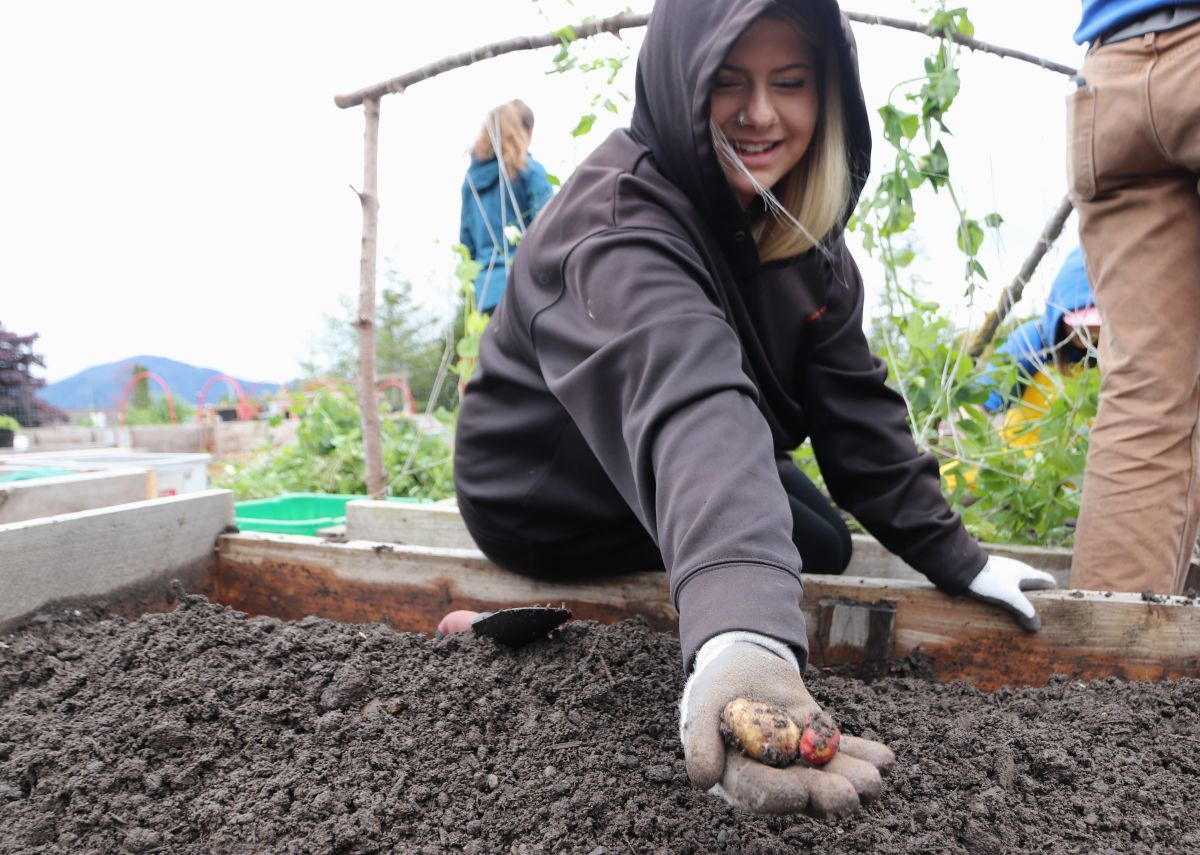
A week after the high schoolers processed eggs at the science center, they’re digging up potatoes at the community garden up the street. These potatoes grew thanks, in part, to the carcasses of the returned salmon, which was turned into fertilizer. Emunah Voluck is digging up spud after spud, which she says is fine, but perhaps not fishy enough.
“I think for me, I want to do more fish activity because I didn’t really get that because I didn’t grow up here,” she says, then adds “But I do like gardening,” as she shoves her trowel into the earth, and pulls up another potato.
“Ooh, that’s a big one. Get wrecked, Logan!” she laughs.
From a tiny eye peering out of an egg, to the eye of a potato, the salmon life cycle is now complete.