



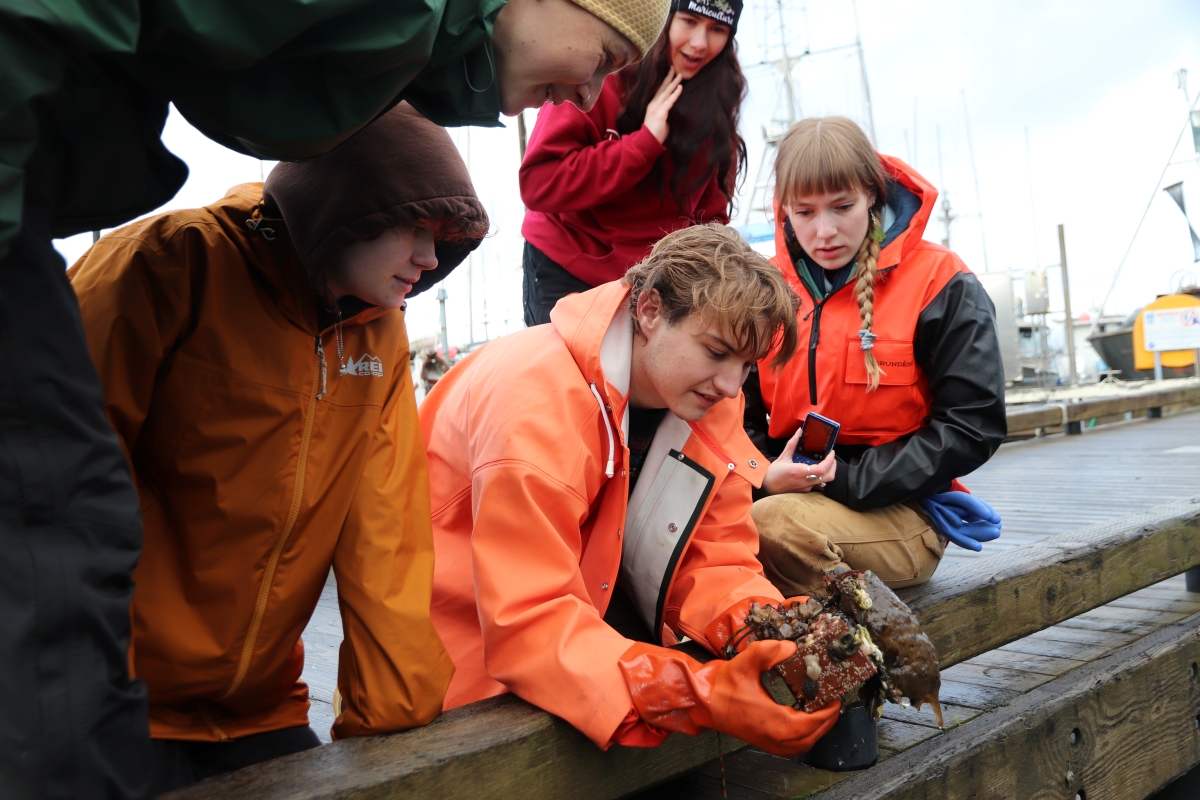
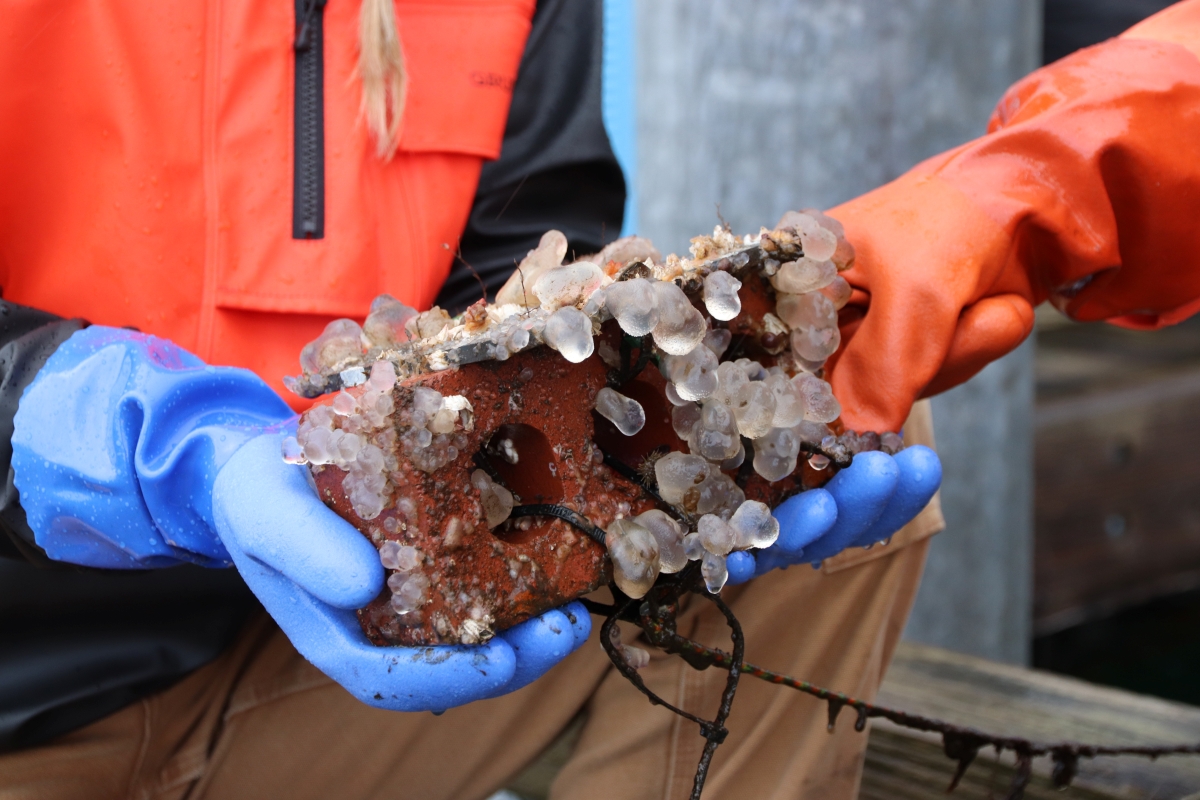
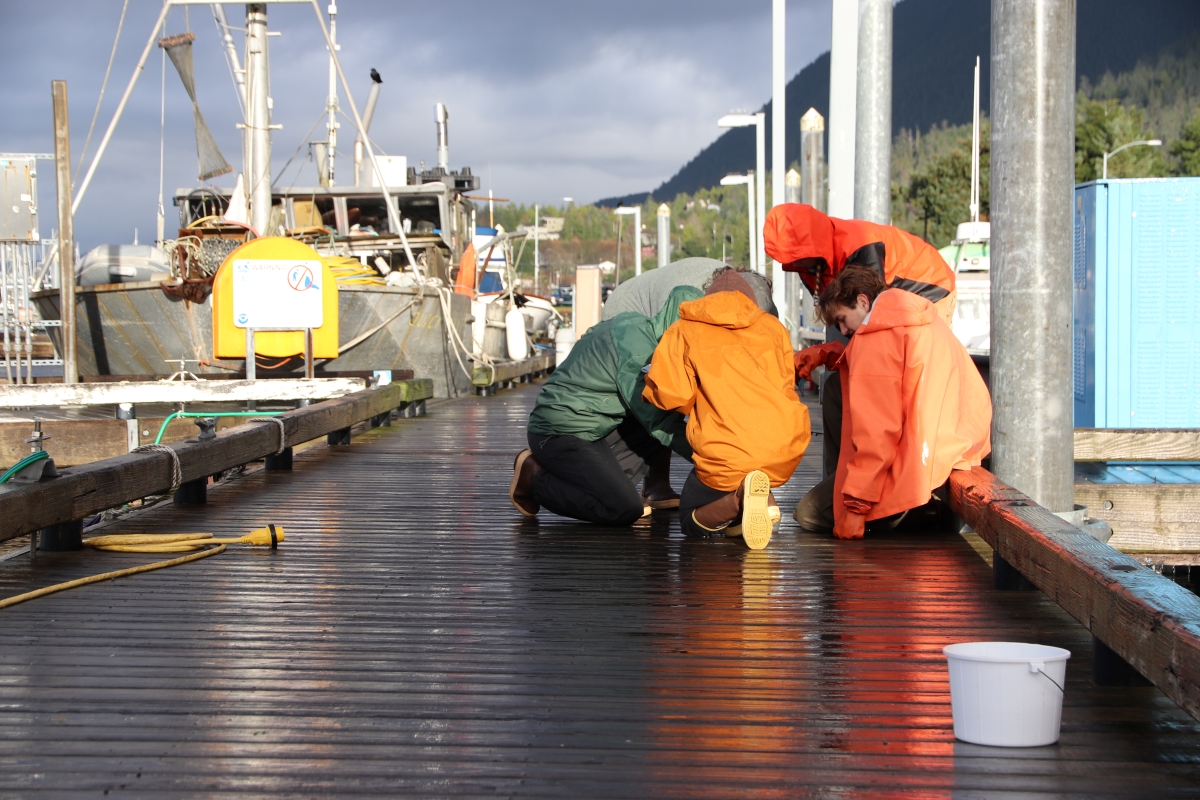
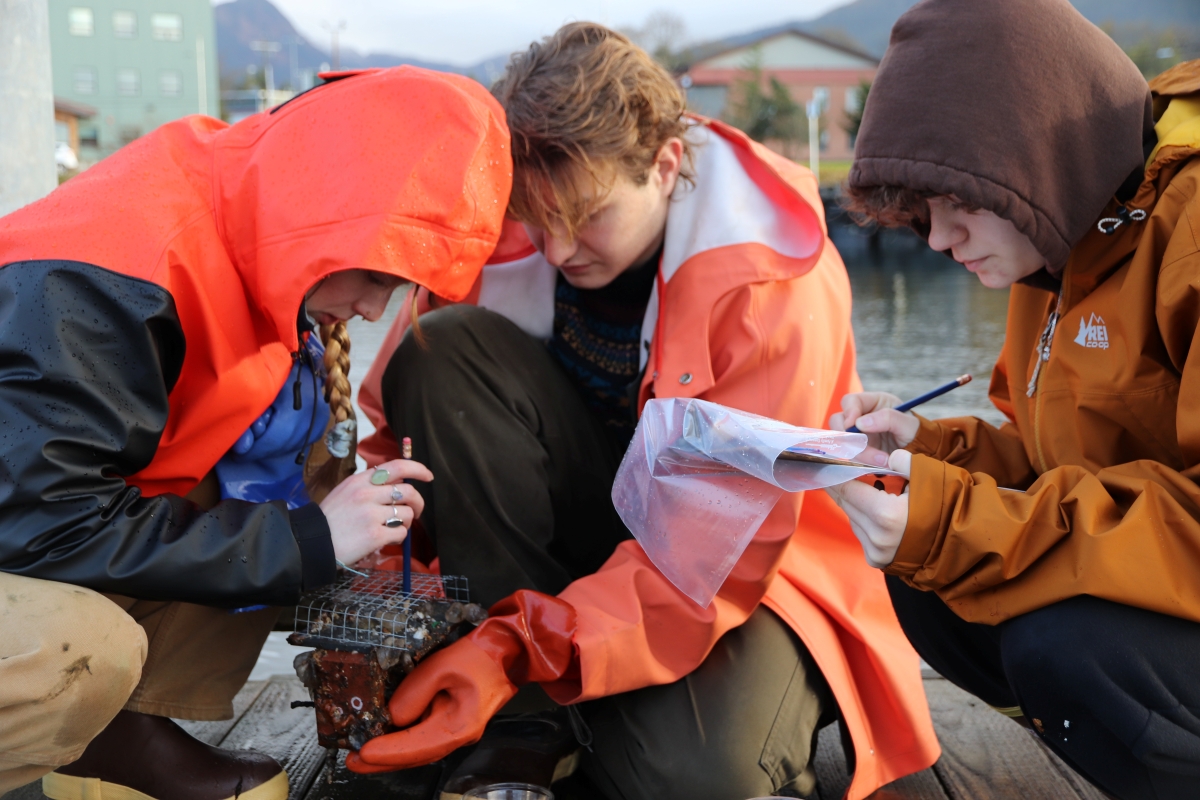
Students dressed in fluorescent raingear huddled at the Thomsen Harbor dock on a Friday morning, poking at white slimy sea creatures suctioned to a PVC plate on the side of a terracotta brick. This basic contraption is called a settlement plate, which is used to monitor for non-native marine invertebrates.
These students are from universities across the state. They gathered in Sitka earlier this month to learn about invasive species in Southeast Alaska as part of Sitka’s 30th annual WhaleFest, where scientists and knowledge-bearers share the latest research and learning about marine life.
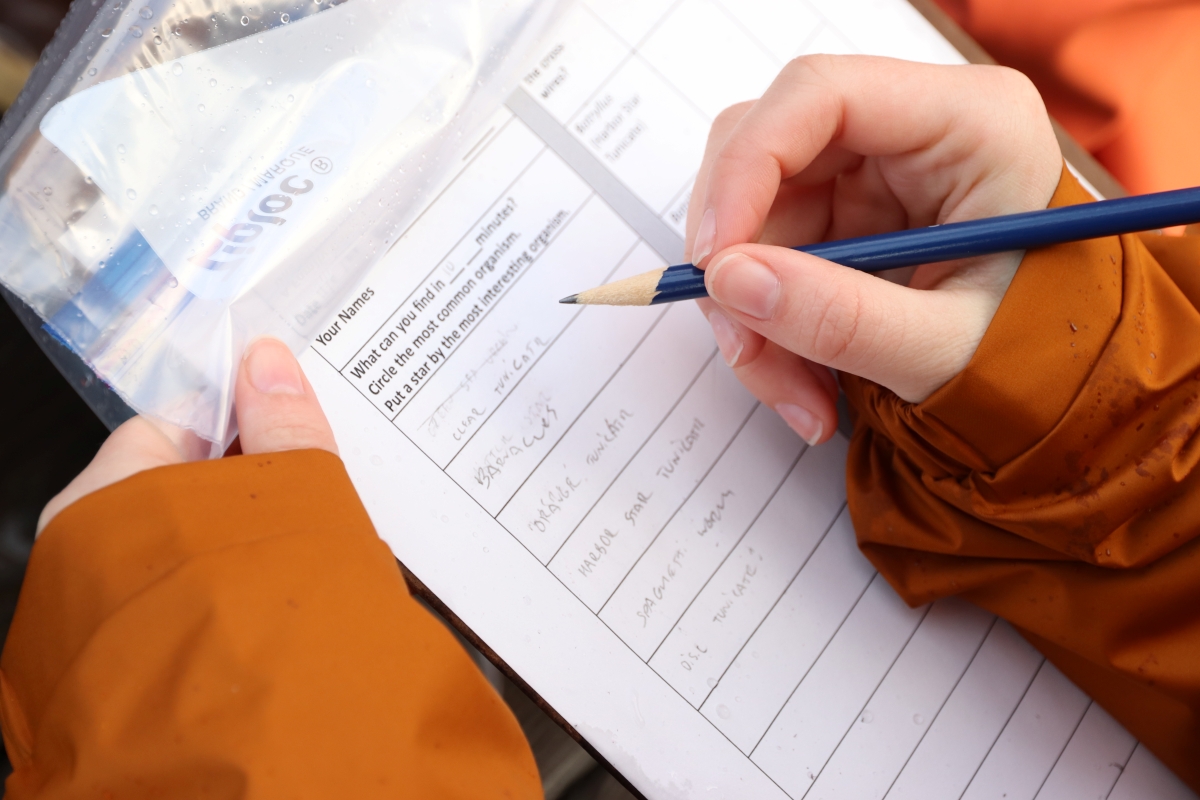
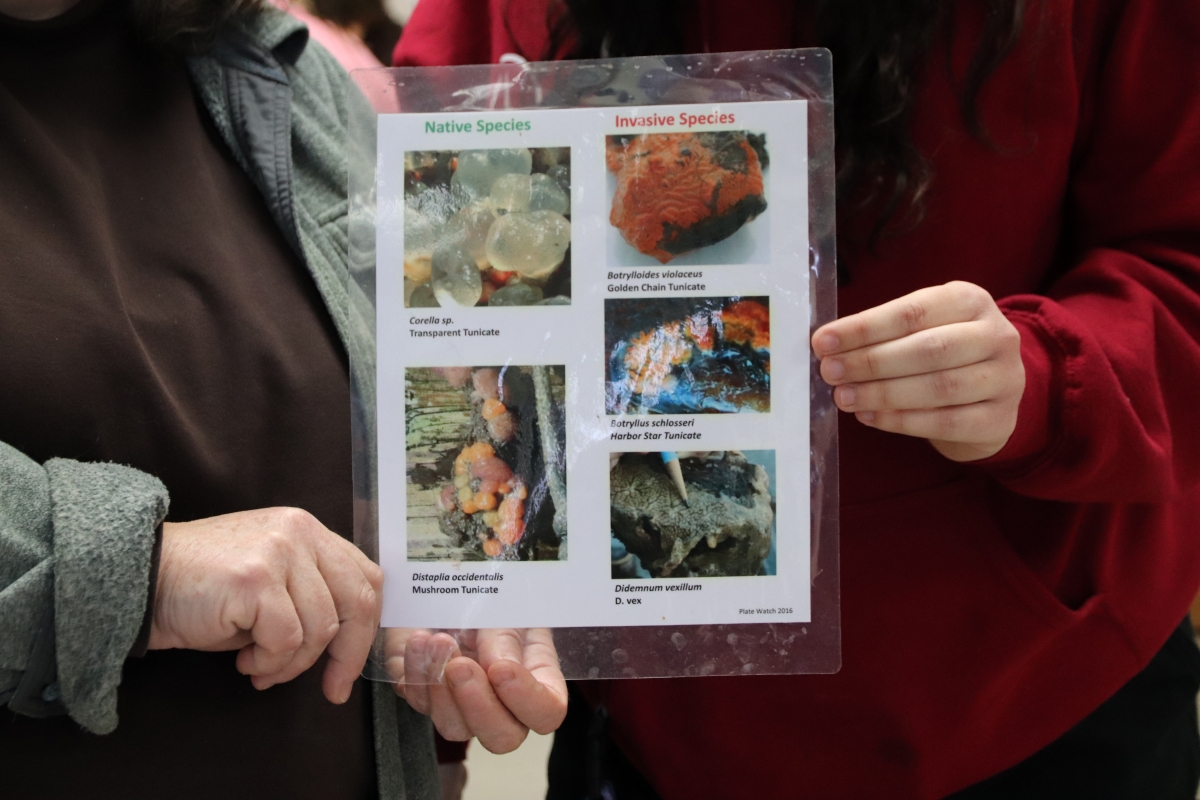
The students took stock of what sea life — both native and invasive — were gathered on the plates. They carefully prodded at invasive tunicates like the harbor star and golden chain, and native species, like the mushroom tunicate, slime worms, and tiny pink mussels.
“Sensitive species have survived here for thousands of years, and with warming water conditions, it’s a whole new battle for them. So these invasives are very important to track,” said Ava Korpiewski, a recent Sitka High School graduate who is currently doing an aquaculture semester at University of Alaska Southeast in Sitka.
She helped walk other students through what specimens to look out for on the settlement plates, and dropped some into labeled plastic cups. And while she didn’t expect to see it in Thomsen Harbor, she and the others were keeping a special eye out for the invasive Didemnum vexillum — colloquially known as D. vex, carpet sea squirt, or marine vomit.
“It looks like candle wax dripping, and is in a pale orange color, and it just multiplies itself so much that it can spread super quickly,” Korpiewski said.
D. vex is a rapidly spreading tunicate that overgrows rocks, shellfish, and other organisms, according to the Smithsonian, which monitors for invasive species through their Plate Watch program. This marine invertebrate likely originated in Japan, and has now been reported in several parts of the world, from New Zealand, Europe, and the East Coast of the United States, to the West Coast, from parts of Mexico, north to British Columbia. Sitka is the only place in Alaska it’s been found.
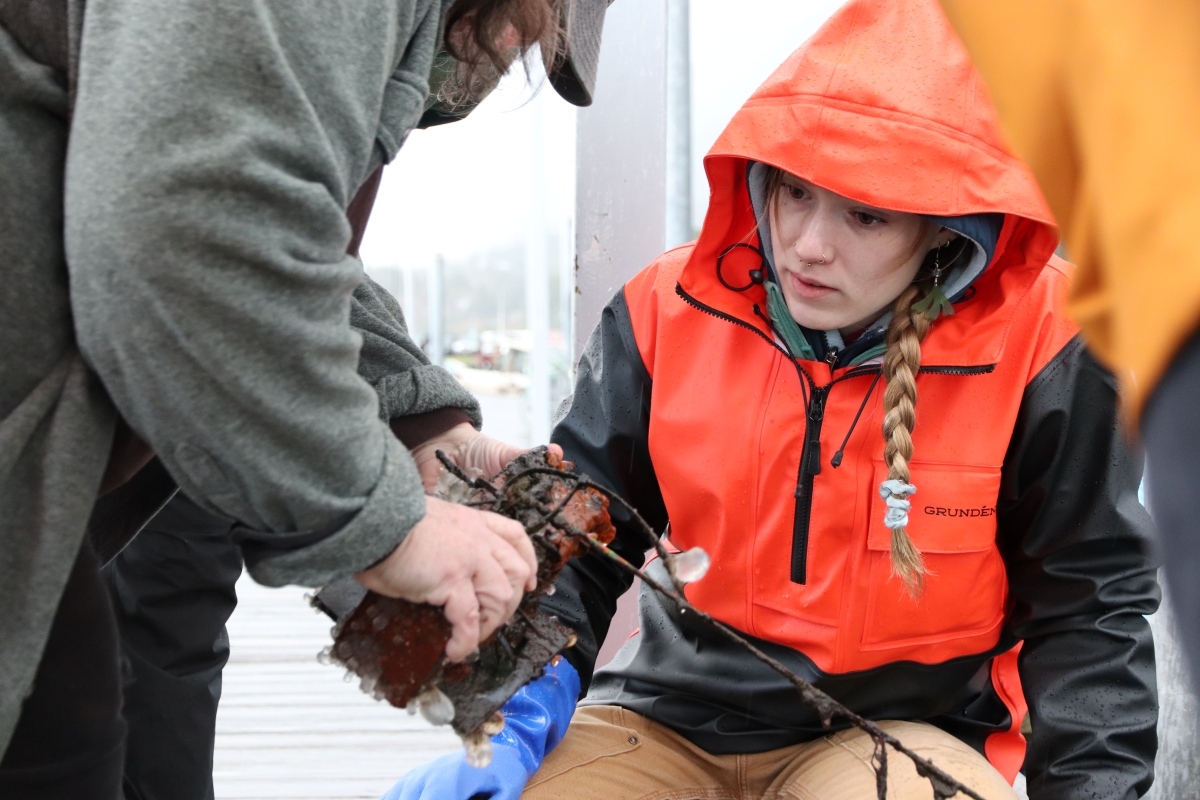
Scientists guess the invasive sea squirt likely hitched a ride to Sitka about two decades ago on equipment for an oyster farm, but they can’t be certain. Since then, Whiting Harbor, just across Sitka’s airport runway, has been closed to mariculture operations, subsistence and commercial fishing, and even recreational use to avoid the spread.
“I would be devastated to see D. vex leave Sitka,” Korpiewski said. “The impacts could be detrimental.”
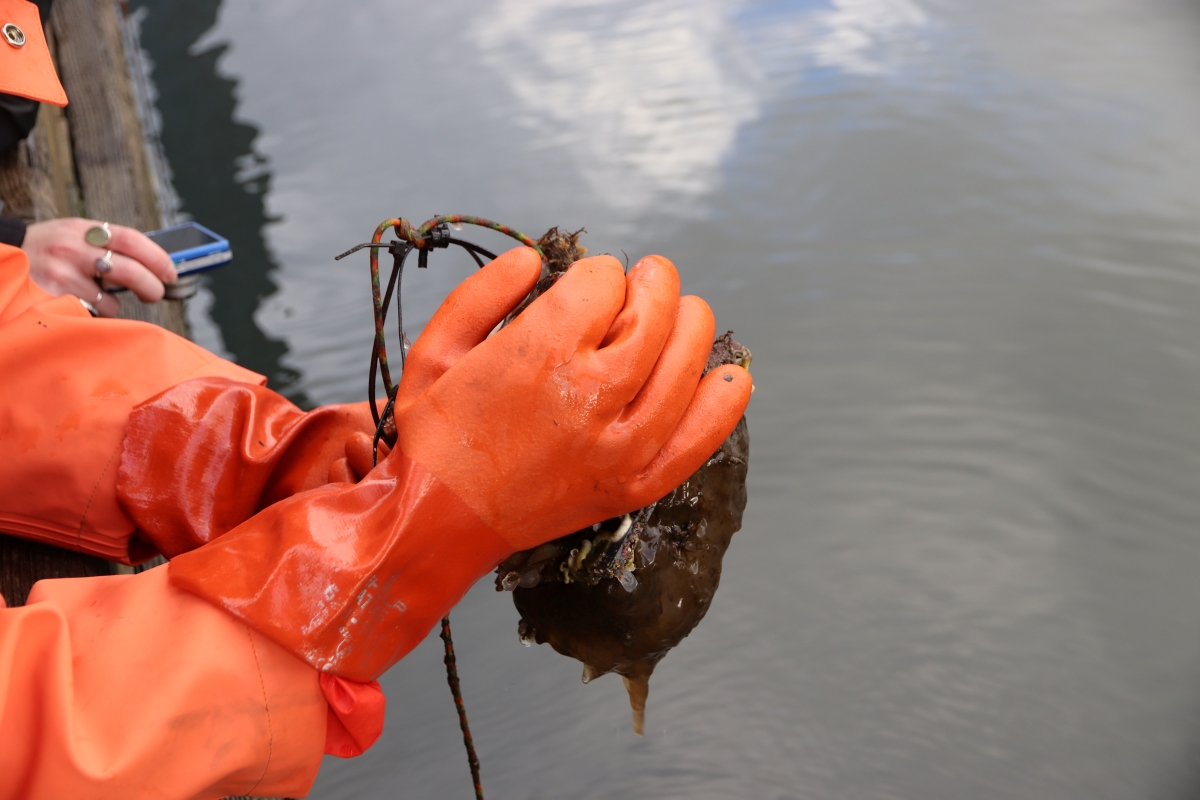
Biology professor Marnie Chapman, who has taught at UAS for about three decades, agrees. She said dealing with invasive species effectively depends on a lot of brains and experiences in the mix. And teaching young people what to look out for is an important piece of that puzzle.
“It’s very much not a top-down thing,” Chapman said. “I think for dealing with invasive species, you gotta work with the people who are there. Work with the people who really know what the history of the area has been. It takes a lot of people thinking through how to manage these things because invasive species can be really hard to manage, and they can really do a lot of damage.”
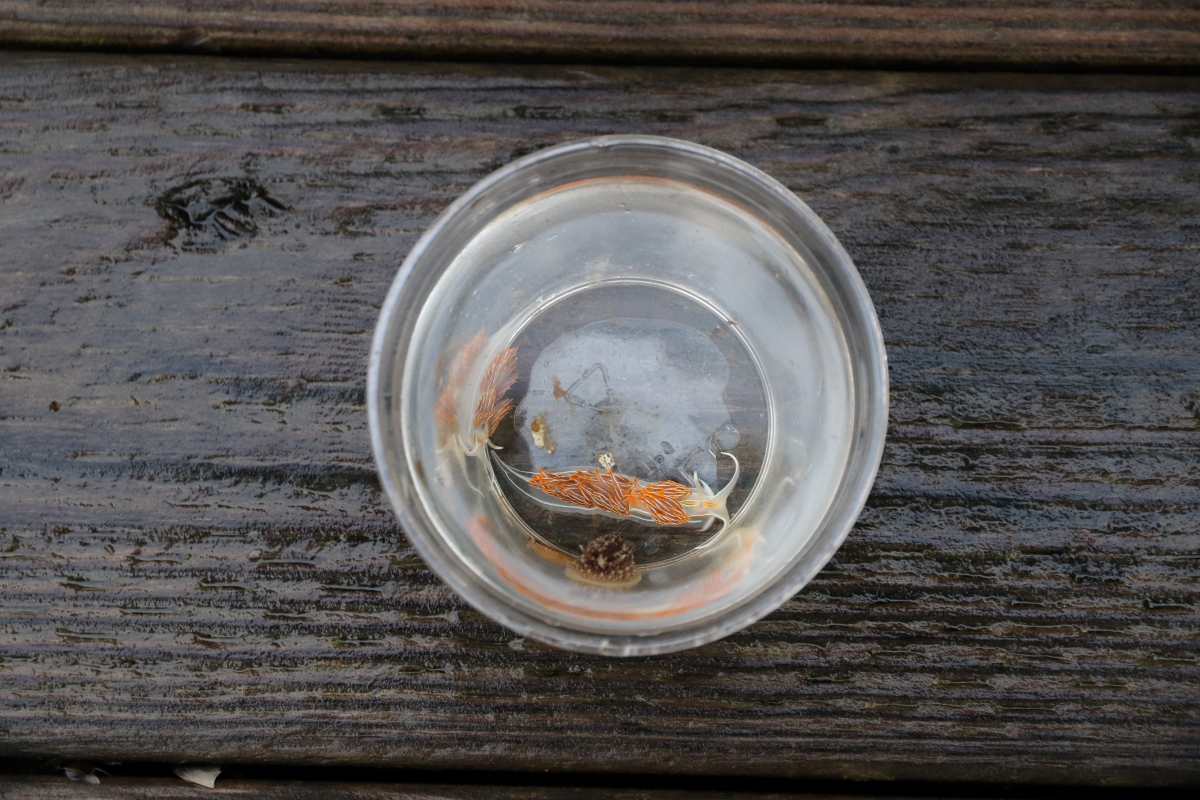
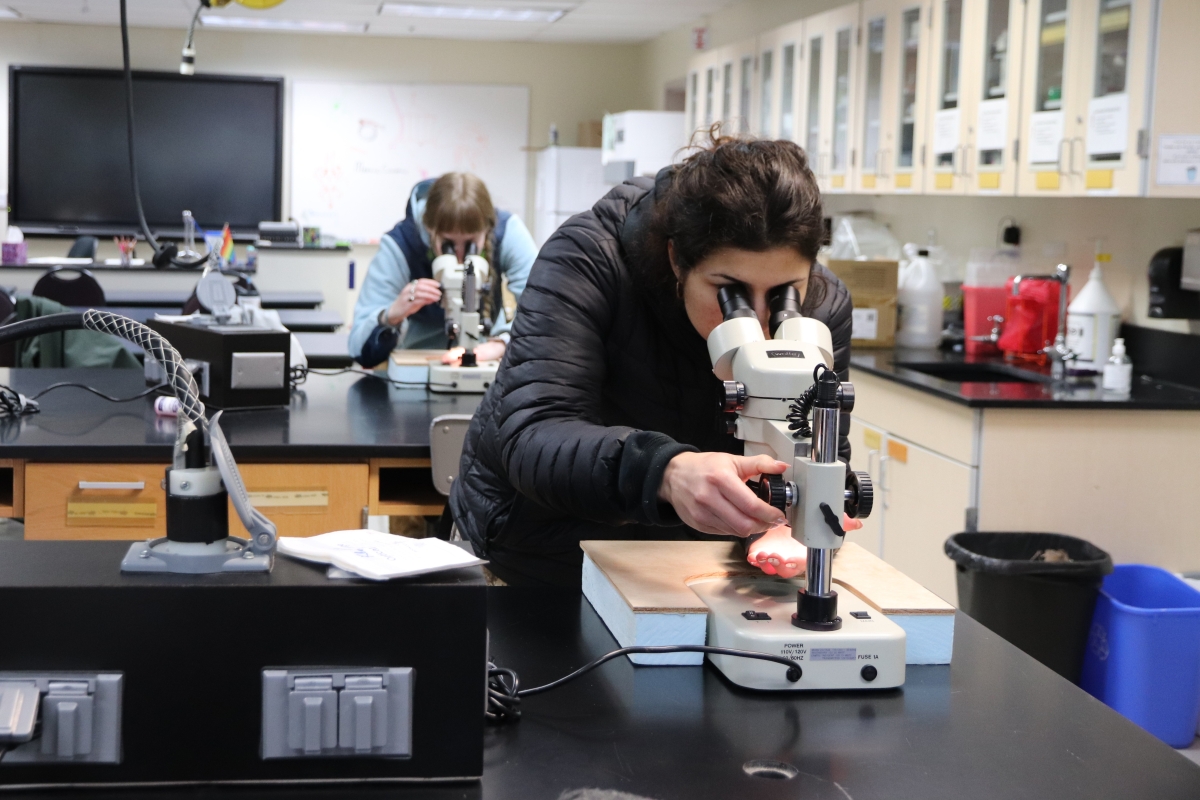
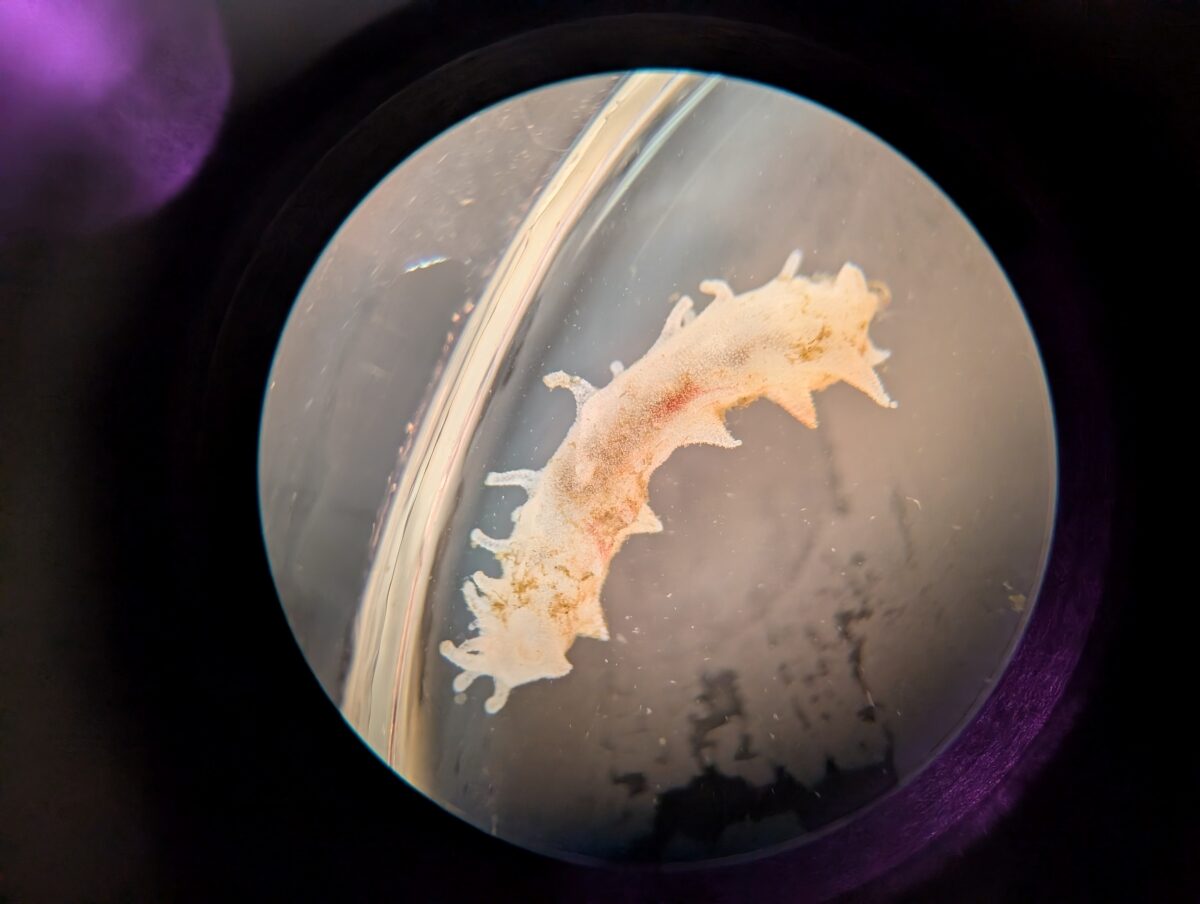
Back at the UAS lab, students selected some of the collected organisms to look at more closely. Margot Oliver picked an opalescent nudibranch, and used a plastic spoon to encourage the brightly colored native sea slug out of the plastic cup and into a shallow glass beaker. She then carried it to the microscope to get a closer look.
“If you took a regular garden slug and you made it translucent, give them two really pronounced front stalks, and then two really pronounced little bunny ears, that’s kind of what these look like,” Oliver described, her eye up against the microscope’s lens.
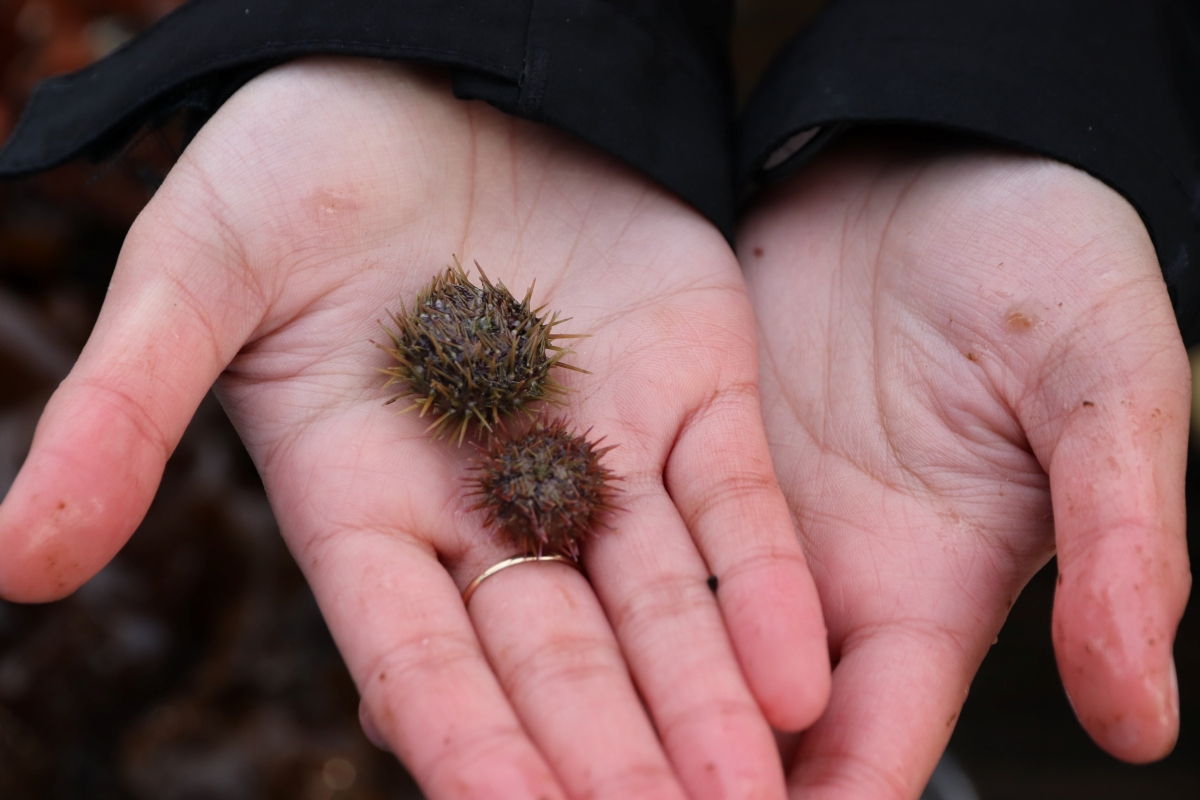
Oliver is originally from Juneau, but is currently a senior at the University of Alaska Fairbanks College of Fisheries and Ocean Sciences. She said a lot of her passion for science comes from growing up tidepooling, and this workshop was the perfect opportunity to see what’s in and around the harbors in another part of Southeast.
She said the issue of organisms deemed invasive is complex. As the climate and oceans change, some animals naturally shift to places with more suitable habitat and resources, while others might hitchhike in on the hulls or ballast tanks of boats. She said monitoring is extremely important to establish a baseline for the areas we love, to better handle the inevitable changes coming down the pike.
“Things aren’t static, and the world is ever changing and ever evolving, and the communities and tide pools that I grew up looking at are probably different now, maybe that I have not noticed, or maybe that I have noticed,” Oliver said. “It’s a good reminder to keep paying attention to what’s around us and the importance of long-term monitoring and looking at things and tracking change because there’s some things that we just might miss.”
As the workshop wrapped up, Chapman told the students that Alaska is doing pretty well in terms of invasive species, and reminded them that monitoring for invasives is about more than the ecological and economic impacts.
“I really think there’s just sort of an aesthetic impact that goes beyond that,” she said. “I feel like sometimes we don’t give enough attention to the fact that we love the places where we live, especially here in Alaska, and invasive species can just sort of homogenize every place and make one place so much more like another place somewhere else, and take away all that great diversity.”
Chapman said the invasives field is wide open, and while no one has all the solutions right now, it’s up to these students and future generations to continue moving the needle forward.
To report invasives to the Alaska Department of Fish and Game, visit their website or call 1-877-INVASIV (1-877-468-2748).


